Independent comparisons. We may earn from shop links. More info

Aluminium or phenolic router plate

Updated: October 2026

You have a full-size router for a table, and a thread that says phenolic sags while any aluminium plate stays flat. The aluminium or phenolic router plate choice depends on thickness, the ring, and how long the router stays mounted. A 5 mm alloy plate on amazon.co.uk is a different object from a shop plate around 9 mm to 10 mm. The Products Compared editorial team updated this page on 16 October 2026 from UK shop pages and owner reports, without a lab measurement. The listings sit on the [router insert plate comparison](/hub/routers/router-insert-plate). A purchase through our links can earn a commission at no extra cost to you.

You have a full-size router for a table, and a thread that says phenolic sags while any aluminium plate stays flat.

Our top picks

Trend Trend RTI/PLATE/A

Best overall

Trend Trend RTI/PLATE/A
8.1/10about £65.99
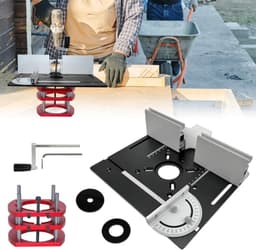
SavingBird SavingBird 235×120

Best value

SavingBird SavingBird 235×120
7.3/10about £12.85
CISSIYOG CISSIYOG lift kit

Rank 3

CISSIYOG CISSIYOG lift kit
5.9/10about £42.99
On this page

The two plates the slogan treats as one

Trend sells two plates that people then treat as one material. The phenolic page describes 9.5 mm and a crown of 0.8 mm. The RTI/PLATE/A alloy page describes 6.35 mm aluminium and makes no crown claim. In this amazon.co.uk extract that alloy plate is £65.99. A 5 mm plate around 240 mm by 200 mm can still be titled aluminium, and it is a lighter panel than either Trend plate. Woodford’s Xcalibur listing calls 0.8 mm of crown a way “to guarantee flatness”. That is the seller’s claim.

What UK owners report under a heavy router

On UK Workshop, more than one owner described a Rousseau or Trend-type phenolic plate, with a crown of about 0.8 mm, going hollow under a T11. The timber snagged on the dip. Axminster classed that older plate as obsolete in the thread. The posts cover routers left mounted. That 8 kg figure is the maximum D&M Tools prints for the Trend alloy plate. Nothing here shows a 5 mm amazon.co.uk insert staying flatter than a 10 mm phenolic blank.
Trend Trend RTI/PLATE/A

Testsieger

Trend Trend RTI/PLATE/A
8.1/10about £65.99

Lighter use, or a router that stays mounted

Axminster’s setup guide puts UJK 10 mm phenolic toward lighter use, and 6 mm aluminium toward what it calls more durable. “More durable” is Axminster’s phrase, with no flatness test behind it. Prices gathered here show UJK phenolic from £19.98, the blank at £104.64, and 10 mm aluminium with a universal base from £199.98. This amazon.co.uk set names no phenolic plate. Its full-size alloy row is the Trend plate at £65.99 and 6.35 mm.

Rings change the material decision

Reviews of the SavingBird plate in this set describe ABS rings. Other plastic rings in UK reviews sit proud, fit loosely, or, on one lift kit, rise into the cutter. UK Workshop owners say plastic rings on a Trend alloy plate can bed into the aluminium, so the ring sits lower than when it was new. Incra’s MagnaLock plate uses steel rings on rare-earth magnets, in aluminium about 9.5 mm thick. Steel and ABS wear the seat differently.

If the rebate is already the wrong depth

A 9.5 mm phenolic plate stands proud in a rebate cut for 6.35 mm alloy. An 8 mm recess is still too shallow, and the lip knocks the timber. Measure the plate you hold, rather than a figure for another Trend model. Levelling screws cannot turn 6.35 mm of aluminium into 9.5 mm of phenolic. A router left near 8 kg is where those owners moved to thick aluminium. A 5 mm title is a third case, and the word aluminium is not a flatness test.

Common questions

Why are some phenolic plates crowned?
A crown is an arch of about 0.8 mm on Trend’s phenolic page and on Woodford’s Xcalibur listing. The middle starts high so the plate can settle when you bolt the router on. Woodford’s line that this will “guarantee flatness” is a seller’s claim. UK Workshop owners later found that arch hollow under a T11, with timber snagging. Treat the crown as a design, and check the plate again after the router has hung on it.
Will a T11 pull a phenolic plate hollow?
UK Workshop owners reported a Rousseau or Trend-type phenolic plate, crown about 0.8 mm, going hollow under a T11, with timber snagging on the dip. Axminster called that older plate obsolete in the thread. That is experience from people who left the router mounted, not a failure rate. A 10 mm blank under a light trimmer you remove after the job is a different load from a router left on near 8 kg.
Is thicker aluminium always flatter?
A thicker aluminium plate is the stronger candidate when the router stays mounted, and the name alone is not a flatness test. Incra’s MagnaLock plate is about 9.5 mm, UJK offers 10 mm, and many amazon.co.uk inserts here are about 5 mm. Trend’s alloy plate is 6.35 mm at £65.99, thinner than those shop plates. No source here is a lab test, so extra thickness helps and still does not prove the surface.
Do plastic rings bed into an alloy plate?
Plastic rings can bed into an alloy plate. UK Workshop notes describe Trend alloy rings sinking into the aluminium. SavingBird reviews in this set describe ABS rings, and other plastic rings in UK reviews may sit proud or fit loosely. One lift kit has a ring that can rise into the cutter. Incra uses steel rings on magnets, a harder pair, and soft ABS can still wear a seat in alloy.
Can a phenolic plate fit a rebate cut for 6.35 mm alloy?
A 9.5 mm phenolic plate stands proud in a rebate cut for 6.35 mm Trend alloy, and an 8 mm recess is still too shallow. The timber hits the lip. Packing a rebate that is already too deep has to stay flat under the router. Cut to the plate in your hand. A figure for the other Trend model is the usual way to get the depth wrong.

Related pages

Sources

Public UK sources used for the dust, machinery and consumer-safety points on this page. Prices, stars and review counts are from the amazon.co.uk listings in this set, snapshot 16 October 2026.

  1. HSE — Wood dust (retrieved 16 October 2026)
  2. HSE WIS22 — CNC and hand-fed routing (retrieved 16 October 2026)
  3. HSE WD5 — Extraction on routers (retrieved 16 October 2026)
  4. General Product Safety Regulations 2005 (retrieved 16 October 2026)
  5. GOV.UK — General Product Safety Regulations 2005, Great Britain (retrieved 16 October 2026)
  6. Axminster — How to set up your router table (retrieved 16 October 2026)
  7. D&M Tools — Trend RTI/PLATE/A (retrieved 16 October 2026)
  8. UK Workshop — Router table insert plates (retrieved 16 October 2026)