Independent comparisons. We may earn from shop links. More info

Glue joint router bit shank size

Updated: October 2026

You know which collet is in the router. The glue joint router bit shank size has to match it, and close is how bits spin loose or refuse to enter. The three sizes you will meet are 1/4 inch, 8 mm, and 1/2 inch. A fourth size, 12 mm, sits just under 1/2 inch and is not a substitute. This page stays on that measurement. Profile choice is on the [finger joint versus edge glue joint](/hub/routers/glue-joint-router-bit/sub/glue-joint-router-bit-finger-vs-edge) page, and the prices are on the [glue joint router bit comparison](/hub/routers/glue-joint-router-bit). Products Compared did not micrometer these shanks. A qualifying purchase can earn a commission at no extra cost to you.

You know which collet is in the router. The glue joint router bit shank size has to match it, and close is how bits spin loose or refuse to enter. The three sizes you will meet are 1/4 inch, 8 mm, and 1/2 inch.

Our top picks

On this page

Three sizes, and a fourth that is close

1/4 inch is 6.35 mm. 8 mm is 1.65 mm larger. 1/2 inch is 12.7 mm. 12 mm is 0.7 mm smaller than 1/2 inch. Trend sells those as separate collets. The T5 manual’s warning is to use a shank that matches the collet. A 12 mm shank in a 1/2 inch collet is loose, and a 1/2 inch shank does not enter a 12 mm collet. Measure the collet, then buy the listing that states that size.

What each listing states

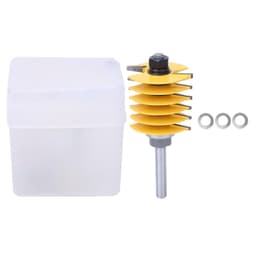
Yonico, Mesee, and Vearter state 1/4 inch. Yonico is the edge bit. Mesee is the finger bit with UK-labelled reviews. Vearter prints both 1/4 inch and 6.35 mm. Vearter’s Canada texts say the 1/4 inch shank bent. That is a condition report, not a reason to file the bit under a larger size. Cocoarm and Newdeli state 1/2 inch. Cocoarm prints almost no other dimension. Fafeicy’s title also says 1/2 inch, and the reviews do not agree. OVAQUIXI is the only listing that states 8 mm, with a 40 mm cutting diameter and no reviews.
Mesee Mesee 1/4 inch finger bit

Testsieger

Mesee Mesee 1/4 inch finger bit
8.8/10about £13.99

The blank and the clash

Freud 99-031 is the listing you cannot file. The amazon.co.uk title, bullets, and spec table do not state a shank. The cutting diameter is 1.5 inches. Fafeicy is the clash. The title says 1/2 inch. Reviews from the Netherlands and Italy say the shank was 12 mm and would not fit an 8 mm router. One UK review says the bit works, which does not tell you the collet. Another says the cutters loosened on softwood. If the label says 1/2 inch and the shank measures 12 mm, do not sleeve it. Send it back. Yonico has a smaller version of the same argument: one UK text says slightly oversized, and one US text says slightly small. Measure the one in your hand.

Sleeves and how far in

A reducer sleeve is not the repair for a 1/4 inch bit in a 1/2 inch collet, or for a 12 mm shank in a 12.7 mm collet. A US review of Vearter already calls that 1/4 inch shaft small under a 35 mm cutter. If the collet is the wrong size, change the collet or change the bit. Trend’s three-quarter insertion line is about a Trend T5. It is not a measured depth for Newdeli, Mesee, or Freud. Newdeli’s own line is the one to follow for that bit: at least 1.26 inch of the shank inside the collet, tightened. Do not copy 1.26 inch onto an OVAQUIXI or Mesee shank. If the straight portion is too short for the collet to close, the bit does not fit. A bent shank is a return. Fafeicy counts for a 1/2 inch collet only if the shank measures 12.7 mm rather than 12 mm. Freud waits until you measure it.

Common questions

What is 1/4 inch in millimetres?
6.35 mm. Vearter is the listing here that prints both 1/4 inch and 6.35 mm. Yonico and Mesee say 1/4 inch without the millimetre figure, and they are the same collet size. 8 mm is 1.65 mm larger, so it is not a looser 1/4 inch. Do not open a 1/4 inch collet to make an 8 mm shank fit.
Will an 8 mm bit fit a 1/4 inch collet?
No. The 8 mm shank is larger than the 6.35 mm hole. OVAQUIXI is the 8 mm bit here, and it stays with an 8 mm collet. Forcing it into a 1/4 inch collet is not a fit. The other way fails too: a 1/4 inch shank is loose in an 8 mm collet, and a sleeve is not the fix Wealden recommends.
Is 1/2 inch the same as 12 mm?
No. 1/2 inch is 12.7 mm. 12 mm is 0.7 mm smaller. Trend lists them as different collets. A review that says 12 mm, as on Fafeicy, is not confirming a 1/2 inch title. A 12 mm shank in a 12.7 mm collet does not grip the way a matching shank does.
Which of these eight bits is 8 mm?
OVAQUIXI, at £22.19, with a stated 40 mm cutting diameter and no star line. None of the 1/4 inch or 1/2 inch titles is a second 8 mm option. If the router is 8 mm only, the other seven are the wrong shank unless you change the collet. Freud cannot be included, because its UK listing never states a size.
What shank is the Freud 99-031 on amazon.co.uk?
The UK extract does not say. Do not write 1/2 inch into that row from Freud’s product page, which does list a 1/2 inch shank and two cutters. The UK spec table says one flute and Blend. Measure the parcel, or skip the bit if you need the size before it arrives. A star line of 4.6 from 52 does not fill the blank.
Can I put a 1/4 inch bit in a 1/2 inch collet with a sleeve?
Wealden treats reducer sleeves as a temporary measure because they grip less well and can slip. That is not a plan for these cutters. A glue-joint bit is already a wide cutter on a small shank. Match the collet. If you only have a 1/2 inch collet, buy a listing that states 1/2 inch, or fit a proper 1/4 inch collet.

Related pages

Sources

Public UK sources for wood dust, employer training, milling-tool safety and satisfactory quality. Prices, stars and review counts are from the amazon.co.uk extracts dated 15 October 2026.

  1. HSE — Wood dust (retrieved 15 October 2026)
  2. PUWER 1998, regulation 9 (retrieved 15 October 2026)
  3. HSE — PUWER overview (retrieved 15 October 2026)
  4. HSE leaflet INDG291(rev1) (retrieved 15 October 2026)
  5. Consumer Rights Act 2015, section 9 (retrieved 15 October 2026)
  6. BSI — BS EN 847-1:2017 milling tools (retrieved 15 October 2026)
  7. General Product Safety Regulations 2005 (retrieved 15 October 2026)