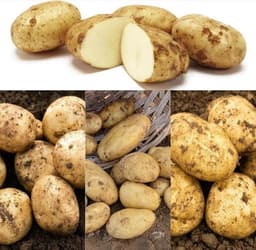
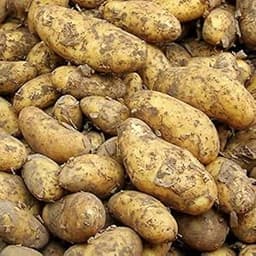
Independent comparisons. We may earn from shop links. More info

Buy certified seed potatoes in the UK

Updated: October 2026

You are about to order a small pack, and the amazon.co.uk bullets say certified or disease-free without a photo of a label. A seed potato is a tuber you plant. A supermarket ware potato is a different product, and a poor substitute for seed. The eleven Carbeth listings, from £9.99 to £14.99 on 15 October 2026, are on our [seed potatoes](/hub/root-vegetables/seed-potatoes) comparison. We did not see a blue label in these dumps, and there was no lab test. Shelf prices move, and a qualifying purchase can earn us a commission at no extra cost to you.

You are about to order a small pack, and the amazon.co.uk bullets say certified or disease-free without a photo of a label. A seed potato is a tuber you plant.

Our top picks

On this page

What you are buying

A seed potato is sold so that you plant it and lift a new crop. An eating potato is sold so that you cook it. Seed marketed in England and Wales has to sit inside the Seed Potato Classification Scheme. The Potato Council’s gardener note says table potatoes are not advisable as seed, because they may have been imported and can carry diseases such as ring rot. SASA explains that virus in a parent tuber is passed on. A supermarket Maris Piper is a different purchase from an 11-tuber seed pack at £10.99. You do not get a lot number, a grade or a country of production. If you have bought overseas seed by mistake, the Potato Council says do not plant it and do not compost it. Variety choice is on best seed potatoes.

What certified means in England, Wales, Scotland and Northern Ireland

GOV.UK’s Seed Potato Classification Scheme says all seed marketed in England and Wales must be classified, and that you cannot market EU seed in Great Britain. Regulation 4 of the Seed Potatoes (England) Regulations 2015 says marketed seed must be pre-basic, basic, certified, or authorised for science or trials. Those are grades. They are not a mood in a product title. The official label for certified seed is blue. Schedule 2 lists variety, grade, size, net weight, producer or lot, the month and year of sealing, and the country of production. In Northern Ireland, DAERA says uncertified seed for planting is against the rules. You can see rot, softness and missing eyes. You cannot see a virus level.

What to look for on a small pack

Open the parcel before you chit anything. Count, press, and look for eyes, then look for the label. The Maris Piper pack is sold as 11 tubers at £10.99. One reviewer received 10, with small and slit tubers. Those are individual reviews, not a failure rate. Eleven still means 11, and a short count is a reason to write to the seller before you plant a gap. Firmness matters as much as the count. Swift reviews include tubers that went soft while chitting, and a pack with no eyes. Soft seed is a stock problem. A deeper hole does not grow an eye that was never there. The named 3 kg mix puts Maris Peer, Nicola and Pentland Javelin in the title, and still does not state a tuber count. One reviewer wrote 68. That is one count, not a specification. Planting steps are on how to plant seed potatoes.

Organic and Safe Haven

Only the Colleen listing, 1.5 kg at £9.99, says certified organic in the title and the first bullet. The dump does not name the certification body. Several other Carbeth listings carry an Amazon attribute that says Organic. Their titles do not. An attribute is not the Colleen claim, and it is not a blue seed label. Safe Haven is a Potato Council assurance scheme, separate from the statutory label. None of these eleven dumps shows a Safe Haven line we could treat as proved. Do not infer the scheme from disease-free copy. A label does not choose between a floury maincrop and a waxy early.

Common questions

Does certified in a product bullet prove the grade?
No. In this set, certified and disease-free are seller copy, and the dumps show no photo of an official label. Certified seed in England is a grade under the classification scheme, with a blue label stating variety, grade, size, net weight, lot and country of production. Check the bag, or ask for the label.
What colour is the official label for certified seed?
Blue. The Seed Potatoes (England) Regulations 2015 set that colour for the certified official label. The particulars include variety, grade, size, net weight, producer or lot, the month and year of sealing, and the country of production. Pre-basic and basic are different classes. A dispatch note, or a line in an amazon.co.uk bullet, is not that blue label.
What is Safe Haven, and did these listings show it?
Safe Haven is a Potato Council assurance scheme, separate from the blue statutory label. These eleven Carbeth dumps do not show a Safe Haven claim we could verify. D.T. Brown states Safe Haven or equivalent on small bags of about 1 kg. If you want the scheme, look for the words on the pack. Disease resistant in a bullet, with no score, is not Safe Haven.
What should I do if tubers arrive soft or short of the stated count?
Photograph the count and the soft tubers, and tell the seller before you plant. A Maris Piper review arrived as 10 tubers rather than 11. Swift reviews describe seed that went soft while chitting. Those reports are not a rate for every pack. They are a reason to reject stock you would not plant.
Is it legal to sell my own saved tubers as seed?
Marketing seed in England and Wales means the seed has to be classified. GOV.UK says you cannot market EU seed in Great Britain, and regulation 4 limits what may be sold as seed. Saving a few tubers to replant in your own garden is a different act from offering them for sale. This page does not explain how to market uncertified tubers.

Related pages

Sources

Public UK sources, checked with the amazon.co.uk listings of 15 October 2026. Shelf prices and star lines are the figures in the display file. This page did not visit a garden centre.

  1. GOV.UK: Seed Potato Classification Scheme (retrieved 15 October 2026)
  2. Seed Potatoes (England) Regulations 2015 (retrieved 15 October 2026)
  3. SASA: Seed and ware potatoes classification (retrieved 15 October 2026)
  4. DAERA: Seed potatoes (retrieved 15 October 2026)
  5. GOV.UK: Farm-saved seed (retrieved 15 October 2026)
  6. RHS: How to grow potatoes (retrieved 15 October 2026)
  7. RHS: Potato blight (retrieved 15 October 2026)
  8. Potato Council: Growing healthy seed potatoes (retrieved 15 October 2026)