Independent comparisons. We may earn from shop links. More info

How to use a raised bed on wheels

Updated: 21 October 2026

The courier has left a flat-pack box on your patio and you are wondering whether to bolt the frame together before you decide where the tomatoes will sit. Using a raised bed on wheels starts with hardware checks, then compost volume, then drainage and brakes, long before harvest. This page assumes you already chose a listing from the [raised bed on wheels comparison](/hub/raised-beds-greenhouses-and-compost/raised-bed-on-wheels). If you are still comparing castors and litres, use the buying guide linked below. Peter F., 21 October 2026, from amazon.co.uk listings and UK review notes. No laboratory load test. A qualifying purchase can earn a commission at no extra cost to you.

The courier has left a flat-pack box on your patio and you are wondering whether to bolt the frame together before you decide where the tomatoes will sit.

Our top picks

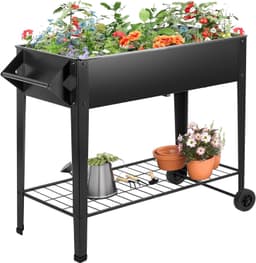
n/a Metal planter on wheels

Best overall

n/a Metal planter on wheels
8.2/10about £39.82
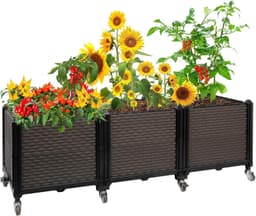
EasyVibe EasyVibe 120 L planter

Alternative

EasyVibe EasyVibe 120 L planter
7.0/10about £71.28
On this page

Assembly and inspection

Lay out every panel, bolt and castor against the instruction sheet before you tighten anything. UK reviews for metal and polypropylene units often mention unclear diagrams and missing fixings, so photograph the parts if you may need a claim. Fit the wheels, then roll the empty bed and confirm each castor spins and each brake holds. Place the empty unit where you will grow, with room for a handle or cover zip. On composite decking, a mat under the wheels limits grit marks. Fix any wobble now. Push a two-wheel layout along the long edge, not across a slope. A four-castor box should sit level. Shim a corner only if the maker allows it and the brakes still lock.

Filling with compost

Use the listing litre line where it exists. A 120 litre box needs roughly four 50 litre bags if you blend in aeration material, and you should leave 5–10 cm below the rim. If the listing quotes kilograms, measure the internal length, width and depth and multiply before you order bags. Use peat-free compost for vegetables, with a little horticultural grit if the plugs are tight. Fill in layers and water lightly between them. Stay under the maker load line: wet soil plus water exceeds a 90 kg dry figure. Deep carrots disappoint in a 40 cm bed. Charge a self-watering reservoir after the fill, using the inlet.
n/a Metal planter on wheels

Testsieger

n/a Metal planter on wheels
8.2/10about £39.82

Watering and drainage

Open-base metal planters drain straight onto the paving. On decking, use a tray or move the bed after a storm so the boards can dry. Keep removable plugs open for winter rain unless you are holding water and you know where the overflow goes. Refill a self-watering reservoir when the top inch is dry, not on a calendar. UK weather swings from heat to a week of rain. If water pools on the patio, open the plugs or slow the fill. On a PVC cover, open the zip on mild days and water the soil rather than treating the cover as ventilation.

Moving safely

Move the bed empty or partly filled. Do not roll a saturated load unless the maker allows it and you have help. Unlock the brakes, push slowly on smooth paving, and avoid thresholds and steps. Lock every brake before you lean on the rim. If you chase sun, do not leave a downhill run while the brakes are off. A two-wheel frame tilts like a sack truck, so keep the load centred. Re-check the levers after a move, because vibration can release a cheap catch. In a forecast storm, move a covered bed off the railing or store the cover folded and dry indoors.

Seasonal care

In autumn, clear dead foliage so pests are less likely to sit in polypropylene corners. Empty the soil only if you are leaving for good. Otherwise top-dress in spring. Inspect the sides yearly. UV-stabilised polypropylene rarely cracks in frost, and it can turn brittle after several seasons. Touch up metal scratches before winter salt and coastal air. Store a PVC cover clean and dry. Brush mud off stiff castors rather than power-washing the bearings, and retighten bolts that loosened under load. Do not leave standing water under metal feet. Balcony weight and neighbour runoff are on raised bed on wheels for balcony and patio. Call a tradesperson only if the deck itself needs reinforcing.

Common questions

Should I assemble before or after placing on the patio?
Assemble where you have space to lay the panels flat, then roll the empty bed to the final spot. Check that every castor spins and every brake holds before compost arrives. A fully filled unit should not be carried upstairs in one piece unless the building rules and your back allow it. Wet compost is the wrong time to discover a missing bag of fixings.
How much compost do I need?
Use the listing litre figure when it is provided. Otherwise measure the internal length, width and depth and multiply. A 120 litre bed typically needs three to four large bags for the first fill, plus a later top-up, and you should leave 5–10 cm below the rim. A kilogram line is a maximum, not a target, because wet soil weighs more than the dry bag.
When should I open drainage plugs?
Open the plugs for free drainage in wet weeks, including on a covered balcony, so winter rain does not sit in the root zone. Close them, or close them partly, only when you can see where overflow will go and who is underneath. If water pools on the patio, the plugs are too tight or you are filling the reservoir too fast.
Can I roll it when full?
Occasionally, and slowly, if the box is only partly filled and the brakes work. Routine moves should be empty or half-filled, to protect the castors and the paving. Do not tow a saturated load over steps or thresholds. Lock every brake again before you lean on the rim to plant or pick.
How do I winterise a polypropylene planter?
Clear spent plants, check the plugs, and optionally cover the soil with mulch. Leave the soil in place and top-dress in spring unless you are moving house. Store a removable PVC cover indoors, clean and dry, so the zip does not mildew. Inspect the sides yearly. UV-stabilised polypropylene rarely cracks in frost, but plastic can turn brittle after several seasons.

Related pages

Sources

Public UK sources from the research digest, October 2026.

  1. Royal Horticultural Society — Raised beds (retrieved 21.10.2026)
  2. GOV.UK — Product safety for manufacturers (retrieved 21.10.2026)
  3. Foxden Home — Wooden raised planter with trellis on wheels (retrieved 21.10.2026)
  4. Robert Dyas — Outsunny wooden planter with lockable wheels (retrieved 21.10.2026)
  5. amazon.co.uk — Metal planter on wheels, B0GJDNVQBT (retrieved 21.10.2026)
  6. amazon.co.uk — YITAHOME elevated planter, B0GR5VHCLP (retrieved 21.10.2026)
  7. amazon.co.uk — EasyVibe 120 L planter, B0DFLMWY9C (retrieved 21.10.2026)
  8. amazon.co.uk — VOUNOT mobile metal bed, B09NQ4T5QW (retrieved 21.10.2026)