Independent comparisons. We may earn from shop links. More info

Greenhouse film or tarpaulin: which clear cover?

Updated: October 2026

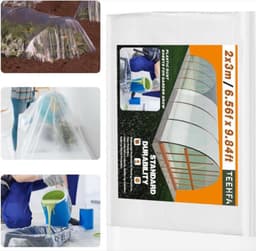
You search for a transparent greenhouse cover and see two nearly identical product photographs: one plain sheet and one clear cover with metal eyelets and a rope. Choosing greenhouse film or tarpaulin is not a cosmetic decision. Film is a plain polyethylene skin that you tension over a frame; a tarp is a reinforced, eyeleted cover intended to be tied down. Our [greenhouse film comparison](/hub/raised-beds-greenhouses-and-compost/greenhouse-film) excludes two tarp listings and two repair tapes so the eight rows remain sheets that can reasonably be assessed as film or general polythene.

You search for a transparent greenhouse cover and see two nearly identical product photographs: one plain sheet and one clear cover with metal eyelets and a rope.

Our top picks

On this page

Two products that look alike in a photograph

Greenhouse film is sold as a continuous sheet. A useful horticultural listing states its thickness in microns or mil, its dimensions and a UV term. A clear tarpaulin is built around attachment points. The deleted B0G4W725ML listing was a 2 m × 4 m clear tarp with metal eyelets at 50 cm spacing and a 10 m rope, and its sales category was Tarps. Deleted B0FPQ7PYNG was a 3 m × 4 m clear tarp supplied with eyelets, rope and bouncy balls, also ranked in Tarps. Those features may be useful, but they identify a different product type. The tarp ASINs were removed because eyelets and horticultural thickness are not alternative specifications for the same object.

Eyelets and rope versus a tensioned skin

An eyelet concentrates the pull at a reinforced hole. That suits temporary covers where ropes or elastic fasteners connect the tarp to a support and the load is expected at those points. It does not reproduce the continuous grip of a polytunnel channel. Northern Polytunnels’ covering method pulls film tight and uses wiggle wire, working from the lintel down before tensioning the hoops. If film is the right cover, use the frame’s proper retention system, protect contact points and fit it in calm weather. The greenhouse film fitting guide explains that sequence.

What a listing should say when you want film

First, look for polyethylene film with a stated thickness. “Heavy duty” without a gauge gives you no comparable thickness, while “UV-resistant” without a year gives you no stated service term. Second, check that the dimensions agree. A title, selected size, model number and dimensions line should describe the same sheet. In the retained set, AGGAFA states 2 m × 3 m and 150 µm but has a model number containing 4M×5M. Teenfa’s title says 2 m × 3 m while its dimensions line reads 500 × 270 × 0.1 cm. Third, separate the film from the accessories. The greenhouse film buying guide goes further into microns, mil and UV wording. If the listing leads with eyelets, rope and a Tarps rank, assess it as a tarp. If it offers a plain polyethylene sheet with a horticultural gauge and UV term, assess it as film.

When a clear tarp is the honest purchase

A tarpaulin is the more honest choice when the job genuinely calls for a tied cover. Examples include protecting a log pile, forming a removable rain cover over a run, covering stored materials or creating a temporary camping shelter. Eyelets and rope make repeated attachment and removal practical. For a greenhouse or polytunnel skin, film is generally the coherent purchase because the cover is tensioned across many frame members and expected to admit light over a growing season. A tarp draped over the same frame may work as a short emergency cover, but the research does not support presenting it as an equivalent multi-season skin.

Repair tape is a third, narrower tool

Repair tape restores a suitable local tear; it does not add width, replace UV stabilisation or make a tarp behave like film. That is why tape listings were removed from the eight full sheets. Before applying tape, remove the cause. The Pumtus UK review says its film was cut where it crossed cut cable ties, which is a frame-contact problem first. Tape cannot add missing width, restore degraded film or create a service life that the original listing never gave.

Common questions

Can a clear tarp cover a greenhouse?
It can provide a temporary tied cover if its dimensions, ventilation and support are suitable, but the researched tarp listings are not horticultural tunnel films. For a tensioned multi-season greenhouse skin, choose measured film with a stated gauge and UV term.
Why were the tarps removed from the comparison?
Both deleted listings were ranked in Tarps and supplied eyelets and rope; one also included bouncy balls. The comparison is for greenhouse film and plain polythene sheets. Keeping tarps would mix two fixing systems and make the rows misleading.
What is the material difference between PVC tarp and polyethylene film?
The retained film listings generally describe polyethylene. One deleted tarp has conflicting material information, with PVC in one field and PE in its bullets, so this research cannot make a clean polymer comparison for that product. Construction and intended fixing provide the safer distinction here.
Do greenhouse films have eyelets?
None of the eight retained sheets lists eyelets or rope. Specialist tunnel fitting guidance uses a tensioned plain film held by the frame’s fixing system, such as channel and wiggle wire. Eyelets are characteristic of the removed tarp examples.
Will eyelets stop a cover flapping?
Not by themselves. Flapping depends on size, tension, fixing spacing, frame shape and wind exposure. Eyelets provide tie points, but poorly tensioned material can still move, and concentrated loads can damage the cover around individual points.
Is repair tape a third cover option?
No. Repair tape is an accessory for a suitable local tear. It cannot span a frame, correct a wrong-sized sheet or give an unstated film a UV warranty. The two tape products found in that search were therefore deleted from the comparison.

Related pages

Sources

Public UK and manufacturer sources from the research digest, used for this page in October 2026.

  1. BSI — BS EN 13206:2025 greenhouse and tunnel films (retrieved 17.10.2026)
  2. Northern Polytunnels — Durathermic clear polythene (retrieved 17.10.2026)
  3. Premier Polytunnels — polythene films (retrieved 17.10.2026)
  4. Northern Polytunnels — covering a polytunnel (retrieved 17.10.2026)
  5. RHS — choosing a greenhouse (retrieved 17.10.2026)
  6. Consumer Rights Act 2015, section 11 (retrieved 17.10.2026)
  7. GOV.UK — waste duty of care code of practice (retrieved 17.10.2026)
  8. SEPA — agricultural waste (retrieved 17.10.2026)