Independent comparisons. We may earn from shop links. More info

How to fit a forestry helmet

Updated: 17 October 2026

How to fit a forestry helmet is the sequence that checks the harness, the mesh and the muffs before you start a saw on the ground. A loose combination still looks like PPE in a photo. It is not protection if a nod drops the brim or a clip has already left its slot. What to buy is the [chainsaw helmet buying guide](/hub/protective-clothing/forestry-helmet/sub/forestry-helmet-buying-guide). The shelf comparison is the [forestry helmet comparison](/hub/protective-clothing/forestry-helmet). Written on 17 October 2026 from HSE guidance and UK review notes. A qualifying purchase can earn a commission at no extra cost to you.

How to fit a forestry helmet is the sequence that checks the harness, the mesh and the muffs before you start a saw on the ground. A loose combination still looks like PPE in a photo.

Our top picks

On this page

Set the shell before the accessories

Put the shell on with the brim level. HSE’s L25 guidance tells you not to wear an industrial helmet back to front, and not to drill it, paint it, or cover it with stickers the maker did not allow. Set the rear ratchet until a firm nod does not send the helmet onto your nose or off the back of your head. A printed head range, often about 51–66 cm, is the starting point. The chin strap should hold the shell without cutting into your ears or sitting so short that you jam your jaw forward. That short-strap complaint shows up in UK reviews of the Mervex. If the strap cannot close under the chin with the brim still level, the shell is not fitted. Do the harness before you clip anything else.

Visor, mesh and glasses

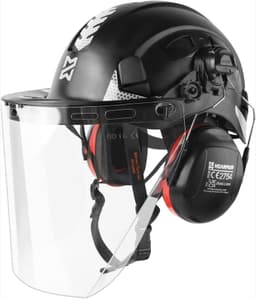
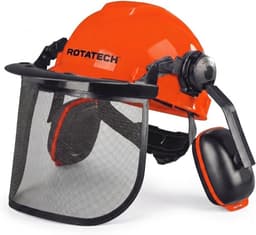
The visor and the muffs use slots in the shell, and those slots are not one universal width. Some forestry kits use a 30 mm Euro slot, and other mounts are narrower. The arm should click fully home. If you are pushing past resistance, or the visor sits half in the slot, it is the wrong part or it is not seated. A half-fitted visor comes off when you lift it, which is when chips are still in the air. The test is still the click. Mesh to BS EN 1731 is for chips and larger fragments. HSE also lists safety glasses to BS EN 166, because the visor is not the whole eye line. Mesh does not block ultraviolet light. One Rotatech review had room for glasses under the mesh. They can also fog, press on the muff seal, or slip when you look down. If your spectacles will not sit with the visor down and the muffs over your ears at the same time, the kit does not fit you yet.
Stihl Stihl Function Basic helmet

Testsieger

Stihl Stihl Function Basic helmet
8.7/10about £42.99

Ear defenders that stay on the helmet

The muffs have to cover your ears while the saw runs, not merely hang on the helmet between cuts. Helmet-mounted defenders to BS EN 352-3 are part of the certified set only when they are clicked in and seated. Park them off the ears and the SNR on the listing is not happening. UK reviews on the Rotatech, the SAFEYEAR, the Stihl and HEARMOR kits describe muffs that snap or leave the slot when the visor is lifted. If that happens, stop. Do not glue the arm, drill a new hole, or tape a broken slot. If the slot in the shell has broken, the helmet is finished. If only the muff arm has failed and the shell slot is intact, use a maker’s spare. A box that never contained ear defenders is the same stop. Mervex reviews include parcels with no muffs, and without them the face shield could not be used as the set. The shell alone is not the kit on the chainsaw helmet with visor and ear defenders page.

When the helmet is finished

A broken mount is already a reason to stop, before any date in the crown. HSE’s industrial guidance is to throw the helmet away after a significant impact, even when the shell looks uncracked, because the damage is not always visible. Deep cuts, a chalky shell and a harness you can no longer tighten sit in the same bin. A helmet left on a van parcel shelf is not in the same condition as one kept indoors. L25 gives three years from manufacture as a guide, and it tells you to check the manufacturer’s own life. The date is often moulded in the shell. That guide does not extend a shell that has already taken a knock.

Common questions

How tight should the rear ratchet be?
Tight enough that the brim stays level when you nod and when you look up into a crown from the ground. The listing’s head range, often about 51–66 cm here, is the size window. There is no single tooth-count. If the strap cuts your ears, or a short strap will not close without pulling the shell forward, the harness is not fitted.
Can you wear your own glasses under the mesh?
Often yes, and at least one Rotatech review had room for glasses. You still need the muffs over your ears and the mesh in place at the same time. Mesh to EN 1731 does not replace BS EN 166 eye protection, and it does not block UV. If the glasses fog or break the muff seal, the combination does not fit.
The muffs fell off when the visor went up. Can you keep sawing?
No. Stop. The visor and the defenders are one certified set only while they stay attached. UK reviews on several of these kits describe that pop-off. Do not glue or tape the arm. A broken shell slot means the helmet is finished. A failed arm may have a maker’s spare. A missing pair in the box is a return.
The box had no ear defenders. Is the shell enough?
No. Mervex reviews include kits that arrived without muffs, and the face shield then could not be used as a set. A shell without EN 352 defenders is not the forestry combination HSE describes for a chainsaw. Send it back rather than sawing with the mesh alone.
When do you throw the helmet away even if it looks fine?
After a significant impact, HSE’s guidance is to discard an industrial helmet even when you cannot see a crack. Also discard it if the shell is deeply damaged, the harness will not tighten, or the maker’s life has passed. Three years from manufacture is the L25 guide, and you still check the manufacturer. A broken muff mount is a stop on its own.

Related pages

Sources

Public UK sources and the amazon.co.uk listings used for this comparison, last checked on 17 October 2026.

  1. HSE, chainsaw PPE (retrieved 17 October 2026)
  2. HSE, aerial tree-work PPE (retrieved 17 October 2026)
  3. HSE AFAG308, aerial tree work (retrieved 17 October 2026)
  4. Control of Noise at Work Regulations 2005, regulation 4 (retrieved 17 October 2026)
  5. HSE, hearing protection (retrieved 17 October 2026)
  6. HSE RR1183, chainsaw noise (retrieved 17 October 2026)
  7. HSE L25, noise at work (retrieved 17 October 2026)
  8. HSE, PPE supply (retrieved 17 October 2026)