Independent comparisons. We may earn from shop links. More info

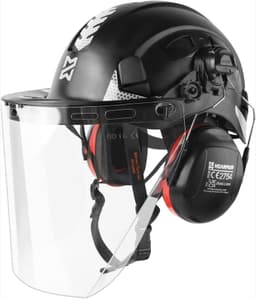
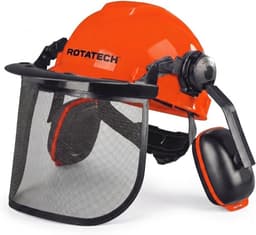
Chainsaw helmet with visor and ear defenders

Updated: 17 October 2026

You already own the saw, and a plain hard hat feels like the head part of the job. A chainsaw helmet with visor and ear defenders is three things that travel together: a shell for falling wood, a mesh visor for chips, and muffs for the noise. The title sounds like one object that stops the chain. It does not. The listings are compared on the [forestry helmet comparison](/hub/protective-clothing/forestry-helmet). Written on 17 October 2026 from HSE guidance and those amazon.co.uk files. There was no saw test. A qualifying purchase can earn a commission at no extra cost to you.

You already own the saw, and a plain hard hat feels like the head part of the job.

Our top picks

On this page

Three jobs, not one shell

HSE’s chainsaw PPE page splits the head into separate rows, and all of them apply on the ground. The helmet is BS EN 397, BS EN 14052 or BS EN 12492. The mesh visor is BS EN 1731, there to catch chips and larger fragments. Hearing protection is BS EN 352, and helmet-mounted muffs are commonly EN 352-3. Safety glasses to BS EN 166 are another row. Mesh is not a substitute for them, and it does not block ultraviolet light. If you only clip a bare shell on, you have bought one of those jobs. STIHL UK describes the same split: a helmet for falling branches, a face guard or glasses for chips, and ear protection for noise. Chainsaw helmet on amazon.co.uk often means those three items in one box. It does not mean the box has been assessed as cut protection. Which numbers have to be printed before you pay is the chainsaw helmet buying guide. Whether EN 397 or EN 12492 matches the job is EN 397 vs EN 12492.

What the helmet will not do

AFAG308 states that no PPE gives complete protection against a chainsaw cut. Chain-resistant trousers, boots and gloves exist because the helmet was never that layer. A visor can stop a chip. It will not stop the chain. Leg and foot protection stay outside this category. The helmet also does nothing for hand-arm vibration. HSE’s INDG317, Chainsaws at work, treats noise and vibration as parts of the saw system. Muffs do not damp the handles. If you are employed, those assessments sit with the employer. Call a trained person for work off the ground, for felling, or for hung-up timber if you are not trained.
Stihl Stihl Function Basic helmet

Testsieger

Stihl Stihl Function Basic helmet
8.7/10about £42.99

Short jobs and parked muffs

A few minutes on the trigger is not an exemption. The Control of Noise at Work Regulations 2005 set a lower action value of 80 dB(A), an upper action value of 85 dB(A), and an exposure limit of 87 dB(A) at the ear with protection counted. Combustion chainsaws are typically around 100 dB(A), already above those action values at the tool. HSE’s indication table puts about 25–35 dB SNR against 95–100 dB(A) noise. It does not apply while the cups are parked on the shell. Muffs off the ears are not EN 352 in use. UK reviews in this set describe defenders that snap when the visor is lifted. If that happens, you stop. Do not finish the log with one cup on.

Which of these listings are actually that kit

Several rows name a visor and muffs together: Rotatech, Oregon Protect, SAFEYEAR, TOOLIOM, the Voltek 5-in-1 sets, the Voltek mesh-plus-clear at about £55.99, and the Bluetooth Voltek at about £99.99. Naming them is not a ranking. Rotatech prints EN 397, EN 1731 and EN 352-3. Oregon prints 26 dB SNR and no EN number on the amazon file. TOOLIOM prints ANSI Z89.1 Type 1 Class C, which is a US hard-hat mark, not the HSE list. Stihl Function Basic prints EN 397 and SNR 24 and does not name a visor standard in the title, despite 4.5 from 2,776 reviews. Mervex bullets claim face and ear protection, and UK reviews include boxes that arrived with no muffs. A missing cup means you do not have this kit, whatever EN 12492 is printed on the shell. Send the parcel back if the muffs or the visor were never in it.

Common questions

Is a hard hat enough for a chainsaw?
No. HSE lists a helmet, hearing protection to BS EN 352, and a mesh visor to BS EN 1731 as separate requirements for chainsaw use, plus safety glasses to BS EN 166. A bare shell covers falling objects only. Chips and noise are still there if the visor and the muffs are missing.
Does the helmet stop the chain?
No. AFAG308 says no PPE gives complete protection against a chainsaw cut. The shell, the mesh and the muffs deal with impact, chips and noise. Chain-resistant trousers, boots and gloves are other PPE. A product title that says chainsaw helmet does not add cut protection the standard does not claim.
Mesh visor, safety glasses, or both?
HSE lists both. Mesh to BS EN 1731 is for chips and larger fragments. Glasses to BS EN 166 are a separate eye line, and mesh does not block UV. You may wear glasses under the visor if they fit with the muffs. The visor does not retire the glasses row.
What are the muffs for if the saw is only on for a few minutes?
Combustion chainsaws are typically around 100 dB(A), above the 80 and 85 dB(A) action values, even on a short cut. The muffs are there whenever the saw runs. An SNR in the mid-20s to low-30s is a selection clue against that noise. It is not a pass for sawing with the cups parked up.
What else do you still wear?
Eye protection beyond the mesh where BS EN 166 applies, chain-resistant trousers, boots and gloves. The helmet does not cover vibration or a contact with the chain. At work you also need training and the employer’s arrangements. At home the injury from a chip or a falling branch is the same.
Which listings in this set actually include visor and muffs?
Rotatech, Oregon, SAFEYEAR, TOOLIOM and the Voltek rows name visor and muffs together. Stihl prints EN 397 and SNR 24 without a visor standard in the title. Mervex claims face and ears, and UK reviews include boxes with no muffs. Inclusion on the bullets is not the same as EN numbers printed, or as parts in the parcel.

Related pages

Sources

Public UK sources and the amazon.co.uk listings used for this comparison, last checked on 17 October 2026.

  1. HSE, chainsaw PPE (retrieved 17 October 2026)
  2. HSE, aerial tree-work PPE (retrieved 17 October 2026)
  3. HSE AFAG308, aerial tree work (retrieved 17 October 2026)
  4. Control of Noise at Work Regulations 2005, regulation 4 (retrieved 17 October 2026)
  5. HSE, hearing protection (retrieved 17 October 2026)
  6. HSE RR1183, chainsaw noise (retrieved 17 October 2026)
  7. HSE L25, noise at work (retrieved 17 October 2026)
  8. HSE, PPE supply (retrieved 17 October 2026)