Independent comparisons. We may earn from shop links. More info

Chainsaw boots class 1 vs class 2

Updated: 17 October 2026

The manual seems to offer two chain speeds. Chainsaw boots class 1 vs class 2 is the choice between a test at 20 metres per second and a test at 24, using the saw's actual rated speed. Class 3, at 28 m/s, matters only after that speed has passed 24. The listings are on the [chainsaw boots comparison](/hub/protective-clothing/chainsaw-boots). Where class sits in the buying order is the [buying guide](/hub/protective-clothing/chainsaw-boots/sub/chainsaw-boots-buying-guide). We updated this on 15 October 2026 from those listings, STIHL, SIP Protection and the Health and Safety Executive. We did not run a cut test. A purchase through our links can earn a commission at no extra cost to you.

The manual seems to offer two chain speeds. Chainsaw boots class 1 vs class 2 is the choice between a test at 20 metres per second and a test at 24, using the saw's actual rated speed.

Our top picks

On this page

The only difference that matters

Class 1 is a test at 20 metres per second. Class 2 is a test at 24. That 4 m/s gap is what Arbortec's table for BS EN ISO 17249:2013 and STIHL's class guide both show. It is not a doubled safety factor, and it is not a higher price. A Class 2 boot has met a faster chain. It can still be hot and tiring. Class 3, at 28 m/s, is the next step. Above 24 m/s actual, Class 2 is already too slow a test. STIHL calls Class 1 the usual forestry and home compromise. That is a manufacturer view, and it does not cover a manual at 21 m/s.

Read the manual once, the right way

SIP Protection says to use the actual rated chain speed, not the nominal speed plus 33 per cent from EN ISO 11681. On a STIHL MS 211 C, SIP quotes 24.8 m/s with the adder and 18.6 m/s actual, and places 18.6 in Class 1. The adder looks like a Class 3 problem if you stop there. Another model can sit above 20 m/s on the actual line, and then Class 1 is the wrong test at home as well. If you cannot tell the lines apart, ask the dealer. Do not average them. At 25 m/s actual you want Class 3, tested at 28. HSE does not do this sum on the PPE page. The regulator names the standard and leaves the speed to the saw.

What HSE does not decide for you

HSE names BS EN ISO 17249, with grip and guarding at the vamp and instep. It does not say buy Class 2, and it does not say professionals must buy Class 3. At work you must be trained for the task and wear appropriate chainsaw clothing. The PPE at Work Regulations 1992 require suitable PPE for employees and also speak to a relevant self-employed person. On these sources they are not a garden offence for a householder. The injury is the same, so the manual still sets the class at home. A householder at 26 m/s actual is not kept on Class 1 by the word home. If the speed will not resolve, ask a competent person rather than buying a higher class because it feels safer.

Where that leaves these listings

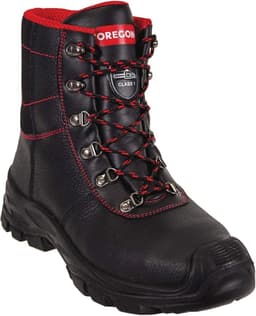
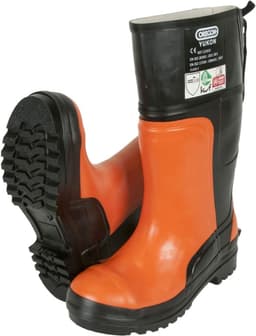
SAFETOE at £108.88 states Class 1. So do the Sarawak sizes. At or under 20 m/s actual, those titles name the matching test. Above 20 m/s, a Class 1 title is the wrong test. This set has no title that states Class 2. The Yukon titles are silent. Leather at £99.99 prints no class. Oregon's page for 295449 states Class 1 at 20 m/s. Rubber at £66.99 is silent too. Oregon's page for 295385 states Class 3 at 28 m/s. A snippet has printed EN ISO 19249. HSE's number is 17249. Fit and the large rubber size are on the rubber vs leather page. Who should leave the set is on the best chainsaw boots page.

Common questions

Is Class 1 enough for home use?
It is enough when the actual rated chain speed is at or under 20 metres per second. STIHL calls that the usual home compromise, which is a manufacturer view, not an HSE rule. A domestic saw can still exceed 20 m/s. If it does, Class 1 is the wrong test in a garden. Read the manual before you treat home as a class.
Is Class 2 twice as safe?
Class 2 is 24 m/s against Class 1 at 20 m/s. The gap is 4 metres per second, which one Yukon leather review also described. It is not a doubled factor, and this Amazon set has no title that states Class 2. Buy that class when the actual speed is above 20 and at or under 24.
Which number in the manual do I use?
Use the actual rated chain speed. Set aside the nominal speed plus 33 per cent. On SIP's MS 211 C example the adder gives 24.8 m/s and the actual speed is 18.6 m/s, which they place in Class 1. Another saw can sit above 20 m/s on the actual line. Those two figures belong to the saw SIP used.
What if the speed is 21 m/s?
You have passed the Class 1 test at 20 m/s. The matching test is Class 2 at 24 m/s. If the 21 is the nominal-plus-33-per-cent figure, find the actual speed before you buy. If the manual will not separate the lines, ask the dealer rather than rounding down.
My listing does not print a class. What then?
Yukon leather at £99.99 and Yukon rubber at £66.99 are in that position. Maker pages and a few UK reviews name a class. Neither is the Amazon title. Read the mark on the boot. If it is missing, or it is the wrong class for your speed, send the pair back.
Is EN ISO 19249 a class standard?
No. A snippet for the rubber listing printed EN ISO 19249. The standard HSE names is BS EN ISO 17249. Class 1, 2 and 3 still mean 20, 24 and 28 m/s under that number. A wrong number on a snippet is a reason to read the boot, not a second system.

Related pages

Sources

Public UK sources and the amazon.co.uk listings used for this comparison, last checked on 17 October 2026.

  1. HSE, chainsaw PPE (retrieved 17 October 2026)
  2. HSE, working with chainsaws (retrieved 17 October 2026)
  3. PPE at Work Regulations 1992 (retrieved 17 October 2026)
  4. STIHL UK, cut-protection classes (retrieved 17 October 2026)
  5. SIP Protection, finding your class (retrieved 17 October 2026)
  6. Oregon Sarawak declaration, model 295448 (retrieved 17 October 2026)
  7. Oregon Yukon leather, model 295449 (retrieved 17 October 2026)
  8. Oregon rubber boot, part 295385 (retrieved 17 October 2026)
  9. Solidur UK chainsaw boots (retrieved 17 October 2026)