Independent comparisons. We may earn from shop links. More info

How to use a hand saw

Updated: 16 October 2026

The kerf sticks halfway along a skirting board, or the pencil line wanders as soon as you lean on the stroke. How to use a hand saw is a held workpiece, a line you can still see, and the stroke the plate was ground for. More force turns a small wander into a split end. Length and pitch belong on the [hand saw buying guide](/hub/power-saws/wood-saw/sub/wood-saw-buying-guide), and prices stay on the [wood saw comparison](/hub/power-saws/wood-saw). Products Compared used public UK guides and amazon.co.uk notes from 16 October 2026, with no lab test. A qualifying purchase through our links can earn a commission at no extra cost to you.

The kerf sticks halfway along a skirting board, or the pencil line wanders as soon as you lean on the stroke. How to use a hand saw is a held workpiece, a line you can still see, and the stroke the plate was ground for.

Our top picks

SURFOU SURFOU pull saw

Alternative

SURFOU SURFOU pull saw
8.4/10about £7.99
Rolson Rolson 58375

Alternative

Rolson Rolson 58375
7.9/10about £5.30
On this page

Hold the wood and mark two faces

A straight cut starts with timber that cannot hop. DIY Doctor’s cutting guide asks you to secure the work and sight down the blade before you worry about speed, because a crooked kerf is what makes the plate stick. Mark the line on the face you can see and on the edge nearest you. Stand with your shoulder over the cut. An arm stretched to the side twists the blade. A 2x4 on two bricks is the usual miss: the offcut drops and the cut pinches. Clamp the piece, or rest the offcut on a second block. BBC Bitesize keeps the free hand clear of the teeth. That hand holds the wood.

Start on the waste side

Place the teeth on the waste side of the line, so the kerf leaves your mark. A thumb above the teeth, not in their path, steadies the plate for three or four short strokes. BBC Bitesize begins those strokes on the pull, so a groove exists before a full push. A western handsaw in this set cuts on the push. A thin pull saw cuts when you draw it towards you. One reviewer of the AIRAJ 450 mm saw could cut only on the backward stroke, though the listing talks about push and pull. Stay with the stroke that bites. The split is on Japanese pull saw or handsaw.

When the plate binds

Halfway down, the saw sticks because the kerf has closed, the plate has twisted, or the teeth have almost no set. DIY Doctor points at set: the teeth are bent wider than the steel so the plate can pass. One reviewer of the Spear & Jackson B98FF said the teeth felt as wide as the plate and the saw stuck on every stroke. Technique will not add that set. Support a sagging offcut on a block. On a long board, a small wedge behind the blade keeps the slot open, if you do not split the timber ahead of the teeth. If the far edge leaves the line, shorten the stroke.

Stop and change saw

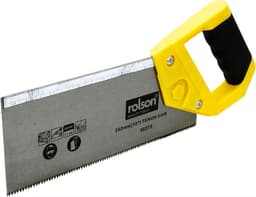
Some jobs are the wrong saw. The Rolson tenon is 250 mm, and UK reviews say it does not span a standard mitre box. Narrow beads can use one slot. A wide architrave cannot. A pull saw asked to rip a fence post starts easily and then bends if you twist it. Sleepers want the long coarse push saw. HSE treats wood dust as a health risk; the FFP3 notes are written for power tools, so open a window for indoor sheet. Call someone qualified for structural timber, a damaged Scorpion lead, or a tree you cannot control. Axminster says hardpoint teeth are not re-sharpened. A saw that arrived dull is a return.

Common questions

How do I start without the saw jumping?
Seat the teeth on the waste side of the line, with a thumb above them, and take three or four short strokes before you lengthen the cut. BBC Bitesize starts those strokes on the pull so a groove exists first. The wood has to be clamped or held against a bench hook. A jump on a loose offcut means the timber moved, and a harder shove makes the scar worse.
Why does the blade stick halfway?
The kerf has closed, the plate has twisted, or the teeth have almost no set. Support the offcut so it cannot sag and pinch the steel. A reviewer of the B98FF described teeth as wide as the plate, and that saw stuck on every stroke. More force will not create set that was never ground in. Ease out and change the saw.
How do I stop the end splitting?
Keep the offcut supported until the last fibres part, and stay on the waste side of the line so you are not levering the show face. A small wedge behind the blade can hold a long kerf open, if you do not split the timber ahead of the teeth. The last strokes should be shorter, with the free hand on the offcut.
Do I push or pull a Japanese saw?
A pull saw cuts as you draw it towards you. Pushing it like a panel saw is why the teeth jump. Draw a short groove, then lengthen the pull, and do not twist a thin plate. One AIRAJ reviewer could cut only on the backward stroke, so test the first groove even when a title says push and pull. A thick post needs the other saw.
Can I force a blunt hardpoint?
No. Axminster states that hardpoint teeth are not re-sharpened. Forcing a blunt one through chipboard or MDF burns the edge and the wood. Replace the saw. If it arrived dull or rusty, the Consumer Rights Act 2015 gives a 30-day short-term right to reject goods that are not of satisfactory quality. That is a return, not a file.
When should I stop and fetch a different saw?
Stop when the plate cannot reach, cannot stay straight, or was ground for the other stroke. A 250 mm tenon that misses the far side of a mitre box, a pull saw twisted through a post, and a coarse saw tearing visible moulding are saw changes, not stance changes. Structural timber, a damaged Scorpion lead, and a tree you cannot control need someone qualified.

Related pages

Sources

Public UK sources used for this comparison. Listing prices, stars, and review counts are the amazon.co.uk lines scraped on 15 October 2026.

  1. HSE, cutting and sanding wood (retrieved 16 October 2026)
  2. HSE, wood dust (retrieved 16 October 2026)
  3. HSE INDG291, providing and using work equipment safely (retrieved 16 October 2026)
  4. HSE L114, safe use of woodworking machinery (retrieved 16 October 2026)
  5. Consumer Rights Act 2015, section 22 (retrieved 16 October 2026)
  6. Electrical Equipment (Safety) Regulations 2016, regulation 35 (retrieved 16 October 2026)
  7. Axminster, hardpoint handsaws (retrieved 16 October 2026)
  8. BLACK+DECKER KS890ECN-GB (retrieved 16 October 2026)