Independent comparisons. We may earn from shop links. More info

Ryoba vs dozuki

Updated: 22 October 2026

You already cut most boards on a machine, and the remaining work is a tenon or a housing that a circular saw leaves rough. The question is whether one double-edge pull saw is enough, or whether a stiffened back is worth a second tool. Ryoba vs dozuki is that split: two edges and a deeper cut, or one fine edge that stops when the spine meets the wood. This page does not pick a ryoba model. Our [ryoba saw comparison](/hub/power-saws/ryoba-saw) is the amazon.co.uk set read on 19 October 2026, and it contains no dozuki. Peter F. compared those listings. There was no lab test. A qualifying purchase can earn a commission at no extra cost to you.

You already cut most boards on a machine, and the remaining work is a tenon or a housing that a circular saw leaves rough.

Our top picks

KLRStec KLRStec 240 mm ryoba

Best overall

KLRStec KLRStec 240 mm ryoba
8.6/10about £24.99
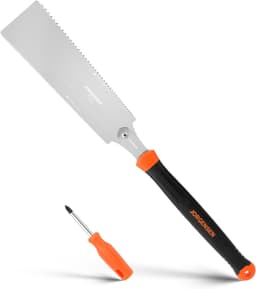
JORGENSEN JORGENSEN 250 mm ryoba

Best value

JORGENSEN JORGENSEN 250 mm ryoba
8.7/10about £18.99
On this page

Two edges, or one edge and a back

A ryoba has rip teeth on one edge and crosscut teeth on the other, and no spine. You flip the plate to change direction of grain, and the cut continues until the blade’s depth runs out. A dozuki has a steel spine along the back. It keeps the plate from wandering, and it stops when the back lands on the wood. A kataba has one edge and no spine. Lee Valley puts a ryoba on sizing and larger joinery, and a dozuki, often around 18–25 TPI, on fine cuts. The Saw Centre shows a Shogun dozuki at 0.3 mm with 20 TPI. That saw is not an ASIN here. If the next cut might be a rip or a crosscut, the ryoba is the first saw. If the shoulder hollows, the spine is the second saw.

Shoulders, depth, and idle teeth

The cheek is a rip down the face of the rail, and the ryoba’s coarser edge can go deeper than a backsaw’s back would allow. The shoulder is a crosscut. If you press, or if the start is not square, the kerf hollows and the joint rocks. A dozuki’s spine resists that hollow on a shallow shoulder, then stops when the back meets the wood. A Niwaki write-up describes one dozuki limited to about 40 mm, and ryoba idle teeth rubbing in a 75–100 mm kerf. Do not treat those figures as every saw. Unused teeth on a ryoba can mark a deep kerf. A kataba avoids that second edge. A dozuki avoids it too, and then refuses the depth. For fine dovetail pins, read ryoba saw for tenons. The stroke, if you are still pushing, is on how to use a ryoba saw.
KLRStec KLRStec 240 mm ryoba

Testsieger

KLRStec KLRStec 240 mm ryoba
8.6/10about £24.99

What this amazon set does not include

There is no dozuki ASIN in this category. You cannot pick a spine saw from these eleven rows, and this page will not invent a dozuki price. The prices you can see, from £16.99 to £45.00, are ryobas and a few cards that conflict with that description. A flush-cut saw is a third confusion. The 150 mm SUIZAN is titled ryoba, and several UK reviews describe a flush-cut saw. It has no spine, so it is not a small dozuki. Temple’s K-265 is titled a single-edge kataba and bulleted as double-edge. Leave it out of this decision.

When to keep the ryoba

Keep a ryoba when you need both edges and a cut deeper than a spine will allow. Buy a dozuki when the shoulder must stay straight and the depth is inside what that back allows. Do not expect either saw to replace the other. A first dozuki, with no ryoba beside it, leaves you without a rip edge for the cheek. Axminster’s Shokunin page asks buyers to be 18 or over. That is that shop’s rule for that saw, not a law about every Japanese saw.

Common questions

What does the spine do?
The spine stiffens a thin plate so a shallow cut stays straighter, and it stops the saw when the back meets the wood. That is why a dozuki is used on shoulders and fine joints, and why it is a poor saw for a deep cheek. Lee Valley describes it as a rigid-backed saw for fine cuts, often around 18–25 TPI. A published Shogun example is 0.3 mm with 20 TPI, and that model is not in this amazon.co.uk set.
Can a ryoba cut a tenon shoulder?
Yes. The crosscut edge severs the shoulder, and the rip edge cuts the cheek, which is why UK shops describe a ryoba as one saw for both parts of a tenon. The limit is a hollow shoulder if the plate flexes or the start is out of square. That is the moment a dozuki earns a place, not a reason to throw out the ryoba. A machine that already crosscuts your stock leaves the ryoba for the cheek and the odd bench cut.
When do the unused teeth scratch the kerf?
When the plate is deep enough for the idle edge to rub the side of the cut. Woodsmith notes that idle teeth can scratch. A Niwaki account describes that rub on stock about 75–100 mm deep, on the saw they were using. It is not a guarantee that every ryoba marks every kerf at 75 mm. On a deep cheek you will see it sooner than on a shallow shoulder. A kataba avoids it by having one edge. A dozuki avoids it too, and then the spine limits the depth.
Is a kataba the same as a dozuki?
No. A kataba has one cutting edge and no spine, so it can go deep without a second tooth line in the kerf, and it has nothing to keep the plate as stiff as a backsaw. A dozuki has a spine and usually finer teeth. Temple’s K-265 in this set is titled a kataba and bulleted as double-edge, so it is not a clean example of either. Do not buy that ASIN as your kataba.
Is a flush-cut saw a small ryoba?
No. A flush-cut saw is a thin plate with little set, for trimming a peg or a proud plug level with a surface. It does not give you a rip edge and a crosscut edge for bench work. The 150 mm SUIZAN is titled ryoba, and UK reviews describe flush cutting. Read those reviews as flush-cut comments. A dozuki is not a flush-cut saw either: the spine would stop you getting the teeth flat to a surface in the same way.

Related pages

Sources

Public sources named in the research digest, plus the amazon.co.uk listings compared on this page. Retrieved 19 October 2026.

  1. SUIZAN SR-001 ryoba, maker page (retrieved 19 October 2026)
  2. SUIZAN hand-saw manual, SR-001 (retrieved 19 October 2026)
  3. Consumer Rights Act 2015, section 22 (retrieved 19 October 2026)
  4. General Product Safety Regulations 2005, Great Britain guidance (retrieved 19 October 2026)
  5. GOV.UK: consumer product safety advice for staying safe (retrieved 19 October 2026)
  6. Woodsmith: selecting and using Japanese saws (retrieved 19 October 2026)
  7. UK Workshop: Japanese ryoba saws (retrieved 19 October 2026)
  8. amazon.co.uk listings for this set, 19 October 2026 (retrieved 19 October 2026)