Independent comparisons. We may earn from shop links. More info

Ryoba saw for tenons

Updated: 22 October 2026

You are cutting a mortise-and-tenon on the bench, the rail is marked, and the saw in your hand has two edges. The cheek runs with the grain. The shoulder runs across it. A ryoba saw for tenons uses those edges in that order, and it is a poor dovetail saw if the rip teeth are as coarse as 7–9 TPI. This page follows one joint. It is not a second buying guide. The listings behind the pitches are in our [ryoba saw comparison](/hub/power-saws/ryoba-saw), read on 19 October 2026. Peter F. compared those listings. There was no lab test. A qualifying purchase can earn a commission at no extra cost to you.

You are cutting a mortise-and-tenon on the bench, the rail is marked, and the saw in your hand has two edges. The cheek runs with the grain. The shoulder runs across it.

Our top picks

KLRStec KLRStec 240 mm ryoba

Best overall

KLRStec KLRStec 240 mm ryoba
8.6/10about £24.99
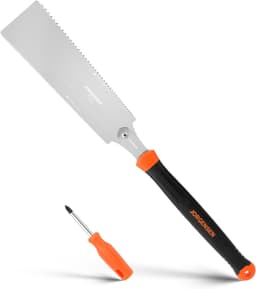
JORGENSEN JORGENSEN 250 mm ryoba

Best value

JORGENSEN JORGENSEN 250 mm ryoba
8.7/10about £18.99
On this page

A cheek is a rip

The cheek is a rip cut along the grain, from the end of the rail back to the shoulder line. Use the coarser edge. Start at the corner, on a diagonal, so the first kerf is a groove you can see, then bring the saw upright. Stay on the waste side of the line. A kerf on the wrong side of the pencil mark makes a thin tenon. Pull from the heel. A push on a 0.5 mm plate kinks it, which is the failure mode on the how to use a ryoba saw page. Saw both cheeks before the shoulder. SUIZAN prints 9 TPI for the rip, JORGENSEN 7–12 TPI, and WORKPRO 7–10 TPI.

A shoulder is a crosscut

Turn the rail and use the finer edge. The shoulder is across the grain, and rip teeth tear it. SUIZAN prints 15 TPI on the crosscut side. JORGENSEN and WORKPRO print 18 TPI. Come in from one face, then the other, so the middle meets in a ridge you can pare. Stay on the waste side, the tenon end, not the face of the rail. If the middle is low and the edges touch first, the joint rocks. A dozuki’s spine resists that hollow on a shallow shoulder and stops when the back meets the wood. When that is the failure, the next tool is the spine saw on ryoba vs dozuki. This set does not include a dozuki. Pare a close shoulder with a chisel. If the plate has already kinked in a door, stop.
KLRStec KLRStec 240 mm ryoba

Testsieger

KLRStec KLRStec 240 mm ryoba
8.6/10about £24.99

Pins are a short rip, and often the wrong pitch

A dovetail pin is a short rip, on a slope. The coarse edge that suits a tenon cheek can grab in that short socket. A UK Workshop contributor found ryoba rip teeth too coarse for pins and preferred a British dovetail backsaw. A 7 TPI or 9 TPI edge takes a hungry bite in a 10 mm pin. An 18 TPI crosscut edge is the wrong tooth direction for a pin that runs with the grain. A practice pin is possible if you stay on the waste and pare to the line. Visible dovetails are where a finer second saw stops being a luxury. Hidden tenons are where the ryoba earns its keep. KLRStec numbers only the rip edge, at 9 TPI. If the card never prints a number, the ryoba saw buying guide is where you drop that row.

When to stop and call a joiner

Call a joiner for structural timber, for a door that must stay square after a kinked plate, and for any cut beside wiring or off a ladder. A bench tenon in a practice rail is the job this saw is for. The teeth are the hazard. If a product is unsafe, report it through Citizens Advice in England and Wales, Advice Direct Scotland, or the Northern Ireland council. Rip the cheek, crosscut the shoulder, and do not ask a coarse rip edge to be a dovetail saw.

Common questions

Which edge cuts a tenon cheek?
The rip edge, the coarser one. The cheek runs with the grain. Start at the corner on a diagonal so the first groove guides the saw, then bring the plate upright, on the waste side of the line. Where this set prints a rip pitch, SUIZAN states 9 TPI, JORGENSEN states 7–12 TPI, and WORKPRO states 7–10 TPI. Pull from the heel. A push on a 0.5 mm plate kinks it before the cheek is finished.
Which edge cuts a tenon shoulder?
The crosscut edge, the finer one. SUIZAN states 15 TPI on that edge. JORGENSEN and WORKPRO state 18 TPI. Cut from one face and then the other so the far side does not break out. Stay on the waste side, which is the tenon end, not the face of the rail. If the middle of the shoulder ends up hollow, pare it or move to a spine-backed saw for the next joint. More pressure on the ryoba usually makes the hollow worse.
Can the same saw cut a dovetail pin?
It can start one, and the coarse rip edge often grabs. A UK Workshop contributor found ryoba rip teeth too aggressive for pins and preferred a dovetail backsaw. A 7–9 TPI edge is a hungry bite in a short pin. Use the ryoba for the practice cut, pare to the line, and treat a dedicated finer saw as the tool for pins you will see. The crosscut edge still cuts the dovetail shoulder. It does not replace a rip tooth in the pin socket.
Why might a shoulder go hollow?
The plate flexed, the start was out of square, or the stroke was a push on a 0.5 mm or 0.6 mm blade. The edges of the shoulder then touch and the middle does not, so the rail rocks in the mortise. A dozuki’s spine resists that on a shallow cut and stops when the back meets the wood. Clamps will not pull a hollow shoulder tight in a way that stays honest. Pare to a flat, or recut if the hollow is deep.
Do idle teeth mark a deep cheek?
They can. The edge you are not using still sits on the plate, and in a deep kerf it can scratch the wall. Woodsmith notes that scratch as a reason some joiners move to a single-edge kataba for deep work. You will notice it more on a wide cheek than on a shallow shoulder. If the cheek is hidden inside the mortise, a light mark may not matter. If the joint is exposed, pare the mark or choose a saw with one edge.

Related pages

Sources

Public sources named in the research digest, plus the amazon.co.uk listings compared on this page. Retrieved 19 October 2026.

  1. SUIZAN SR-001 ryoba, maker page (retrieved 19 October 2026)
  2. SUIZAN hand-saw manual, SR-001 (retrieved 19 October 2026)
  3. Consumer Rights Act 2015, section 22 (retrieved 19 October 2026)
  4. General Product Safety Regulations 2005, Great Britain guidance (retrieved 19 October 2026)
  5. GOV.UK: consumer product safety advice for staying safe (retrieved 19 October 2026)
  6. Woodsmith: selecting and using Japanese saws (retrieved 19 October 2026)
  7. UK Workshop: Japanese ryoba saws (retrieved 19 October 2026)
  8. amazon.co.uk listings for this set, 19 October 2026 (retrieved 19 October 2026)