Independent comparisons. We may earn from shop links. More info

How to use a chainsaw mill

Updated: 22 October 2026

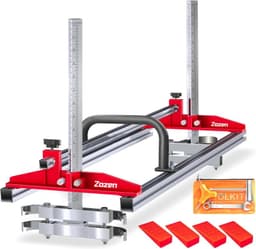
The frame is clamped, the saw is the one you already own, and the log in front of you has no flat face. That first cut is the whole job. How to use a chainsaw mill, on a Zozen-style frame rather than a branded rail you do not own, is mostly preparation: the log cannot roll, the guide cannot move, and the kerf has to stay open while the chain stays oiled. This page does not rank the nine amazon.co.uk listings. Those are on our [mobile sawmill comparison](/hub/power-saws/mobile-sawmill), read on 20 October 2026 by Peter F. There is no lab test. A qualifying purchase can earn us a commission at no extra cost to you.

The frame is clamped, the saw is the one you already own, and the log in front of you has no flat face. That first cut is the whole job.

Our top picks

On this page

Support the log before the saw starts

Chock the log on both sides before you think about thickness. Granberg’s note says to keep the first-cut rails level, and the same applies to a straight board you fasten so it cannot creep. Do not stand on the downhill side. The chain stays exposed: none of these frames is a guard. At work, the Health and Safety Executive’s list cites a helmet to BS EN 397, hearing protection to BS EN 352, a visor to BS EN 1731, gloves, chainsaw trousers to BS EN 381-5, and boots to BS EN 381-7 and BS EN ISO 17249. A garden is not a workplace, and the chain does not know the difference. If the log is near a road, a building or a power line, stop and hire someone who mills for a living. Bar fit is on the chainsaw mill buying guide. Felling law is on the portable sawmill for a small woodland page.

The first cut is the one that matters

The first face has nothing true to follow. Granberg says you can use their rail or a straight board, and that you stop if the rail moves. Check the guide at both ends and fasten it. A wedge under a sagging board is not a level. For a MKIV, the bar should be at least 6 inches longer than the log, and you should not see-saw it. Push the cut through in one direction. After that face exists, drop the mill onto it and set the thickness. If the rail shifts, stop and re-level.

Chain, oil and wedges

A felling chain is filed to cross-cut, and a mill is ripping with the grain. Granberg’s pages tell you to fit a ripping chain. The Chilterns note says to check the tension as you go and to take the saw off the mill to sharpen. These frames do not include that chain. Fit it before the first face. A long rip drinks more oil than a few minutes of cross-cutting. A dry chain smells hot and throws fine dust instead of chips. Stop and sort the oiler. Wedges hold the kerf open. Granberg describes a wedge about 6 inches by 3 inches, the first after about 2 feet, then about every 2 feet. Another note of theirs says every 12–18 inches.

When the cut goes wrong

Granberg’s FAQ lists three causes of bogging: pinch, a dull chain, or a saw that is too small. A closed kerf needs another wedge, not more throttle. Review notes on the zozen 14–36 inch card mention spring washers when bolts walk. Check them before each slab. An Italian review of the £69.99 Zozen, not a UK review, says not to clamp the nose roller. UK reviews of the AGS jig describe bind when the bar is not parallel, and a clamp that bent. One US review describes a cooked clutch with the chain brake left on. Take the brake off before the chain is asked to cut. If you cannot see the bar, stop. When a wide kerf is the cost you mind, see chainsaw mill or bandsaw mill.

Common questions

How do I make the first flat face?
Chock the log so it cannot roll. Level a straight board or a rail and fasten it so it cannot creep. Granberg says to stop if that rail moves. Run the bar in one direction, not in a see-saw, and do not start the thickness cuts until that face is the reference. Every later board copies it, including a twist you hoped would disappear.
What are the wedges for?
They hold the kerf open so the log does not pinch the bar. Granberg’s FAQ describes a wedge about 6 inches by 3 inches, the first after about 2 feet of cut, then about every 2 feet. A separate note of theirs says every 12–18 inches. Some frames name felling wedges in the box. Use them as soon as the cut behind the bar starts to close, and replace any wedge that falls out.
Can I mill with the chain that fells trees?
You can, and you will work harder for a rougher face. A felling chain is filed for cross-cutting. Milling is a rip. Granberg tells you to use a ripping chain, and the Chilterns note says to file for ripping, check tension as you go, and take the saw off the mill to sharpen. These frames do not include that chain. Fit it before the first face.
Why does the saw bog or smell hot?
Granberg lists three causes: the kerf is pinching, the chain is dull, or the saw is too small. Heat and fine dust point at oil and sharpness. A closed kerf points at another wedge, not at more throttle. A small saw on a large log will bog even when the chain is right. Stop, rather than rocking the nose to force the cut through.
How do I stop the mill bolts rattling loose?
Check them before each slab. Review notes on one horizontal frame mention spring washers once the bolts start to walk. If the rail can move, the bolts will not save the face. An Italian review, not a UK one, warns against clamping the nose roller. Leave the roller free to track, and do not treat a loose mill as something the chain will pull straight.

Related pages

Sources

Public UK sources and the amazon.co.uk listings compared on this page. Shelf date 20 October 2026.

  1. GOV.UK, when a felling licence is needed (retrieved October 2026)
  2. Forestry Act 1967, section 9 (retrieved October 2026)
  3. HSE, PUWER overview (retrieved October 2026)
  4. HSE, chainsaw PPE (retrieved October 2026)
  5. GOV.UK, supply of machinery regulations (retrieved October 2026)
  6. Chilterns, on-site sawmilling (retrieved October 2026)
  7. Brian’s of Risborough, Granberg MKIV (retrieved October 2026)
  8. Logosol UK, F3 chain sawmill (retrieved October 2026)