Independent comparisons. We may earn from shop links. More info

How to use a Metabo jigsaw

Updated: 21 October 2026

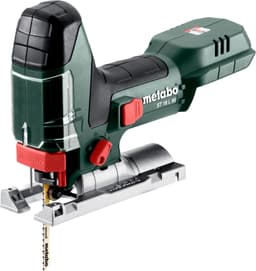
You have a genuine Metabo on the bench, a pencil line on the board, and the pendulum lever still on whatever the last job used. This is how to use a Metabo jigsaw for a controlled cut: blade, shoe, orbit, then dust, with a scrap pass before the finished face. The steps follow Metabo Quick, the ST 18 L 90 datasheet, and the settings named on the kept amazon.co.uk listings. Peter F. did not run a cutting trial. The [Metabo jigsaw comparison](/hub/power-saws/metabo-jigsaw) is where the models differ. A qualifying purchase can earn a commission at no extra cost to you.

You have a genuine Metabo on the bench, a pencil line on the board, and the pendulum lever still on whatever the last job used.

Our top picks

On this page

Fit a Metabo Quick blade and set the shoe

Unplug a STEB, or remove the 18 V pack on an ST, STB, or STA, before the blade goes in. Metabo Quick is the tool-free change on the kept listings. Open the lever, seat a T-shank blade until it locks, and tug it. A half-seated blade walks off the line. Use a wood blade for timber and a metal blade for sheet. Plant the shoe flat before the teeth touch. On a bevel, lock the shoe and check it with a square on scrap. The ST 18 L 90 and the STA 150 BL datasheets state ±45°. If the card leaves bevel blank, set it on the saw in your hand, not from a neighbouring model. Support the offcut, or the last 20 mm of veneer can split. Fit a Metabo or CAS 18 V battery only after the blade is locked. The buying guide covers that platform if you are still choosing the saw.

Set pendulum and speed, and leave orbit off for metal

Pendulum, or orbit, swings the blade forward on the upstroke so a rip in timber goes faster. The ST 18 L 90 datasheet lists four levels and 750–3000 strokes per minute. The STA 150 BL lists 1000–3500, and the STEB 65 bullets call the control Vario. Start at zero for a marked curve, a laminate face, metal, or anything thinner than about 12 mm. Add a level only in solid wood when the edge is hidden. Full orbit on a kitchen-door curve leaves a scalloped edge, and an aggressive orbit overheats a metal blade. Ignore a 750 RPM or 180 W row. Let the saw reach speed, and relieve a tight curve so the blade is not bending in a 22 mm or 26 mm stroke. If the grip is what you are fighting, the body grip versus top handle page is the buying choice.

Bevel the scrap first, then cut the real piece

Mark the waste side and stand so you can see the blade. On a top-handle saw you look down the front of the blade. On the body grip you are closer, which helps an internal cut and hides the line if you stand too upright. Clamp the work. Cut a 100 mm sample at the same bevel before a worktop or a stair string. If the veneer tears, drop the pendulum to zero, slow the stroke, and tape the exit face. Depth is capacity, not a handsaw finish. Stop if the blade colours, the shoe lifts, or the kerf closes. A long straight edge, a fitted worktop, or a cut beside pipes is a joiner's job, or a track saw.

Clear the line without pretending the blower is extraction

The kept cordless cards and the STEB 65 list a dust blower. It clears the pencil line for the next 10 mm. It does not capture dust. For employers, HSE workplace exposure limits are 3 mg/m³ for hardwood dust and 5 mg/m³ for softwood. Fit the nozzle to a vac beyond a single notch, and switch the blower off so it does not fight the airflow. On the STA 150 BL you can switch the LED off when glare hides the line. The ST 18 L 90 declares 90 dB(A), above the 80 and 85 dB(A) action values, so wear hearing protection beyond a quick cut. HSE's typical band is about 9–17 m/s². Metabo's 7.6 m/s² in wood and 8.7 m/s² in metal apply only if the cut matches the test. PUWER 1998 still requires a suitable tool at work. Charge only with a BS 1363 charger for that 18 V system.

Common questions

What does Metabo Quick change involve?
With the pack out or the lead unplugged, you open the Quick lever, insert a T-shank blade fully, and lock it. Pull the blade to confirm it has seated. The listings in this comparison use that system rather than a hex key. A blade that clicks once but pulls out by hand is not locked.
Can I use pendulum on metal?
No. Set the orbit to zero, use a metal blade, and keep the stroke rate down. The four pendulum levels on the ST 18 L 90 are for speeding a timber cut. Orbit on steel or on a finished laminate face tears the edge and overheats the teeth.
Should the dust blower stay on?
Leave it on when you need to see a pencil line and you are not connected to a vac. Turn it off or divert it when a nozzle is on extraction, because the blower fights the airflow. Neither setting replaces a vacuum for hardwood dust.
Why does my listing say 750 RPM?
That figure appears as amazon catalogue noise on some Metabo cards, beside wattage rows that also disagree with the datasheet. The ST 18 L 90 is specified at 750–3000 strokes per minute. Set the dial by how the blade is cutting, not by the RPM cell.
How do I know the bevel is really 45°?
Lock the shoe, then check it on a scrap with a square before you cut the finished piece. Datasheets for the ST 18 L 90 and the STA 150 BL state ±45°, but a worn shoe or a half-locked lever will not hold that angle through a long cut.
When should I stop and call a joiner?
Stop when the worktop is already fitted, the cut is structural, services are in the wall, or you need a long straight finished edge. Also stop at work if nobody has looked at noise, vibration, and dust for an all-day job. A jigsaw is the wrong tool for those tasks even when the blade and pendulum are set correctly.

Related pages

Sources

Public sources listed for this comparison, October 2026. Prices, stars and review counts are the amazon.co.uk figures in that set. We did not run a lab test.

  1. Metabo UK ST 18 L 90 (retrieved October 2026)
  2. Metabo datasheet ST 18 L 90 (retrieved October 2026)
  3. Metabo STA 18 LTX 150 BL (retrieved October 2026)
  4. CAS battery alliance (retrieved October 2026)
  5. HSE vibration assessment (retrieved October 2026)
  6. Control of Noise at Work Regulations 2005 (retrieved October 2026)
  7. HSE wood dust (retrieved October 2026)
  8. GOV.UK Supply of Machinery (Safety) Regulations 2008 (retrieved October 2026)