Independent comparisons. We may earn from shop links. More info

How to use a cordless circular saw

Updated: 21 October 2026

You have the saw on the bench, or it is still in the box, and the next ten minutes are about the cut rather than the brand. Kickback, a blade set far too deep, and a lower guard that does not spring back are how a cordless circular saw injures people. Battery off while you set the shoe, the board supported so the kerf cannot close, then one cut at full speed with your body off the line. The [cordless circular saw comparison](/hub/power-saws/cordless-circular-saw) is where the nine amazon.co.uk listings are scored. Blade class for a measured thickness is on the [depth of cut](/hub/power-saws/cordless-circular-saw/sub/cordless-circular-saw-depth-of-cut) page. Peter F. compared the listings and public UK safety pages. There was no lab test. A qualifying purchase can earn a commission at no extra cost to you.

You have the saw on the bench, or it is still in the box, and the next ten minutes are about the cut rather than the brand.

Our top picks

On this page

Before the battery goes on

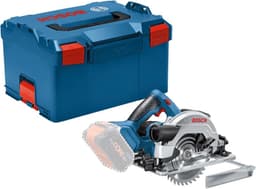
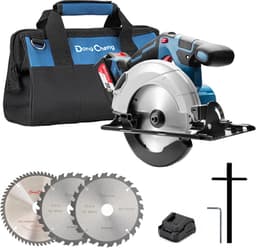
Take the battery off before you look at the blade, and leave it off until the shoe, the guard and the depth are set. Check that the teeth point in the direction of the arrow on the guard. A blade fitted backwards will burn and climb instead of cutting. Match the bore. In this set Ryobi and Galax state 10 mm, and the Bosch blade in the box is 165 mm with a 20 mm hole. Do not force a mismatch. The Galax kit includes a 60-tooth HSS blade as well as a 24-tooth TCT blade. Keep the HSS blade off timber. Set the depth so less than a full tooth shows below the wood. SGS Engineering puts that at about 5–10 mm past the underside. Do not copy an 8 mm riving-knife gap from a saw bench onto this handheld guard. With the battery still off, pull the lower guard back and let it go. It should snap home.

Support and the line of cut

The board has to be clamped, and the offcut has to be free to fall. Support the keep side so the kerf cannot close on the blade. If you support only the middle of a long strip, the two ends drop, the cut pinches, and the saw kicks back toward you. Support the piece you are keeping, let the waste fall, and stand to the side of the blade rather than behind it. Both hands stay on the saw. UK reviews of the Ryobi call its fence only roughly true, so a clamped straight edge still matters. A laser shows a line. It does not stop the shoe wandering. If the cut has to start in the middle of a fitted worktop, stop. That is a plunge-saw job, or a joiner's job, on the circular saw vs plunge saw page.

During the cut

Start the saw and let it reach full speed before the teeth meet the wood. Push only hard enough to keep the cut moving. If you have to lean on the saw, the depth is too ambitious, the blade is blunt, or the pack is flat. Keep the shoe flat. Lifting the heel mid-cut is how the blade climbs out of the kerf. Galax reviews in this set mention kickback at the end of a board. If the blade binds, release the trigger and hold the saw until it stops. Do not yank it backward through the cut while the motor is still driving. Wait until the blade has stopped, then take the battery off before you free the saw. TEENO reviews describe smoke after about 10 seconds and stalling when the saw is pushed. A brake, where the Bosch, Dong Cheng or TEENO listing mentions one, shortens the run-down. It does not make a bound blade safe to wrestle.

Dust, noise, and when to stop

At work, wood dust and noise are the employer's duties, not a setting on the saw. HSE's workplace exposure limits are 3 mg/m³ for hardwood and for mixtures, and 5 mg/m³ for softwood, as an eight-hour average. The Control of Noise at Work Regulations 2005 set action values at 80 and 85 dB(A) and a limit of 87 dB(A) after hearing protection. Those duties do not bind a hobby in a home garage. None of the nine listings publishes a noise figure, so this page does not invent one. Wear eye protection to EN 166, hearing protection, and a dust mask, and use the dust port if the saw has one. Stop and get a joiner when the timber is structural, when the cut starts in a fitted worktop, or when the motor has smoked. A saw that smells of burning insulation is a return under the Consumer Rights Act 2015 if it is not of satisfactory quality. The buying guide is where you choose the saw.

Common questions

How far should the blade stick out under the wood?
Less than a full tooth. SGS Engineering describes about 5–10 mm of blade past the underside of the wood. A deeper setting does not cut faster. It exposes more tooth if the saw kicks, and it makes the blade more likely to bind. Set that depth with the battery off, on the actual piece, not on a guess from the blade diameter. If the stated maximum depth of your saw is only just over the thickness, you may not have 5 mm to spare, and you need a larger saw rather than a buried blade.
What do you do if the blade binds?
Release the trigger and hold the saw still until the blade stops. Do not pull it back toward you while it is still spinning. When it has stopped, remove the battery, then free the blade and look for why the kerf closed: an unsupported offcut, a twist in the board, or a depth set so deep that the back of the blade is rubbing. Support the keep side, let the waste fall, and start again from a position where the blade is clear. If the motor smoked while it was bound, stop using that saw.
When do you take the battery off?
Take it off before you set the depth, before you check the guard, before you change the blade, and before you clear a jam. Put it on only when the shoe is set, the guard returns, and both hands are ready for the cut. A battery found already fitted in the box, which one buyer in this set reported, comes off before you do anything else. The pack is the power. Treat a fitted pack the way you would treat a saw that is plugged in.
How do you support a sheet so the kerf does not close?
Support the piece you are keeping, clamp it, and let the offcut fall away rather than drop onto the blade. On a full sheet, use bearers under the keep side so the saw's shoe stays supported to the end of the cut. If both sides of the kerf sag, the wood pinches the blade and the saw kicks. A fence or a laser does not hold the sheet up. The supports do, and you stand to the side of the line, not behind the saw.
Do wood-dust limits apply in a home garage?
The HSE limits of 3 mg/m³ and 5 mg/m³ are workplace exposure limits for employers, measured as an eight-hour average. They do not bind a hobby. The dust is still the same dust. Wear a mask, cut outdoors or with extraction if the saw has a port, and do not treat a home garage as if those numbers had been measured there. None of these listings states a dust figure you can quote as your own exposure.
What is the difference between a bench riving knife and the lower guard?
A riving knife on a saw bench sits in the kerf behind the blade and holds the cut open. HSE's 8 mm gap is a bench setting, not a gap you dial into these handheld saws. On a cordless circular saw the lower guard is a spring cover over the blade, and it has to return on its own. Do not lock it open. Some saws also have a small riving knife. Leave it in place unless you are competent to plunge, which these kits are not sold to do in the middle of a panel.

Related pages

Sources

Public UK sources used for this comparison. Listing prices, stars and review counts are the amazon.co.uk figures captured on 19 October 2026. We did not run a lab test.

  1. HSE wood dust (retrieved 19 October 2026)
  2. Control of Noise at Work Regulations 2005 (retrieved 19 October 2026)
  3. HSE noise duties for employers (retrieved 19 October 2026)
  4. Supply of Machinery (Safety) Regulations 2008 (retrieved 19 October 2026)
  5. HSE circular saw bench (retrieved 19 October 2026)
  6. Bosch Professional GKS 18V-57 G (retrieved 19 October 2026)
  7. Bosch 18 V GKS guidance PDF (retrieved 19 October 2026)
  8. BuildWiz circular saw blade classes (retrieved 19 October 2026)