Independent comparisons. We may earn from shop links. More info

Radiant heater vs fan heater

Updated: October 2026

You are cold in one room, or only cold in the chair you actually sit in, and a product page has told you that a radiant heater is cheaper than a fan heater. It is cheaper only when it uses fewer watts, or when it runs for less time. A radiant heater vs fan heater, held at the same watts for the same hour, uses the same electricity. The [Vasner radiant heater comparison](/hub/portable-heaters/vasner-radiant-heater) is seven radiant listings, not a fan-heater catalogue. The fan side of this page is the type, described by UK energy and safety sources, not a dropped ASIN brought back in. The Products Compared editorial team used those listings, Ofgem’s price cap, Energy Saving Trust, and the Centre for Sustainable Energy. This is not a lab test. A qualifying purchase can earn a commission at no extra cost to you. Prices and stars below are the amazon.co.uk lines from 15 October 2026.

You are cold in one room, or only cold in the chair you actually sit in, and a product page has told you that a radiant heater is cheaper than a fan heater.

Our top picks

On this page

Same watts, same electricity

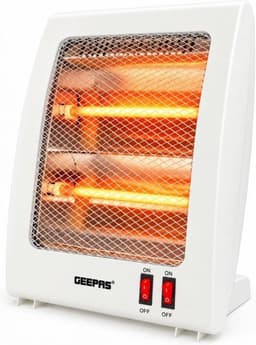
Ofgem’s average Direct Debit electricity rate for 1 October to 31 December 2026 is 26.32 p/kWh in England, Scotland, and Wales. Northern Ireland is outside that cap. A full-power hour is about 16p at 600 W, about 21p at 800 W, about 32p at 1,200 W, and about 53p at 2,000 W. A 2 kW fan heater at full power is the same about 53p for that hour. The Könighaus P-600 and the Nedis on its low setting are the 600 W case. The Geepas and the SONBION at their high setting are the 800 W case. The Warmlite, the Nedis on high, and the Stiebel Eltron IW 120 are the 1,200 W case. The Mylek MY284858 is the 2,000 W case. The 21p figure is arithmetic from that Ofgem rate, 0.8 times 26.32p, not a number printed on the listing. energy.org.uk’s comparison of electric heaters makes the same point in kilowatt-hours: a 2 kW hour is 2 kWh whatever the badge on the front. Savings come from a thermostat, a timer, and a smaller job, not from the word infrared. A seller line of up to 95 percent on the SONBION listing does not make 800 W cheaper than another 800 W heater. A claim that infrared is over 100 percent efficient is not a bill. A VASNER radiation-efficiency test, on a panel that is not one of these ASINs, does not change the watts of the Warmlite or the Geepas. A lower wattage can still be the wrong tool. If you need the air in a cold box room warm, an 800 W bar is not a substitute for a 2 kW fan left to do that job. You have bought a smaller heater. You have not bought a more efficient one. The checks that stop you misreading a title are on the buying guide.

What each heater warms

A halogen or quartz bar, and a radiant panel, heat the person and the surfaces in front of them. Energy Saving Trust describes infrared panels as the same class of direct electric heat as other panel heaters, often 350–900 W for a home wall panel, and not always enough on their own. The Centre for Sustainable Energy says radiant heat suits a person or part of a room, and that little warmth is left in the air once it is off. You feel the Warmlite quickly if you are in the beam. You do not store that heat in the air for the next hour. A fan heater warms air and pushes it out of a vent. Electrical Safety First describes that as a noisy burst, with vents that must stay clear, and describes a halogen heater as infrared lamps that warm objects and that can topple. The warmth from a fan fades when the fan stops, because you were heating air that leaves the room under the door. The warmth from a bar fades for a different reason: you stepped out of the beam. Both still need about a metre from curtains and clothes. Noise is the practical split. A fan is the heater you hear. A glowing bar is the heater you see. The SONBION’s UK reviews describe it as a quiet local heater, which fits a desk if fabric stays off the grille. The Warmlite’s reviewers mention glare. If you are on a call, the fan is the one that competes with the microphone. If you are watching a film in a dark room, the halogen tubes are the distraction. Neither point changes the pence per hour at a given wattage.
Mylek Mylek MY284858 mica panel

Testsieger

Mylek Mylek MY284858 mica panel
6.3/10about £99.99

When a radiant heater, when a fan heater

Choose a radiant heater when one person needs to be warm and the rest of the room can stay cooler. In this set that is the Geepas, the Warmlite, or the SONBION, used for the time you are in the chair, then unplugged. The Warmlite can give you 1,200 W and a stated 120 degree swing. The Geepas and the SONBION top out at 800 W. None of those three states a thermostat, so a long session does not cycle off by itself. The Centre for Sustainable Energy’s warning applies: bars often have no thermostat, so a long session can cost more than the cheap-radiant headline suggested. How to place them, including the carpet pin, is on the how to use page. Choose a fan heater when you need the air in a small room warm for a short time and you will accept the noise. A 2 kW fan at full power costs about the same per hour as the Mylek at full power. It is the wrong comparison if you then set the fan to a lower wattage, or if you only needed the chair. A fan left running for hours, with no thermostat, can cost more than heating the home another way. That is a time problem, not a technology prize. The Mylek is the listing here that states a thermostat and a timer. That can shorten the hours, which is how a bill falls. It does not make each watt cheaper. At 2,000 W it is about 53p for a full-power hour, the same band as a 2 kW fan. The Könighaus is 600 W with no thermostat stated, so it is the cheap hour, about 16p, and the small output. Energy Saving Trust’s range for home panels, often 350–900 W, is a description of that band. It is not a promise that one 600 W panel heats a typical UK room as the only source. If the air stays cold, the Centre for Sustainable Energy notes that moisture can still condense. Do not claim a radiant heater prevents damp. Who should skip each listing is on the best radiant heater page.

What this comparison leaves out

Halogen versus quartz is not a separate decision on this URL. Both are glowing bars in this set, and both are radiant next to a fan. Bathroom IP ratings and bare wires are not a running-cost question. The Nedis states IPX4 and ships without a plug. Oil-filled radiators are a third type. They are not one of the seven listings, and they are not the other half of this comparison. The recommendation is conditional. Use a radiant bar when you are the thing that needs to be warm, you are in the room, and you will switch it off. Use a fan heater when the air itself is the job and a short noisy burst is acceptable. We do not claim a lab test, a Which? win, or that any ASIN is a Vasner. At the same watts and the same hour, pick the heater that warms the thing you need warm. The word on the box does not change the kilowatt-hour.

Common questions

Is a radiant heater cheaper to run than a fan heater?
Only if it uses fewer watts or runs for fewer hours. At the same watts and the same time, the electricity matches. On the Ofgem Direct Debit rate of 26.32 p/kWh, a full-power hour is about 32p at 1,200 W whether the heater is a halogen bar or a fan. A 95 percent claim does not change that.
Why does a 1,200 W halogen feel hot when a 2,000 W fan heats the room?
The bar throws radiant heat at you, so your skin and clothes warm while the air behind you can stay cool. The fan warms air and spreads it, so the room changes and you may feel less of a direct beam. The 2,000 W fan is still the larger heater. Feeling hotter in the beam is not a lower bill.
Will an 800 W quartz bar replace a fan heater?
Not if the fan’s job was to warm the air in the room. The Geepas and the SONBION top out at 800 W, about 21p for a full-power hour on the rate above. A 2 kW fan is about 53p and delivers more heat. The bar can replace the fan only when the job shrinks to one person for a short time.
Does infrared efficiency above 100 percent change the bill?
No. Do not use an over 100 percent line, or the SONBION’s up to 95 percent line, as a reason the meter will run slower. A full-power hour costs the watts times the pence per kilowatt-hour. A Vasner efficiency test on a different panel does not alter these ASINs.
Which is quieter?
The fan heater is the noisy one, because it moves air. A radiant bar or panel has no fan in the descriptions used here, so the room stays quieter, and a halogen bar adds glare instead. Quiet does not mean cheaper. An 800 W bar and an 800 W fan still cost the same per hour at full power.
Which is better if I sit in one chair?
A radiant bar, for the time you are in that chair, then unplugged. The Warmlite, Geepas, and SONBION are the desk listings. They do not state a thermostat. Keep fabric a metre away. A fan is the better tool if you need the air around the chair warm and you can tolerate the noise.
Does a thermostat change the comparison?
It changes how long the heater stays at full power. It does not change the price of a watt. In this set only the Mylek states a thermostat and a timer. The desk bars and the Könighaus do not. A heater that cycles off can cost less over an evening than one left at 1,200 W or 2,000 W. That is control, not a different kind of electricity.

Related pages

Sources

Public UK sources and the VASNER Citara M page. Listing prices, stars, and review counts are from amazon.co.uk on 15 October 2026.

  1. Energy Saving Trust — Infrared heating explained (retrieved 15 October 2026)
  2. Ofgem — Energy price cap, 1 October to 31 December 2026 (retrieved 15 October 2026)
  3. Plugs and Sockets etc. (Safety) Regulations 1994, regulation 12 (retrieved 15 October 2026)
  4. Electrical Equipment (Safety) Regulations 2016 (retrieved 15 October 2026)
  5. Electrical Safety First — Portable heaters (retrieved 15 October 2026)
  6. London Fire Brigade — Portable heaters, gas fires and open fires (retrieved 15 October 2026)
  7. IET — Section 701, locations containing a bath or shower (retrieved 15 October 2026)
  8. VASNER Citara M infrared heating panel (retrieved 15 October 2026)