Independent comparisons. We may earn from shop links. More info

Fan heater running cost

Updated: 21 October 2026

You are about to leave a fan heater on for the evening, and you want the cost in pence rather than the word efficient on the box. Fan heater running cost, for the wattages in this amazon.co.uk set, is the heater's kilowatts times the unit rate, for as long as the element is actually drawing power. The figure used here is Ofgem's price-cap rate for 1 October to 31 December 2026, with the wattages printed on these listings. This is not a forecast of your bill, and it is not a lab test. A qualifying purchase can earn a commission at no extra cost to you. Which heater suits the room is on the [fan heater with remote control comparison](/hub/portable-heaters/fan-heater-with-remote-control).

You are about to leave a fan heater on for the evening, and you want the cost in pence rather than the word efficient on the box.

Our top picks

On this page

The sum

Ofgem's average Direct Debit unit rate for electricity, for England, Scotland and Wales, is 26.32p per kilowatt-hour from 1 October to 31 December 2026. Northern Ireland is outside that average. The standing charge is 54.83p a day, and you pay it whether the heater is on or not, so it does not belong in the hourly figure. A 1,500 W heater is 1.5 kW, and 1.5 times 26.32p is 39.48p, about 39.5p an hour. A 2,000 W heater is 2 kW, and 2 times 26.32p is 52.64p, about 52.6p an hour. These figures are ceilings for an hour on high. A thermostat that has reached its set point is not drawing 1,500 W for that whole hour.

1,500 W versus 2,000 W in this set

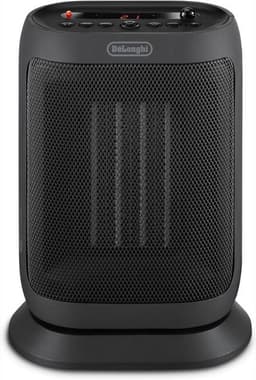
Most of these listings are 1,500 W, so the full-power hour is about 39.5p on the cap rate above. The Dreo DR-HSH020 is also sold as 1,500 W, with a specification table that says 120 V, so settle the plate before you worry about the pence. The Belaco's high setting is 1,400 W, about 36.8p an hour, and its 800 W step is about 21p. The two 2,000 W listings are the De'Longhi HFXR40T20.G and the Morphy Richards HeatFlux, both at £34.99, about 52.6p an hour. The De'Longhi states 230 V. The Morphy Richards does not. A lower step, such as 700 W on the KQPZ or 950 W on the FLANUR, only saves money while you are content with the heat.
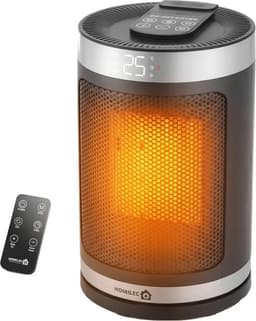
Homilec Homilec HL-003 1500 W

Testsieger

Homilec Homilec HL-003 1500 W
6.4/10about £28.99

What ECO and ceramic do not do

ECO does not change 26.32p per kilowatt-hour. On the Russell Hobbs, the Dreo Atom, the Pro Breeze, the FLANUR and the De'Longhi it aims at a set point, or changes fan speed. While the element is on high, you pay for high. While it is off, you pay nothing for the element. Heater type does not beat wattage, and there is no measured percentage saving to copy from a thermostat. Ceramic and PTC do not create a cheaper unit of electricity either. A 1,500 W ceramic element costs the same per hour at full output as any other 1,500 W electric element. The order of plug, watts and timer is the fan heater with remote control buying guide.

How to use the figure

Three hours at full 1,500 W is about £1.19. Two hours at full 2,000 W is about £1.05. The shelf price does not change the hour. The Belaco at £15.99 is about 37p an hour on its 1,400 W high setting, against about 39.5p for a 1,500 W heater. Who should skip it for other reasons is on the best fan heater with remote page. Set a timer so the ceiling has an end, and do not treat it as a reason to sleep with the heater running. None of these figures is an A–G energy label.

Common questions

How much is 1,500 W per hour right now?
About 39.5p an hour at full output, on Ofgem's average Direct Debit rate of 26.32p per kWh for England, Scotland and Wales, from 1 October to 31 December 2026. The sum is 1.5 times 26.32p, which is 39.48p. It excludes the standing charge. If your unit rate is different, multiply 1.5 by the figure on your bill. The result is a ceiling for an hour in which the element never switches off.
How much more is 2,000 W?
About 13p more per hour at full power on that same rate: about 52.6p rather than 39.5p. Over two hours of continuous high output the 2,000 W heater is about £1.05 and the 1,500 W heater is about 79p. In this set the De'Longhi and the Morphy Richards are the 2,000 W listings. The extra cost is the watts, and it only applies while the element is drawing 2,000 W.
Does ECO mode make it cheaper per unit?
No. Eco aims the heater at a set point, or changes the fan, depending on the listing. The Russell Hobbs, Dreo Atom, Pro Breeze, FLANUR and De'Longhi all use that kind of mode. The price of each kilowatt-hour stays 26.32p on the cap rate used here. You pay less only for the minutes the element is off or on a lower step. There is no fixed percentage saving to quote.
Does ceramic cost less to run than a coil?
Not at the same wattage. A ceramic or PTC element at 1,500 W costs the same per hour at full output as any other 1,500 W electric heat. The word ceramic describes the block the air passes over. It is not a tariff. A thermostat can cut the cost by cycling, and that depends on the room, not on the element's marketing name.
What if I am on a fixed tariff?
Use the unit rate on your bill instead of 26.32p. A fix signed earlier may be lower or higher than the October 2026 cap, and a prepayment meter can differ again. The method does not change: kilowatts times your pence per kilowatt-hour, only while the element is drawing that power. Northern Ireland is not covered by this GB average even on the standard cap.
Is the £15.99 heater cheaper to run than the £50 one?
Only if it draws fewer watts, or it runs for less time. The Belaco at £15.99 is about 37p an hour on its 1,400 W high setting, against about 39.5p for any 1,500 W heater, including the £49.99 Dreo Atom. That is a few pence, not a different kind of heat. Left on high, a cheap heater costs the same as any other heater of the same watts. One Belaco reviewer returned theirs because of the electricity use.

Related pages

Sources

Public UK sources for the plug, clearance, the room-heater identifier, and the unit rate. Listing prices, stars, and review counts are the amazon.co.uk figures in this set. Shelf date 19 October 2026.

  1. Ofgem — Changes to the energy price cap, 1 October to 31 December 2026 (retrieved 19 October 2026)
  2. Electrical Equipment (Safety) Regulations 2016, regulation 35 (retrieved 19 October 2026)
  3. BSI — BS EN 60335-2-30 room heaters (retrieved 19 October 2026)
  4. Electrical Safety First — Portable heaters (retrieved 19 October 2026)
  5. Hertfordshire Fire and Rescue — Portable heater safety (retrieved 19 October 2026)
  6. West Midlands Fire Service — Heating premises and bathroom use (retrieved 19 October 2026)
  7. Quiet Mark — How Quiet Mark certifies products (retrieved 19 October 2026)
  8. Consumer Rights Act 2015, section 22 (retrieved 19 October 2026)