Independent comparisons. We may earn from shop links. More info

Ceramic fan heater buying guide

Updated: 21 October 2026

You are looking at a row of near-identical boxes on amazon.co.uk, and the titles all say ceramic, quiet and energy efficient. A ceramic fan heater buying guide for a UK room starts with the plug and the watts, then the thermostat and the timer, then the cut-outs, and only then the brand story. The [ceramic fan heater comparison](/hub/portable-heaters/ceramic-fan-heater) holds the twelve rows, with prices and review counts from the listings on 19 October 2026. This page is the order of those checks. Running cost, and the choice between a fan heater and an oil-filled radiator, each have their own page.

You are looking at a row of near-identical boxes on amazon.co.uk, and the titles all say ceramic, quiet and energy efficient.

Our top picks

On this page

Start with the plug and the watts

UK mains are 230 V, and a portable heater belongs on a BS 1363 three-pin plug in a wall socket. Electrical Safety First asks for a proper plug, a wall socket, and about a metre of clear space. The Dreo 16 inch, ASIN B0B1JCB1X2, lists 120 V, a Fahrenheit thermostat and a two-prong plug beside an 1800 W title, and one UK review says that unit arrived with a three-prong plug, so the page and the parcel can disagree. The worked figures for full power at Ofgem’s October 2026 rate are on the ceramic fan heater running cost page. The Centre for Sustainable Energy’s point still holds: the same watts cost the same, whatever the word ceramic is doing on the box.

Thermostat, timer and ECO

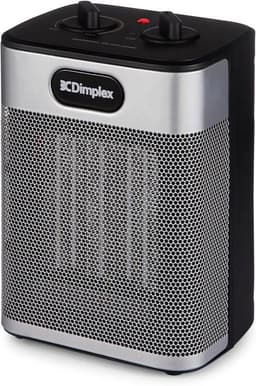
A thermostat saves money only while the element is switched off. ECO on a Dreo, or on the Amazon Basics tower, steps the heat. It is not a lower unit rate. A 12-hour timer on the white Dreo Atom stops the heater when you forget. A dial with no timer, on the Dimplex DXUC2BS, the Pro Breeze mini and both DAHTEC models, means you are the timer. The white and gold Atoms share opening reviews, so the higher price is not a second sample.
DREO Dreo Atom 316 1500 W (White)

Testsieger

DREO Dreo Atom 316 1500 W (White)
8.6/10about £42.49

Noise, oscillation and where it sits

Every heater in this set moves air with a fan, so every one of them makes noise. The 34 dB claim on three Dreo models was not measured here. Reviewers call the low Dreo setting quiet enough for television, which is not silence. Oscillation spreads the same heat past one direction. It does not add watts. The Pro Breeze mini prints 28 square feet beside a 2000 W claim. If a quiet evening matters more than a fast blast, the next decision is the type of heater, on the ceramic heater vs oil filled radiator page.

Cut-outs and rooms to avoid

Tip-over and overheat cut-outs are claimed on the Dreo models, the Dimplex, both Pro Breeze heaters, and both Amazon Basics heaters. They are not on the DAHTEC 2000 W feature line, and one UK review says that heater kept running when it was laid on its face. A cut-out is a last resort if the heater falls. Electrical Safety First still says not overnight, not for drying clothes, and not from an extension lead. No listing in the twelve states an IP rating. North Yorkshire Fire and Rescue’s advice is that a standard portable heater does not belong in a bathroom. The DQ075 bullet excludes bathrooms. Where the heater stands is on the how to use a ceramic fan heater page.

Common questions

How many watts do I need for one room?
For one person at a desk or a small bedroom you are sitting in, 1500 W is the step this set uses, as on the Dreo Atom. A colder or larger bedroom often moves to 1800 W or 2000 W, as on the Amazon Basics DQ075, the Dimplex and the Pro Breeze mini. The 2800 W DAHTEC is listed at 12.73 A and belongs in a workshop conversation, not a lounge. These are shopping bands from the listings, not a heat-loss calculation for your walls.
Is a ceramic element cheaper to run than another electric heater?
No. The Centre for Sustainable Energy’s advice is that an electric room heater turns the electricity it uses into heat, so a ceramic fan heater is not a cheaper unit of electricity than another electric heater of the same watts. PTC is the type of element. ECO is a control mode. Neither one changes Ofgem’s unit rate. Compare 1500 W with 1500 W, then decide on noise, a timer and the plug.
Do I need a thermostat and a timer?
You want a thermostat if the room can reach a temperature and you would rather the element cycled off. You want a timer if you might leave the room or fall asleep. The white Atom has both a 5–35 °C range and a 12-hour timer. The Dimplex has a dial and no timer. The Pro Breeze mini has a dial, and reviews say it has no timer and no remote. A dial alone is workable if you switch the heater off at the socket when you leave.
What if the listing says 120 V or a two-pin plug?
Treat that as a buying problem, not a footnote. The Dreo 16 inch spec block lists 120 V and a two-prong plug, while one UK buyer reported a three-prong plug in the box. Check the unit you can see, or choose a listing that states 230 V or 220–240 V, such as the DQ075 or the gold Atom bullet. A 12.73 A workshop heater is a different problem: one review of the 2800 W DAHTEC mentions a 16 A fuse. Do not solve either issue with an extension lead.
Is tip-over protection on every ceramic heater?
No. It is claimed on the Dreo, Dimplex, Pro Breeze and Amazon Basics models in this comparison. It is not in the feature line of the 2000 W DAHTEC, and one review says that heater kept running on its face. The plug-in 1200 W listing does not state a tip-over cut-out either. Even where a cut-out is claimed, Electrical Safety First still says not to leave a portable heater on overnight.

Related pages

Sources

Public UK sources for the plug, clearance, the unit rate and the cost of electric heat. Listing prices, stars and review counts are the amazon.co.uk figures in this set. Shelf date 19 October 2026.

  1. Electrical Safety First — Portable heaters (retrieved 19 October 2026)
  2. Electrical Safety First — Bathroom (retrieved 19 October 2026)
  3. Ofgem — Energy price cap, 1 October to 31 December 2026 (retrieved 19 October 2026)
  4. GOV.UK — Placing energy-related products on the UK market (retrieved 19 October 2026)
  5. GOV.UK — Updating standards for local space heating products (retrieved 19 October 2026)
  6. Centre for Sustainable Energy — Room heaters (retrieved 19 October 2026)
  7. Energy UK — Room heating calculator (retrieved 19 October 2026)
  8. North Yorkshire Fire and Rescue — Heating your home (retrieved 19 October 2026)