How to use a pool vacuum
The first pull brings up nothing when the head is still in the air, the bag is wrong, or the chamber dumps its load as you lift it. How to use a pool vacuum, for the hose jets and cordless sticks here, is a short sequence: dry charge, people out, head fully under, slow pass, lift so the dirt stays in. Which type you should have bought is the [pool vacuum comparison](/hub/pool-care/pool-vacuum). The Intex lift described below is from a different brand's manual. Listing lines are from 19 October 2026. This is not a lab test. If you buy through our links, we may earn a commission at no extra cost to you.
The first pull brings up nothing when the head is still in the air, the bag is wrong, or the chamber dumps its load as you lift it.
The first pull brings up nothing when the head is still in the air, the bag is wrong, or the chamber dumps its load as you lift it. How to use a pool vacuum, for the hose jets and cordless sticks here, is a short sequence: dry charge, people out, head fully under, slow pass, lift so the dirt stays in. Which type you should have bought is the pool vacuum comparison. The Intex lift described below is from a different brand's manual. Listing lines are from 19 October 2026. This is not a lab test. If you buy through our links, we may earn a commission at no extra cost to you.
Our top picks
| Badge | Product | What must be under water | Filter | Stated runtime | Note | Price | Offer |
|---|---|---|---|---|---|---|---|
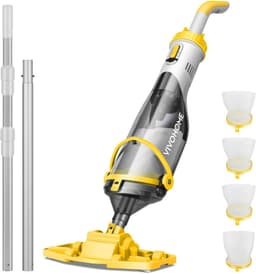
| Best overall |  VIVOHOME VIVOHOME handheld pool vacuum, yellow | n/a | 180-mesh and 300-mesh bags | 60 minutes | 8.6 | about £79.99 | View offer |
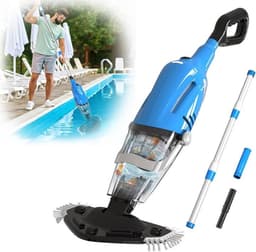
| Best value |  PoolyPoly PoolyPoly 1818 pool hoover, blue | Outlet under water | 1.5 litre basket | About 60 minutes | 8.4 | about £59.99 | View offer |
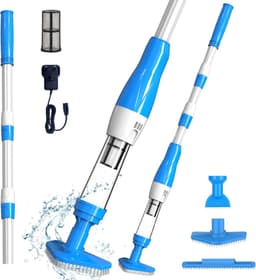
| Alternative |  PoolyPoly PoolyPoly 1814 spa vacuum, blue | Starts at 30 cm | Mesh filter | About 90 minutes | 8.4 | about £59.99 | View offer |
On this page
Charge it dry, and keep swimmers out
Put the head fully under and fit the finer bag for sand
Move slowly, then lift so the dirt stays in
If it still will not suck
Common questions
Do I switch it on before it is under water?
How do I stop dirt falling back in?
Which bag is for sand?
Can I vacuum algae with it?
What if the garden-hose head has no suction?
Related pages
Sources
Public UK sources from the research digest, read with the amazon.co.uk rows on 19 October 2026. Listing prices, stars and review counts are from those rows, not from a later scrape.
- SPATA — Swimming pool cleaning and accessories (retrieved 19 October 2026)
- SPATA — Using the water safely (retrieved 19 October 2026)
- HSE HSG179 — Health and safety in swimming pools (retrieved 19 October 2026)
- HSE — Electricity frequently asked questions (retrieved 19 October 2026)
- IET Wiring Matters — Section 702, swimming pools and other basins (retrieved 19 October 2026)
- Consumer Rights Act 2015, section 9 (retrieved 19 October 2026)
- GOV.UK — General Product Safety Regulations 2005, Great Britain (retrieved 19 October 2026)
- GOV.UK — Recycling batteries and electrical waste (retrieved 19 October 2026)