Independent comparisons. We may earn from shop links. More info

How to use pool test strips: seconds, light and white pads

Updated: 21 October 2026

You have the bottle in your hand, and a remembered 15 seconds may belong to a different brand. How to use pool test strips starts with the seconds printed on this bottle, because a match to the chart at the wrong moment is still the wrong reading. The examples are the amazon.co.uk listings in the [pool test strips comparison](/hub/pool-care/pool-test-strips) on 19 October 2026. We did not lab-test a pad. Which bottle to buy, if this one keeps failing, is on the [pool test strips buying guide](/hub/pool-care/pool-test-strips/sub/pool-test-strips-buying-guide). A qualifying purchase can earn a commission at no extra cost to you.

You have the bottle in your hand, and a remembered 15 seconds may belong to a different brand.

Our top picks

On this page

Read the bottle before you dip

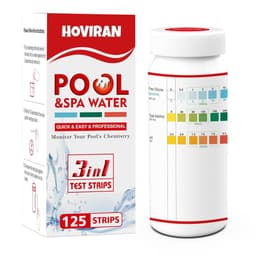
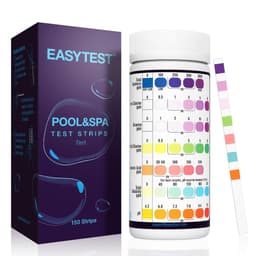
The bottles in this comparison do not share a clock. EASYTEST says a 1 second soak and a level hold for 15 seconds. Clearwater says remove the strip immediately and hold it level for 15 seconds. HOVIRAN says a 2 second dip and a 30 second wait. VivaTest says a 2 second dip, then 30–60 seconds. Nacerlary says a 2 second dip and 15–30 seconds. Dr.Tim.Wang says 15 seconds and a later bullet says 30. HLLNWB states a 2 second dip and does not state a wait. Canadian Spa and AquaChek yellow do not state a dip time in the saved fields. A UK review of EASYTEST says the pads keep changing after the stated 15 seconds, so you read at the printed moment. If your bottle says do not shake, as Clearwater's guide and the FIXINGS DIRECT listing both do, you do not shake.

Dry hands, level strip, daylight

Take the strip with dry fingers. Dip in still water, away from a return jet, and take the strip out in the time your bottle states. Hold it level so the pads do not bleed into each other. FIXINGS DIRECT says do not shake, hold for 15 seconds, and compare at once in natural light. A kitchen bulb shifts the blocks. Read the sanitiser pad on the bottle's schedule, then pH and alkalinity. Compare each pad with the chart on that bottle only. If the colour sits between two blocks, write the range, for example between 7.2 and 7.6, and do not invent a third number the chart does not show. BISHTA says follow the bottle and bin out-of-date strips. EASYTEST's 90 days after opening is a printed limit, not a limit you can paste onto Clearwater, whose listings do not state an opened life.

A white pad is not automatically zero

A chlorine pad that stays white looks like no chlorine and pushes people to shock the water. Fi-Clor's troubleshooting note, sold through a UK pool shop, says no colour on a chlorine test often means the residual is high enough to bleach the reagent. Clearwater's hot-tub guide gives the same warning. Target bands for a tub are on hot tub test strips. Fi-Clor describes a check when you suspect bleach-out: mix the pool water half and half with tap water, test the mixture, and double the reading. If that diluted test shows a colour, the original pad was bleached, not empty. Their leaflet also says do not bathe if free chlorine is above 10 mg/l. That line is theirs, and it is not a PWTAG target for a hypochlorite pool. Do not add more chlorine because the pad is white.

When the colour will not match

Sometimes the pad develops a colour and none of the blocks are that colour. UK reviews on Canadian Spa describe colours that run and strips that disagreed on one dip. HLLNWB reviews say the colours do not match the bottle. One AquaChek pH pad stayed on 6.8 while a PoolLab meter read 7.4. Two EASYTEST 7-way reviews doubted the cyanuric acid pad. Do not dose from the pad that will not sit on a block. If two methods disagree before a heavy dose, if bathers are ill and the water is suspected, or if you are about to add a large correction from a colour you cannot place, use a DPD tablet kit or a photometer. If the same bottle mismatches on every dip, replace it, and do not average this chart with last month's brand. Which bottle fits the job is on best hot tub test strips.

Common questions

How long do I leave the strip in the water?
Use the seconds on your bottle. In this set that might be a 1 second soak and a 15 second hold, a 2 second dip and 30 seconds, or 30–60 seconds. HLLNWB states the dip and not the wait. Canadian Spa and AquaChek do not state a dip time in the saved fields. A retailer’s 15 second habit is wrong for a bottle that prints a different window.
Do I shake it?
Only if your bottle says so. Clearwater’s guide and the FIXINGS DIRECT listing say do not shake. A US maker’s shake step is not an instruction for these bottles. Hold the strip level so the pads do not run into each other, then read at the stated second.
Why is the chlorine pad white?
It can mean very high chlorine bleaching the reagent, not zero. Fi-Clor describes a half-and-half dilution with tap water and doubling the reading, and says do not bathe above 10 mg/l free chlorine. Clearwater warns of the same bleach. Do not add chlorine because the pad is white. Dilute and retest, or use a tablet kit, before you dose.
Can I read it under a kitchen bulb?
You will struggle to match the blocks. FIXINGS DIRECT says compare at once in natural light, and a household bulb shifts the print. Take the strip to a window, and write a range if the colour sits between two blocks.
When do I stop and use a tablet test instead?
When the pad is white and you suspect bleach-out, when two strips from the same dip disagree, when a meter and the strip disagree before a heavy dose, or when the water is part of a commercial or let-tub regime. Lovibond points commercial testing at DPD tablets or a photometer. A second strip from a damp bottle repeats the same error.

Related pages

Sources

Public UK sources for pool and spa water targets, taken from the research digest. Listing prices, stars and review counts are from amazon.co.uk on 19 October 2026. No bottle here is a PWTAG approval.

  1. HSE — swimming pool safety (retrieved 19 October 2026)
  2. PWTAG code of practice (retrieved 19 October 2026)
  3. PWTAG standards (retrieved 19 October 2026)
  4. HSE — HSG282, control of legionella and other infectious agents in spa-pool systems (retrieved 19 October 2026)
  5. BISHTA — water treatment (retrieved 19 October 2026)
  6. BISHTA — daily, weekly, monthly and annual hot tub checks (retrieved 19 October 2026)
  7. Lovibond UK leisure — water testing (retrieved 19 October 2026)
  8. Amazon.co.uk best sellers — Pool & Hot Tub Testers (retrieved 19 October 2026)