Independent comparisons. We may earn from shop links. More info

Chlorine granules for a hot tub

Updated: 21 October 2026

A pool tablespoon is the wrong tool once the water is a 1,200-litre spa at 38 °C with the cover on. Chlorine granules for a hot tub are still dichlor if the tub says so, and the daily residual sits higher than a garden pool’s 1–3 ppm. You measure in grams for about 1,000–1,500 litres, you pre-dissolve, and nobody soaks until a test is back in range. This is not the 5,000-litre shock sketch. Bucket steps are on [how to use chlorine granules](/hub/pool-care/chlorine-granules/sub/chlorine-granules-how-to-dose). Prices are on the [chlorine granules comparison](/hub/pool-care/chlorine-granules). A qualifying purchase can earn a commission at no extra cost to you.

A pool tablespoon is the wrong tool once the water is a 1,200-litre spa at 38 °C with the cover on.

Our top picks

On this page

The residual is not the pool’s 1–3 ppm

BISHTA’s water-treatment sheet puts daily chlorine in a hot tub at 3–5 mg/l. The daily-checks sheet is more precise: organic chlorine, which includes dichlor and trichlor, at 3–5 mg/l, and inorganic chlorine at 2–4 mg/l, with pH at 7.0–7.6. If your sanitiser is dichlor granules, the organic band is the one those sheets name. A pool label that says 1–3 ppm is a different vessel. Holding a spa at 1 ppm because the pool tub says so leaves the water short of the spa guidance. Your own label can print a different band, and then that label wins. Zagosa’s 5 kg bullets print 1–3 ppm for pools and 3–5 ppm for hot tubs. Total Pool’s SP102 label has used a maintain band of 2–4 ppm, which is not BISHTA’s 3–5 mg/l. Do not average them into about 3 ppm. Free chlorine is the reading after the jets have mixed the water. If a stabiliser test is already high, more dichlor is the wrong correction, because cyanuric acid stays in the spa.

Measure for a small volume

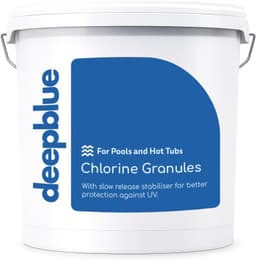
Total Pool’s SP102 consumer label gives one spa example: 5 g per 1,000 litres to raise free chlorine by about 2.5 ppm. On that label, 1,000 litres needs about 5 g and 1,500 litres about 7.5 g. Weigh it. A heaped tablespoon from a pool chart is several times that spa dose. If your tub prints 2 g or 4 g per 1,000 litres, the tub wins. Pre-dissolve those grams in a jug of spa water, pour the solution in with the jets running, and leave the cover off while you test. Five grams still visible in the jug are not a 5 g dose in the water. CUQOO reviewers who left solids on a seat found them the next morning. A spa you drain will rarely finish 5 kg before the granules cake. In this set, 1 kg tubs cost £7.95 to £20.00. aBalchemy’s 1 kg listing is the one that states 56% dichlor. Deep Blue leaves hot-tub use as a question on the page.

Shock, the cover, and granules on the seat

A daily top-up and a shock are different jobs. BISHTA’s cloudy-water sheet says sodium dichlor may be taken up to about 20 ppm with the cover off, then you wait until the level has fallen before anyone bathes. The fresh-fill shock of 20 ppm for about 2.5 hours on the water-treatment sheet is written for calcium hypochlorite, and bathers go back in only under 10 ppm. Those are shock procedures, not the Tuesday teaspoon. The cover stays off for a chlorine shock, so a closed cabin is not holding the vapour. Granules left on a seat are a reason to stop. CUQOO’s file includes a chemical-burn report from granules still on a hot-tub seat the next morning. Dissolve first, and do not brush grains off with a wet hand. If the manual bans trichlor tablets, BISHTA records that some makers void the warranty, and the floater stays on the garden pool.

What to do before anyone soaks

If the label includes spas and the powder is dichlor, use a spa residual, often 3–5 mg/l for organic chlorine, and a weighed gram dose for about 1,000–1,500 litres. If your tub prints a different band or a different gram rate, that tub wins. If the cover is on during a shock, take it off until a test is back in the daily band. If grains are still on the seat, nobody soaks. A 5 kg pool tub that never names a hot tub is the wrong default for a spa you drain.

Common questions

Can pool chlorine granules go in a hot tub?
They can when the label includes spas or hot tubs and the powder is dichlor, not calcium hypochlorite. You then use a spa residual, often 3–5 mg/l for organic chlorine on BISHTA’s daily checks, and a gram dose for about 1,000 litres. Zagosa’s 5 kg bullets print 3–5 ppm for hot tubs. Deep Blue asks the hot-tub question and does not answer it in the bullets.
What free chlorine should a home spa sit at?
BISHTA’s daily-checks sheet says 3–5 mg/l for organic chlorine such as dichlor, and 2–4 mg/l for inorganic chlorine, with pH at 7.0–7.6. A pool label’s 1–3 ppm is a pool band. Total Pool has printed 2–4 ppm as a maintain range on an SP102 label, which is not the same sentence as BISHTA’s 3–5. Follow the tub in your hand if it prints a range, and confirm with a test.
How much is a dose for about 1,000 litres?
On Total Pool’s SP102 consumer label, about 5 g per 1,000 litres raises free chlorine by about 2.5 ppm, so 1,500 litres is about 7.5 g on that same line. That is a label example, not a BISHTA dose. If your tub prints a different gram rate, use that rate, weighed, and pre-dissolved. A pool tablespoon is the wrong unit in this volume.
Do I shock a spa with the same granules?
You can, if the label allows a high dose of that dichlor. BISHTA’s cloudy-water sheet allows sodium dichlor up to about 20 ppm with the cover off, then a wait until the level falls. The 20 ppm fresh-fill timed for 2.5 hours on the water-treatment sheet is calcium hypochlorite, with bathing only under 10 ppm. A daily 3–5 mg/l top-up is not a shock.
Should the cover stay on after a shock?
Leave it off while chlorine is at shock level, so the cabin is not holding a high residual and the vapour. Run the jets to mix a pre-dissolved dose, then test. People get back in when the reading is down in the daily band, not when the cover has been on for an hour. A normal top-up still needs a test before anyone soaks.
What if granules are still on the seat?
Get out, and do not brush them off with a wet hand. CUQOO’s review file includes a chemical-burn report from granules still on a hot-tub seat the next morning. Dissolve the dose in a jug until it is clear, and wipe away any grains you can see. If skin is already burned or eyes are affected, use the label’s emergency wording and get medical help.

Related pages

Sources

Public UK sources used for this page in October 2026. Shelf prices and star lines are the amazon.co.uk figures for these eight listings.

  1. HSE: Swimming pools (retrieved 21 October 2026)
  2. HSE: Biocides, product type 2 (retrieved 21 October 2026)
  3. PWTAG: Code of Practice (retrieved 21 October 2026)
  4. Total Pool: SP102 stabilised chlorine granules safety data sheet (retrieved 21 October 2026)
  5. BISHTA: Water treatment (retrieved 21 October 2026)
  6. Hydrospares: The facts about stabilised chlorine granules (retrieved 21 October 2026)
  7. Clearwater: Why pre-dissolve granules (retrieved 21 October 2026)
  8. PoolStore: What is available chlorine? (retrieved 21 October 2026)