Independent comparisons. We may earn from shop links. More info

Stabilised chlorine granules: how to choose a tub

Updated: 21 October 2026

You are looking at two white powders that both say chlorine, one for a 3,000-litre above-ground pool and one that might be shock. Stabilised chlorine granules are the dichlor you pre-dissolve for a measured top-up. This page is about the words on the tub, not a ranking of the eight amazon.co.uk listings. Prices and star lines sit on the [chlorine granules comparison](/hub/pool-care/chlorine-granules). You should leave knowing whether a 1 kg spa tub or a 5 kg pool tub fits, and which chemical name has to appear before you pay. Listings were read on 19 October 2026, with no lab test. A qualifying purchase can earn a commission at no extra cost to you.

You are looking at two white powders that both say chlorine, one for a 3,000-litre above-ground pool and one that might be shock. Stabilised chlorine granules are the dichlor you pre-dissolve for a measured top-up.

Our top picks

On this page

What stabilised chlorine granules are

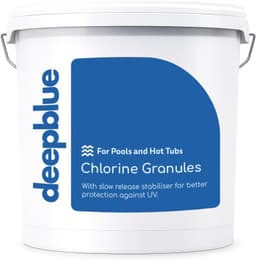
Stabilised chlorine granules, in the UK retail sense, are usually sodium dichloroisocyanurate, also sold as troclosene sodium dihydrate. Hydrospares says the label should name that dichlor, because the powder already carries cyanuric acid, which slows sunlight from stripping chlorine out of an outdoor pool. PoolStore puts dichlor at about 55% available chlorine, trichlor tablets at about 90%, and calcium hypochlorite shock at 65% or more. Only aBalchemy’s 1 kg listing in this set prints a figure, and it says 56%. Treat about 55% as a retailer rule of thumb. Cyanuric acid stays after the chlorine is used. A managed pool under the PWTAG code, which the Health and Safety Executive points to for commercial pools, keeps it at no more than 150 mg/l, with free chlorine at 2.5–5 mg/l where chlorinated isocyanurates are the sanitiser. A domestic label more often says 1–3 ppm. Dichlor is not calcium hypochlorite. The SP102 sheet says contact with acids liberates toxic gas. Deep Blue’s 5 kg titles say stabilised and print no percentage. Zagosa’s titles never say it. What that does to each listing is on the best chlorine granules page.

1 kg or 5 kg

Pack size follows the litres, then the price. A hot tub of about 1,000–1,500 litres, drained on a schedule, rarely needs 5 kg. In this set a 1 kg tub costs £7.95 to £20.00. A 5 kg tub costs £22.00 to £27.99, about £4.40 to £5.60 per kilogram. The large tub is cheaper chlorine per kilo only when a pool will use it before the powder cakes in a damp shed. A 10-foot easy-up pool dosed through July matches five kilograms. Deep Blue’s £22.00 listing with 40 reviews is about £4.40 per kilogram. The weekend spa is the 1 kg case. aBalchemy at £8.99 states 56% and names cyanuric acid. Zagosa’s 1 kg at £7.95 does not say stabilised. The extra £1.04 buys a named dichlor on the listing, and three short reviews are still a thin check. ChlorineXpress at £27.99 says stabilised, names spas, and has one review.

What the label still has to say

Read four lines before the tub goes in the basket. You want stabilised, or sodium dichloroisocyanurate or troclosene sodium. You want a percentage only when it is printed, so high-strength stays a slogan. You want pool, spa, or both named. Shock or calcium hypochlorite must not share a scoop with dichlor. Zagosa’s 1 kg and 5 kg both say granules for hot tubs, spas, and pools. The 5 kg bullets print 1–3 ppm for pools and 3–5 ppm for hot tubs, and they still do not say stabilised. PristiClear at £20.00 for 1 kg also omits that word, and many review texts describe tablets. A star line cannot fill in a chemical the title never names. If the parcel arrives and the tub still does not say dichlor or stabilised, the shopping is unfinished. Stabilised does not replace a test. Smell is not a reading. Perfect pH on a Deep Blue bullet is a slogan: one reviewer still needed other chemicals.

When the label and the litres agree

If an above-ground pool will use several kilograms through a warm spell, compare 5 kg tubs whose titles say stabilised, and keep the lid shut. If the vessel is a spa you drain, start at 1 kg and require the chemical name. If the title says shock or calcium hypochlorite, it does not share a bucket with dichlor. If stabilised is missing, read the tub in the parcel before the first scoop.

Common questions

What chemical should the label name?
Look for stabilised chlorine granules, sodium dichloroisocyanurate, or troclosene sodium. That is dichlor with cyanuric acid already in the powder, which is what shops sell for outdoor pools. PoolStore puts dichlor at about 55% available chlorine. aBalchemy is the only listing in this set that prints a number, and it says 56%. If the title only says chlorine granules, you still do not know which powder is in the tub.
Are shock granules the same product?
Calcium hypochlorite is a different shock granule. PoolStore puts that chemistry at about 65% available chlorine or more, and it must not share a bucket with dichlor. Some labels allow stabilised dichlor as a light shock, and Hydrospares still describes dichlor as a weak shock next to cal-hypo. The word shock on its own is a prompt to read the chemical name.
Is 5 kg better value than 1 kg?
Per kilogram, the 5 kg tubs in this amazon.co.uk set cost about £4.40 to £5.60, and the 1 kg tubs cost £7.95 to £20.00. The large tub is the better spend when a pool will use it before moisture gets in. A spa you drain is usually a 1 kg job, even though each kilogram costs more.
Does stabilised mean I can skip a test?
It means the powder contains cyanuric acid, so sunlight destroys the chlorine more slowly. It does not tell you today’s free chlorine or pH. You still test, and you stop adding dichlor if cyanuric acid is already high, because the stabiliser stays behind when the chlorine is used up. A chlorine smell is not a reading.
Will dichlor raise pH the way some liquid chlorine does?
Shops sell dichlor as close to neutral on pH. That claim is separate from a measured result. Deep Blue’s bullets say perfect pH and print no pH number, and one reviewer still used other chemicals to balance the water. Test pH after dosing, and follow the range printed on your own tub.
What if the listing never says dichlor?
Treat the chemical as unknown until you read the tub in the parcel. Zagosa’s 1 kg and 5 kg listings never say stabilised, and PristiClear does not either. You can still order them. A review score does not supply the missing name. The comparison shows which of the eight listings print the word and which leave it out.

Related pages

Sources

Public UK sources used for this page in October 2026. Shelf prices and star lines are the amazon.co.uk figures for these eight listings.

  1. HSE: Swimming pools (retrieved 21 October 2026)
  2. HSE: Biocides, product type 2 (retrieved 21 October 2026)
  3. PWTAG: Code of Practice (retrieved 21 October 2026)
  4. Total Pool: SP102 stabilised chlorine granules safety data sheet (retrieved 21 October 2026)
  5. BISHTA: Water treatment (retrieved 21 October 2026)
  6. Hydrospares: The facts about stabilised chlorine granules (retrieved 21 October 2026)
  7. Clearwater: Why pre-dissolve granules (retrieved 21 October 2026)
  8. PoolStore: What is available chlorine? (retrieved 21 October 2026)