How to shock an above-ground pool without guessing

How to shock an above-ground pool: test first, follow the label, brush and filter. The 5 mg/l overnight figure is a managed-pool reference, not a gram dose.
On this page

When an above-ground pool turns dull or its chlorine reading collapses, shock it sounds like a complete instruction. It is not. To shock an above-ground pool is to make a deliberate, temporary chlorine raise, while brushing, circulation and filtration do the physical work that chlorine cannot. The safe method starts with testing and the chemical label, not a guessed scoop copied from a pool of another size.
This page uses PWTAG's algae response for managed pools, Palintest's ordinary free-chlorine figure, the UK Kleen Pool directions named below, and the Relax tablet listing on amazon.co.uk. It is not a lab treatment of a garden pool. A purchase through our links can earn a commission at no extra cost to you.
In short
Pool shock is a corrective chlorine treatment, not a replacement for your pump or filter. PWTAG gives 5 mg/l free chlorine overnight as an algae response for managed pools, but that is a reference rather than a universal gram dose for a garden frame pool. Never mix a separate algaecide and chlorine product together in a bucket.
What pool shock means
Shock describes the result you are trying to create: a higher free-chlorine level for a treatment period. It does not identify one chemical format, one scoop size or one dose that works in every pool. Your pool volume, present free-chlorine reading and the concentration of the product all affect how much chemical would be required. This guide does not contain a supported UK gram-per-litre recipe.
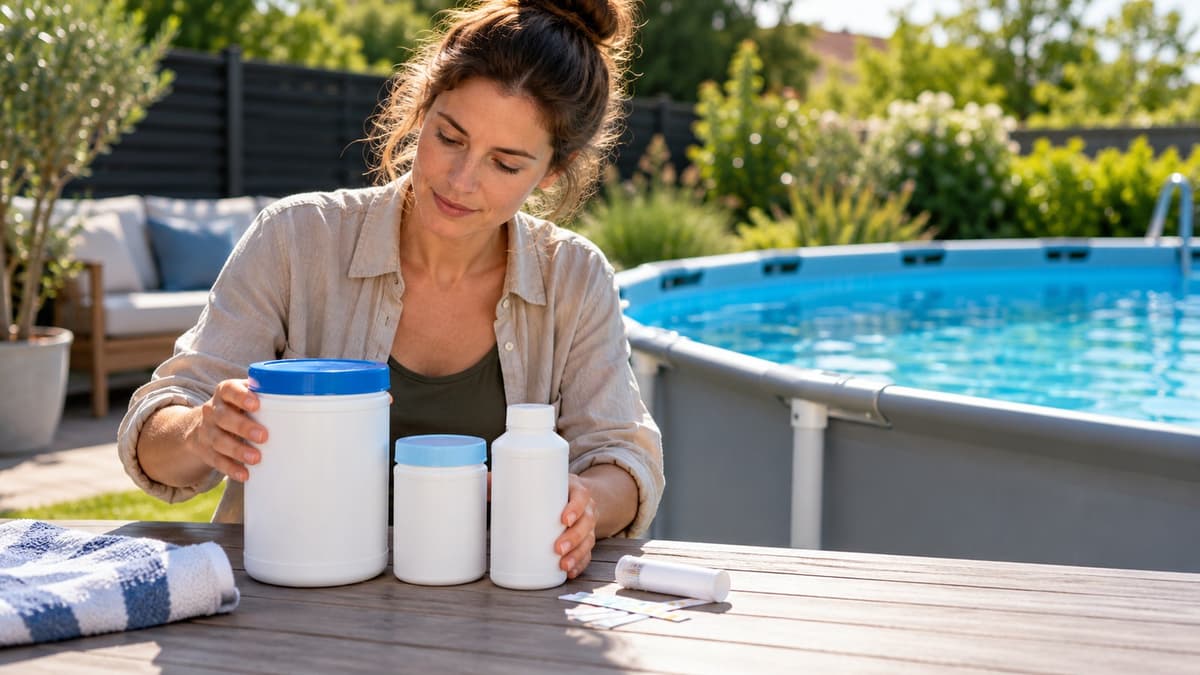
That distinction matters if the only chlorine you own is in tablet form. Chlorine tablets for pools are ordinarily chosen for ongoing sanitation, so they should not be treated as an improvised shock dose merely because they contain chlorine. The featured Relax tub contains 200 g multifunction tablets and names trichloroisocyanuric acid, stabiliser, algaecide and clarifier. Its amazon.co.uk listing does not give a shock dose, and no floater is included, at about £26.99 with 4.6 from 264 reviews. Neither the tablet weight nor that review line tells you how to perform this treatment.
Normal residual and shock level are different ideas. The Palintest material places free chlorine near 1.0 mg/l in a well-designed UK pool as an ordinary operating figure. That is context, not a target for every garden pool and not evidence that one tablet will correct green water. Read the instructions supplied with your pool, test kit and chemical.
The 5 mg/l overnight reference
The firmest treatment number here is PWTAG's advice for algae: raise free chlorine to 5 mg/l overnight, scrub affected surfaces and ensure turnover. PWTAG writes for managed pools, so treat the number as an algae response in that setting, not as a ready-made Bestway, Intex or other frame-pool recipe.
The unit is a concentration measured in the water. It is not the same thing as putting 5 g of product into a pool, because products have different active concentrations and your starting reading may not be zero. Without a label-supported calculation, converting 5 mg/l into scoops is unsupported. This guide stops short of telling you a weight.
pH adds another reason not to dose blindly. PWTAG notes that each 0.5 rise in pH roughly doubles chlorine demand in its Code of Practice context. Test the water and correct it according to the relevant labels. A high reading can make a chlorine treatment appear weak even when you added what seemed like plenty. If the label sets a different range, follow it. If it does not cover your pool volume, do not fill the gap with a US calculator or a social-media recipe.
How to shock an above-ground pool
Treat the job as a measured sequence. Keep children and swimmers out while you work, avoid combining products, and use only the handling method printed on the container. These steps organise the supported actions without inventing a dose or a swim-wait time.
- Test free chlorine rather than relying only on colour or smell. Dull water and a crashed reading fit this guide. If you cannot measure the water, get a suitable test before a high-chlorine treatment.
- Check the volume for your pool model and whether the shock product covers it. Read whether the label requires direct application, separate pre-dissolving or another method. Do not transfer advice from one granule or tablet to another.
- Check circulation before you add chemical. Look for weak return flow, a blocked intake or a filter that needs attention under its own instructions. A chlorine rise cannot remove suspended debris by itself.
- Apply only the labelled amount, with the dedicated measuring tool kept away from tools used for other chemicals. Do not copy a gram figure from a different formulation, and do not add a separate algaecide to the same bucket.
- Brush the floor, wall seams, steps and sheltered areas. PWTAG couples the overnight chlorine raise with scrubbing so attached growth meets treated, circulating water. Brushing can make the pool look cloudier for a while.
- Keep the water circulating for the treatment period on the pump, filter and chemical labels, and check that the return stays active. Filtration should be on. There is no single number of hours for every garden pool.
- Retest after that interval and use the result rather than adding another dose automatically. Swimming waits until the label permits it and testing confirms the specified range.
Testing, chemical application, brushing and filtration each have a different job. Repeating the chemical step will not correct a blocked filter or a missing water reading.
Why brushing and filtration still matter
Chlorine acts in the water, but it does not lift every deposit from a liner or carry suspended material out of the pool. PWTAG's algae response includes scrubbing and turnover alongside the 5 mg/l overnight rise. Brush reachable surfaces and keep circulation through the filter. A dose will not produce clear water on its own.
Inspect flow before blaming the chemical. A weakened return, a dirty cartridge or a circulation gap can leave treated water moving poorly around the frame. Follow the equipment instructions for checking and cleaning the filter. The sand filter guide explains that circulation option. It is not a chemical cure.
Cloudiness after brushing may mean that material is now suspended. The filter still has to collect it, and it may need attention as the load rises. Do not keep adding shock while the circulation problem remains. A clean filter cannot create free chlorine, and high chlorine cannot replace a functioning filter.
Shock, then algaecide
Separate chlorine shock from any additional algaecide. The Pool & Spa Centre page for Kleen Pool says never to mix that product with chlorine products. A UK review describes shocking one day, adding algaecide the next and leaving the filter on. That sequence is useful, and it is not a timetable for every brand. The how to use pool algaecide page keeps the order on the bottle.
Do not pour shock granules and a separate algaecide into one bucket, do not combine their measuring tools, and do not add them together unless the labels for those exact products explicitly authorise it.
Product directions can conflict. One Kleen Pool source says to hold chlorine at 1–3 mg/l before that algaecide, while another retailer says to raise chlorine to 6 ppm. Neither figure should be borrowed for an unrelated bottle. Check the container in your hand. A tablet that already lists algaecide is not the same as mixing an algaecide concentrate with a shock chemical. For the separate category, see the pool algaecide comparison.
When the water does not clear
If the pool remains green or cloudy, retest free chlorine, confirm that water is circulating, brush remaining deposits and inspect the filter. A second blind shock dose may raise chlorine again without fixing poor turnover, an unsuitable pH or debris that still needs removing. A routine residual near 1.0 mg/l and PWTAG's 5 mg/l overnight algae response are different readings. Your label sets the return-to-use conditions.
If you have no test kit, stop guessing. You cannot confirm the starting point, the treatment level or a safe return by looking at the water, and there is no fixed number of hours after which swimming becomes safe. The sources support a corrective raise for an algae problem, not a weekly timetable for every above-ground pool.
Common questions
What does shock mean if I only have chlorine tablets?
Is 5 mg/l the right shock level for my Bestway pool?
Can I pour shock and algaecide together?
How long should I run the pump after shocking?
Why is my pool cloudy after shock?
When can I swim after shocking the pool?
Should I shock my above-ground pool every week?

Peter F. is the editor for DIY & tools at productscompared.co.uk. Comparisons in this category are checked against amazon.co.uk listings, review evidence and public UK sources.
Related articles

Green pool water: what to do first
Work out whether to brush, circulate, treat or empty a green garden pool.
What pool chemicals cost for a summer
Separate the seasonal cost of sanitiser, algaecide and water testing.
Algaecide or chlorine tablets
See why routine sanitiser and additional algae control do different jobs.