Independent comparisons. We may earn from shop links. More info

Rivet nut hole size

Updated: 16 October 2026

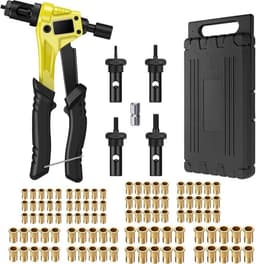
The drill is in your hand, the panel is marked, and a forum post has told you that M6 means a 9 mm hole. Rivet nut hole size is not a property of the pliers. It is a property of the nut you are about to set, and two UK sellers can print two diameters for the same thread. The [rivet nut pliers comparison](/hub/pliers/rivet-nut-pliers) does not choose a drill bit. The figures below are maker charts, not the nuts in an amazon.co.uk case. A qualifying purchase can earn a commission at no extra cost to you.

The drill is in your hand, the panel is marked, and a forum post has told you that M6 means a 9 mm hole. Rivet nut hole size is not a property of the pliers.

Our top picks

On this page

The hole is a property of the nut

The pliers pull a mandrel. They do not decide the drill. PEM Europe publishes a hole for its own standard round bodies: M3 at 5.1 mm, M4 at 6.1 mm, M5 at 7.1 mm, M6 at 9.1 mm, M8 at 11.1 mm, M10 at 13.1 mm and M12 at 16.1 mm, each ±0.1 mm. An undersized hole will not let the nut set, and an oversized hole loses grip. That list is one maker's round body, not the nut in a £30 kit. The same thread moves when the body changes. Westfield Fasteners lists a flat knurled open nut with an M6 hole of 9.0 mm. Orbital Fasteners lists a thin-sheet M6 steel nut at 9.6 mm, and a flanged M6 at 9.1 mm. Challenge Europe shows more than one grip row per thread, so M6 was never one hole. For M8, PEM's round body is 11.1 mm and Westfield's knurled open table shows 11.0 mm. A hex body needs a hex hole when the screw must not rotate the insert.

Grip range is the stack thickness

Grip range is the thickness that nut is designed to clamp, in millimetres on a serious packet and often missing from the nuts supplied with pliers. Measure the stack, not the single sheet you can see. Two panels, a gasket and paint all count if they sit inside the grip. PEM's advice is to work near the middle of the range. Too thick and the nut under-sets: the bulge never forms. Too thin and the nut over-sets: the thread distorts. You pick a nut whose printed grip covers the stack you measured. Take an M6 bracket on 1.5 mm steel. Westfield's knurled open chart gives an M6 grip of 0.5–3.0 mm and another of 3.1–5.0 mm, with a 9.0 mm hole on that table. The thin band covers a single 1.5 mm sheet. Add a second 1.5 mm plate and you are at 3.0 mm before paint. The kits here rarely state material or grip. Reviewers call some included nuts soft aluminium. Use them to learn the tool.

When the nut spins

A nut that spins after it looked set is usually the hole, the grip, or the body. An oversized hole gives the knurl nothing to bite. A thin sheet does the same if the grip was too short and the bulb never locked. A round body under a hard-tightened screw can rotate even when the set looked neat. Rivetwise, writing about thin sheet, names the wide hole and the wrong grip. The pliers cannot shrink a hole. If the hole is slightly tight, open it only if the packet's maximum still allows the next drill. If you are already over the packet, or over PEM's +0.1 mm on a PEM nut, stop. A larger nut of the same thread rarely repairs a round hole, because body and hole are a pair.

Check it on scrap

Cut an offcut of the same stack, including the gasket if you will have one. Drill the packet's hole, not a bolt clearance and not an average of PEM and Orbital. Set one nut. The flange should sit flat. A matching screw should start by hand. The nut should not rotate when you twist that screw lightly. If any of those fail, change the nut or the hole before you mark the panel. Then follow how to use a rivet nut tool: mandrel matched, nut level with the mandrel end, full close, mandrel unscrewed. A perfect 9.1 mm hole does not help if the case stopped at M6 and the insert is M8. If you cannot see behind a box section, or the panel is next to fuel, an airbag or a loom, do not discover the cavity with a drill.

Common questions

What drill bit for M6?
There is not one. PEM's round body is 9.1 mm ±0.1 mm. Westfield's knurled open nut on the table used here is 9.0 mm. Orbital's thin-sheet M6 steel nut is 9.6 mm. A 9 mm bit can be right for one of those and wrong for the others. Use the figure printed for the nut you are setting.
Is the hole the same for steel and aluminium nuts?
Not automatically. Material changes the pull, and the hole is still the body on that part number. A steel M6 and an aluminium M6 from different ranges can share a diameter or differ by several tenths. Read the line on the bag. The thread name alone is not the drill size.
What is grip range in millimetres?
It is the stack that nut is meant to clamp, for example 0.5–3.0 mm or 3.1–5.0 mm on Westfield's knurled open M6. Measure every layer the flange and the bulb will see, including a gasket. Below the minimum the nut over-sets. Above the maximum it under-sets. Aim for the middle of the band.
Do I add up two sheets?
Yes. Two 1.0 mm sheets are 2.0 mm before paint or a gasket. A nut sold for 0.5–1.5 mm is the wrong grip for that pair. Write the total down before you open the drill box. The outer panel on its own is not the stack.
Can the pliers fix a hole that is too big?
No. The tool pulls the mandrel. It does not move the edge of the hole inwards. If the diameter is already over the packet's maximum, change the fixing. Leaning on a short lever until the mandrel strips leaves the same hole and a damaged tool.

Related pages

Sources

Public UK sources and the amazon.co.uk listings in this comparison, checked on 15 October 2026. Shelf prices and star lines are the figures in the display file.

  1. Normandy Fasteners: rivet nut hand tools (retrieved 15 October 2026)
  2. Kennedy M3–M12 inserter manual (Cromwell PDF) (retrieved 15 October 2026)
  3. Sealey AK3984 / AK3985 instructions (retrieved 15 October 2026)
  4. PUWER 1998, regulation 4 (retrieved 15 October 2026)
  5. HSE: using the right type of PPE (retrieved 15 October 2026)
  6. JC Fasteners: blind rivet nut technical guide (retrieved 15 October 2026)
  7. Fixings Megastore: rivet tooling (retrieved 15 October 2026)
  8. amazon.co.uk listings for the eight ASINs in this comparison (retrieved 15 October 2026)