Independent comparisons. We may earn from shop links. More info

How to use water pump pliers

Updated: October 2026

You have the grips in your hand and a nut that will not start with fingers. How to use water pump pliers is a set, seat, turn and release sequence, not a harder squeeze. The [pipe pliers comparison](/hub/pliers/pipe-pliers) is the eight-row table. This page does not pick a winner. It teaches the motion for the joints in that set: box, slide, and push-button. If the setting jumps or the lock will not hold, stop. A collapsing adjuster on a live joint is a reason to switch tool or call someone, not a reason to lean harder.

You have the grips in your hand and a nut that will not start with fingers. How to use water pump pliers is a set, seat, turn and release sequence, not a harder squeeze.

Our top picks

On this page

The motion in four steps

Set the jaw on the workpiece first. Open the pliers, present the upper jaw to the nut or pipe, then bring the lower jaw in until the teeth sit on opposite sides of the round. The bite is two serrated faces on a curve, not a pinch on a flat. Seat the joint next. On a push-button pair, hold the button, slide the lower jaw until the teeth touch, then release the button and wiggle. On a box-joint or slide pair, open fully, move the pivot to the groove that lets the jaws close, then close. If the pivot still slides, you are not seated. Turn with the handles and keep the jaws square. A short pull that stays seated beats a long heave that opens the mouth. What changes is how the joint tells you it has caught. For which fittings this motion is the right idea, use water pump pliers for plumbing.

Push-button and push-lock

Press the button, slide the lower jaw, and feel for a click as the pin enters a hole. Stanley’s FatMax prints 17 PushLock positions. HAUTMEC, WORKPRO, SHALL, and KRETLAW sell the same idea. Wiggle the handles. The jaw should not walk to the next hole. If it does, you are between holes, or the pin is not home. Knipex’s Cobra then takes pressure on the upper handle and self-locks. That geometry is not a claim that SHALL or HAUTMEC will clamp the same way. One UK review of the HAUTMEC says the jaws only close fully on the lowest setting. WORKPRO’s mini file has a sticky button and one unit that broke within about ten minutes. Stanley’s button rusts if stored dry, and some units release under load. SHALL’s largest lock collapsed and crushed fingers. KRETLAW’s adjuster has broken on first use. If the button will not click, stop. A failed adjuster on first use is a Consumer Rights Act 2015 section 22 reject, not a reason to lean harder.

Box-joint and slide

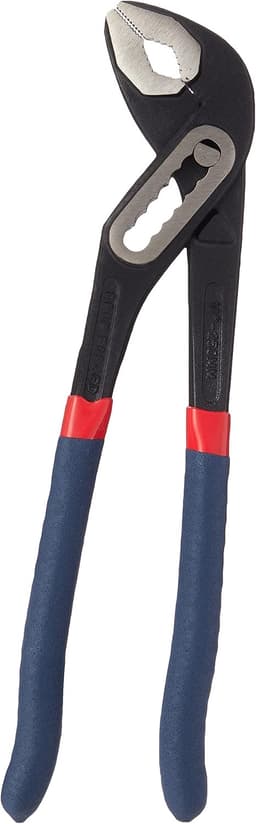
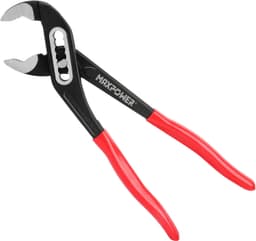
A box-joint pair, here the Blue Spot 250 mm, has a pivot that travels in a closed slot. Open the handles fully, slide to the groove that matches the nut, then close. The UK file says that setting locks and does not slip under pressure. The steps are coarser than a 17-position PushLock. A plain groove slide, here the MAXPOWER 250 mm, uses the same open, move, close sequence. One UK review says the locking grooves are shallow and the tool slips. Extra hand pressure will not make a shallow groove deeper. Reset one groove tighter, or switch pair. YAYODS claims a self-locking jaw on a three-length slide set. That is a bullet, and the handle covers in that file come off. If you are still choosing a joint, the water pump pliers buying guide is the spec page.

Marks, tape, and when to stop

Serrated teeth mark chrome, brass, copper, and soft plastic. Screwfix’s pliers guide suggests taping the jaws when you must not leave a scar. A cloth does the same job. None of the eight listings is a soft-jaw pair. A Draper nylon-jaw 245 mm exists on the UK trade shelf. It is not in this table. Compression nuts with flats want a spanner. Hold the valve body with grips and turn the nut with the spanner. Plastic wastes should go hand-tight first. A 250 mm lever on a thin trap is how you crack the thread. Stop if the joint will not hold, if the fitting is on gas, if you cannot isolate the water, or if a plastic stack may split. SHALL’s crushed-finger review is the pinch risk when a large lock collapses. Several of these listings do not name a pinch guard. When the work is iron pipe, use water pump pliers vs a pipe wrench.

Common questions

How do I set the jaw on a push-button pair?
Present the upper jaw to the work, press the button, slide the lower jaw until the teeth touch, release the button, then wiggle. If the jaw walks, the pin is not in a hole. Do not start the turn until the wiggle stays put.
How do I set a box-joint or slide pair?
Open the handles fully, move the pivot to the groove that lets the jaws close on the nut, then close and wiggle. Blue Spot’s box joint held in the UK file. MAXPOWER’s slide depends on groove depth. If it walks, reset or switch tool.
How do I stop the jaws jumping size?
Seat the joint before you pull. A push-button that sits between holes will jump. A slide with shallow grooves will jump under load. Extra squeeze does not fix either. Oil a Stanley button if rust is the reason it will not pin.
Will the teeth mark chrome or copper?
Yes. Tape the jaws, or use a cloth. Switch to a spanner on flats and to a strap or soft-jaw tool on visible chrome. These eight pairs are serrated grips.
What is self-locking supposed to feel like?
On a Knipex Cobra, pressure on the upper handle holds the setting. On HAUTMEC or YAYODS, self-locking is a bullet. Check it on scrap. If the jaw opens when you ease the handles, it is not locking.
What if the button stays in or collapses?
Stop loading it. A stuck WORKPRO button, a Stanley that releases under load, or a SHALL lock that collapsed is a failed adjuster. Reject a new tool under the 30-day right if it fails on first use. Do not finish a live joint with it.
Should I wrap the jaws?
Wrap them when the surface must stay unmarked: chrome taps, plated wastes, visible copper. Leave them bare on a rusty garden tap or a hidden steel nut you will not see. Tape is a shop tip, not a hardness upgrade.

Related pages

Sources

Public UK sources from the research digest. Shelf prices and star lines are the amazon.co.uk figures checked on 19 October 2026.

  1. ISO 8976:2021, multiple slip joint pliers (retrieved 19 October 2026)
  2. HSE: PUWER ACOP L22 (retrieved 19 October 2026)
  3. HSE: upper limb force guidance (retrieved 19 October 2026)
  4. Consumer Rights Act 2015, section 22 (retrieved 19 October 2026)
  5. Knipex: water pump pliers (retrieved 19 October 2026)
  6. BuildWiz: pipe wrench (retrieved 19 October 2026)
  7. PlumbRevise: choosing and using plumbing hand tools (retrieved 19 October 2026)
  8. Housewarm: water pump pliers (retrieved 19 October 2026)