Independent comparisons. We may earn from shop links. More info

Water pump pliers for plumbing

Updated: October 2026

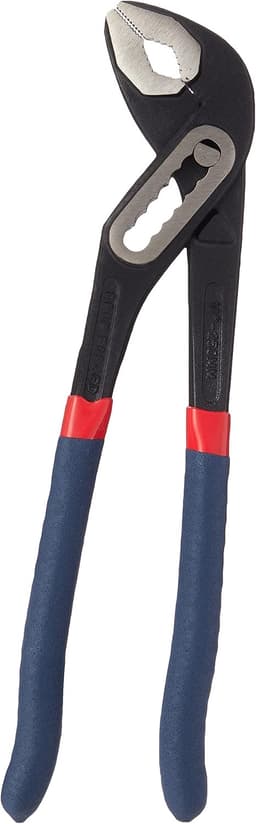
The cupboard under the basin is open, the waste nut will not start, and you do not want to mark the chrome you can see. Water pump pliers for plumbing are the grips that hold the awkward part while a spanner turns the flats. The [pipe pliers comparison](/hub/pliers/pipe-pliers) is the eight-listing table. This page is the job: wastes, traps, radiator valves, and the point where you stop. Teeth do not belong on a visible tap. The motion is on [how to use water pump pliers](/hub/pliers/pipe-pliers/sub/pipe-pliers-how-to-use). Here the question is whether that motion is even the right idea.

The cupboard under the basin is open, the waste nut will not start, and you do not want to mark the chrome you can see.

Our top picks

On this page

Jobs these pliers actually do

UK reviewers in this set used grips on a wash-basin waste (HAUTMEC), a 52 mm basin-waste back nut and a toilet seat (Blue Spot), TMVs and isolators (Stanley), plus garden taps and a 3/4 in joiner (MAXPOWER). SHALL’s file has a sink waste. That is the domestic list: nuts you cannot get a box spanner onto, in a cupboard. Stevenson Plumbing’s Silverline 300 mm note gives that trade pair a 50 mm jaw. Printed openings here are 25 mm, 32 mm, 42 mm, and 60 mm. A pump nut that wants 50 mm is a size problem, not a technique problem. Hold a trap body so the pipe does not twist. Hand-tight first on plastic. If the other tool is a Stillson, water pump pliers vs a pipe wrench keeps iron pipe off this list.

Radiator valves and compression flats

A radiator valve is two parts. The body can twist if you turn the union the wrong way. Housewarm’s method is the one to keep: hold the valve with grips, turn the nut with a spanner. If you put serrations on the compression nut, you round the flats and the next spanner slips. Lockshields and wheelheads both have that union. Isolate, then hold and turn. Wrap a chrome head, or leave it to a strap. Isolators and TMVs in the Stanley file are the same pattern. If the olive is seized, that is a plumber’s job once you have isolated, not a reason to chew the nut until it is round.

Chrome, copper, and plastic

Serrated jaws mark chrome, brass, copper, and plastic. A Draper soft-jaw 245 mm pair with nylon faces exists on Tooled-Up. None of these listings is that tool. Tape or a cloth is the workaround on a hidden nut. Visible mixer taps and plated traps are the fittings to protect. A garden tap is not. Plastic wastes should start by hand. A 300 mm lever on a thin coupling is how the thread strips. WRAS is a fitting-approval regime, not a mark on a plier. Soft jaws or a strap wrench first, then grips only on the part nobody sees.

Size for the nut in front of you

Measure the nut, then read the printed jaw. WORKPRO prints 25 mm: pocket fittings, not a waste. Blue Spot prints 32 mm. One UK review still turned a 52 mm waste nut. That review is not a rating. HAUTMEC prints 42 mm on 180 mm. Stanley prints 60 mm, the only single here that states a pump-nut kind of opening. MAXPOWER, SHALL, and KRETLAW do not print a clean millimetre jaw. If the job is a circulating-pump union, Stevenson’s 50 mm on a 300 mm trade pair is the benchmark this set mostly does not meet. Length versus jaw is the water pump pliers buying guide. Buy 250 mm for most cupboard work, 180 mm when the handle hits the back board. Do not buy the mini as your only plumbing pair.

When to stop and call someone

Stop if you cannot isolate the water, the leak is in the floor or the wall, or the fitting is on gas. None of these listings makes you Gas Safe. A seized radiator or cylinder connection is the other stop: a 300 mm lever on an old olive is how you tear a tail out of a board. A collapsing adjuster is a third stop. SHALL’s largest lock crushed fingers. KRETLAW’s large pair has snapped. Stanley’s button can release under load. A new pair that fails on first use is a Consumer Rights Act 2015 section 22 reject. Call a plumber when the plastic stack looks brittle, when the only access is through a sealed bath, or when you would need a cheater bar. The eight pairs are household grips, not a substitute for isolation and the right hex.

Common questions

Can I use water pump pliers on a basin waste?
Yes, on the back nut you cannot reach with a box spanner, if the printed jaw covers it. HAUTMEC’s UK file has a wash-basin waste. Blue Spot has a 52 mm nut in one review against a 32 mm print. Hold the waste body so the bowl does not twist. Hand-tight on plastic first.
How do I use grips on a radiator valve?
Hold the valve body with the grips so the copper tail does not twist. Turn the union nut with a spanner. Do not serrate the compression flats or the chrome head. Isolate before you start.
Will they mark a chrome tap?
Yes. Tape the jaws, use a cloth, or switch to a strap wrench or a soft-jaw pair. None of the eight listings has nylon faces. Visible chrome is the fitting you will see afterwards.
What size for a circulating-pump nut?
Trade 300 mm pairs print around 50 mm for those nuts. In this set only Stanley states 60 mm. The 25–32 mm prints are the wrong mouth. A kit’s 300 mm pair may open wide, but SHALL and KRETLAW have large-lock failures and no clean jaw figure.
Can I turn a compression nut with these?
You can hold the body. Turn the nut with a spanner. Teeth on the flats round them. That is the Housewarm pairing, and it is the one that leaves you a serviceable hex.
When should I call a plumber?
When you cannot isolate, the leak is concealed, the pipe is gas, a plastic stack may crack, or the adjuster will not hold on a live joint. Seized cylinder and radiator connections are the same call.
Do I need soft jaws or tape?
You need one of them on chrome, plated wastes, and show copper. Soft-jaw water-pump pliers exist. They are not in this comparison. Tape is the shop method on the pair you already own.

Related pages

Sources

Public UK sources from the research digest. Shelf prices and star lines are the amazon.co.uk figures checked on 19 October 2026.

  1. ISO 8976:2021, multiple slip joint pliers (retrieved 19 October 2026)
  2. HSE: PUWER ACOP L22 (retrieved 19 October 2026)
  3. HSE: upper limb force guidance (retrieved 19 October 2026)
  4. Consumer Rights Act 2015, section 22 (retrieved 19 October 2026)
  5. Knipex: water pump pliers (retrieved 19 October 2026)
  6. BuildWiz: pipe wrench (retrieved 19 October 2026)
  7. PlumbRevise: choosing and using plumbing hand tools (retrieved 19 October 2026)
  8. Housewarm: water pump pliers (retrieved 19 October 2026)