Independent comparisons. We may earn from shop links. More info

How to crimp a bootlace ferrule

Updated: 21 October 2026

The strands on a piece of flex have splayed in a screw terminal, and you want them to stay as one conductor. How to crimp a bootlace ferrule is a short sequence: match the sleeve to the mm², strip to the metal tube, complete one squeeze, then pull. If the ferrule slides off, you cut it away and start with a new one. This is not a ranking. Which plier to buy sits on the [ferrule pliers comparison](/hub/pliers/ferrule-pliers). The steps below use the IET’s account of BS 7671, the listing notes for these tools, and published how-to lengths, read on 19 October 2026. We did not crimp a sample in a lab.

The strands on a piece of flex have splayed in a screw terminal, and you want them to stay as one conductor.

Our top picks

On this page

Match the ferrule before you strip

The mm² on the cable and the mm² on the ferrule have to be the same part. A 2.5 mm² flex in a 4 mm² sleeve will feel loose after the squeeze, and a 1.5 mm² flex forced into a 1.0 mm² tube will not seat. Colour is not a substitute, because at least three collar sequences are sold in the UK. The bootlace ferrule sizes page sets those codes out. Pick the sleeve, then strip. On the AivaToba YXQ008-16-NEW, UK reviews say the hex jaws do not spring open for 10 mm² and 16 mm². A twin is a different part, marked as two conductors of a stated size.

Strip, seat, and crimp the tube

Cut the insulation so the bare copper fills the metal tube and the plastic collar sits against the insulation. BuildWiz uses about 8–12 mm as a rule of thumb for 1.0–6.0 mm² ferrules. That is their figure, not a British Standard. If copper sticks out past the tube, trim it. If bare copper shows between collar and sheath, the strip was too long. A light twist keeps the strands together while you push them in. Stop when the insulation meets the collar. The metal tube goes into the jaw. The plastic collar stays out of the dies. A red, blue and yellow crimper is the wrong die. On a ratchet, close the handles until the tool releases. On the Knipex 97 72 180 there is no ratchet stated. You choose the marked nest for that mm² and close it. The ferrule crimping tool buying guide is where that choice is made.

Look, pull, and a stuck ratchet

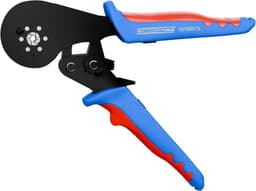
A finished ferrule is one sleeve, crimped on the tube, with no loose strands beside the collar and no insulation trapped in the dies. Hold the ferrule and pull the conductor. If the sleeve slides off, cut it away and start with a new ferrule. Do not squeeze the same sleeve again. One UK review of the Knipex describes wires that pull out, so tug-test the first joint. A ratchet that has not finished its travel will feel locked. The Weicon 10100513 bullets include an emergency release. Forcing the handles with another tool ruins the ferrule in the jaw. UK reviews of the Riiriou describe a jam on the first attempt and a pin that falls out. A jammed new tool is a Consumer Rights Act 2015 matter with the seller.

Where the steps stop

Do not tin the strands and call that a ferrule. The IET’s explanation of BS 7671 regulation 526.9 rejects solder in a screw terminal, because it can creep. A bootlace ferrule, crimped before insertion, is the treatment they name. These steps stop at notifiable work. In England and Wales, a new circuit, a replacement consumer unit, and work in a bath or shower room are not jobs this guide can clear. Scotland and Northern Ireland have their own rules. If the circuit may be live, an electrician takes over. The Weicon sheet says not to use that model on live conductors.

Common questions

How long should I strip the conductor?
Long enough for the bare copper to fill the metal tube, with the insulation meeting the plastic collar. BuildWiz suggests about 8–12 mm as a rule of thumb for 1.0–6.0 mm² ferrules, and another published step uses about 10 mm. Neither figure is a British Standard. If copper sticks out well past the tube, trim it. If bare copper shows behind the collar, you stripped too far for that sleeve.
Should I twist the strands?
A light twist stops the strands splaying while you insert them, which reviewers of square kits also mention as a help. Twist only enough to enter the tube. A hard twist can thin the bundle and make a weak crimp. Stop when the insulation bottoms on the collar, and do not leave strands outside the metal.
Do I crimp the plastic collar or the metal tube?
Crimp the metal tube. The plastic collar stays out of the jaw and faces back along the insulation. Crushing the collar splits it and leaves the copper uncrimped. On the Knipex 97 72 180 you place the tube in the marked nest for that mm². On a ratchet you close through one full cycle so the dies finish on the tube.
What if the ratchet will not open?
Use the release if the tool has one. The Weicon listing includes an emergency release. Do not add a second pair of pliers to beat the pawl. Cut off a damaged ferrule once the jaws are open, and crimp a new sleeve. If a new tool jams on the first squeeze, as UK reviews describe on the Riiriou, treat that as a return rather than a technique.
Is this how I terminate a new circuit in a consumer unit?
The crimp sequence is the same on a ferrule, and the legal job is not. In England and Wales, a new circuit or a replacement consumer unit is notifiable. Bathroom and shower work is too. This page does not design that circuit. If you are unsure the supply is dead, or which terminal class you have, stop and use a qualified electrician.

Related pages

Sources

Public UK sources from the research digest, last checked on 19 October 2026. Shelf prices and star lines are the amazon.co.uk figures in the display file. The price bands are this set, not a market average.

  1. IET Wiring Matters: terminal blocks and regulation 526.9 (retrieved 19 October 2026)
  2. GOV.UK: building work, replacements and repairs (retrieved 19 October 2026)
  3. IET: Part P FAQ for England and Wales (retrieved 19 October 2026)
  4. Electricity at Work Regulations 1989 (retrieved 19 October 2026)
  5. Knipex 97 72 180 product page (retrieved 19 October 2026)
  6. Weicon 10100513 data sheet (retrieved 19 October 2026)
  7. RS Online: crimp tools guide (retrieved 19 October 2026)
  8. Termnex: bootlace ferrule colour codes (retrieved 19 October 2026)