Bootlace ferrule sizes
The collar in your hand is red, the flex is marked 1.5 mm², and on the next reel a red collar means something else. Bootlace ferrule sizes are decided by the square millimetre on the conductor and on the sleeve. Colour only works after you know which of three sequences the panel, or the kit, is using. This page is that match. It is not a ranking of pliers. Which tool to buy, and what it costs, stays on the [ferrule pliers comparison](/hub/pliers/ferrule-pliers). Colour notes and the listing claims in this set were read on 19 October 2026. We did not measure a kit’s compartments ourselves.
The collar in your hand is red, the flex is marked 1.5 mm², and on the next reel a red collar means something else. Bootlace ferrule sizes are decided by the square millimetre on the conductor and on the sleeve.
The collar in your hand is red, the flex is marked 1.5 mm², and on the next reel a red collar means something else. Bootlace ferrule sizes are decided by the square millimetre on the conductor and on the sleeve. Colour only works after you know which of three sequences the panel, or the kit, is using. This page is that match. It is not a ranking of pliers. Which tool to buy, and what it costs, stays on the ferrule pliers comparison. Colour notes and the listing claims in this set were read on 19 October 2026. We did not measure a kit’s compartments ourselves.
Our top picks
| Badge | Product | Ferrules claimed | Twin ferrules | Size line to check | Note | Price | Offer |
|---|---|---|---|---|---|---|---|
| Best overall |  KNIPEX Knipex ferrule pliers 97 72 180 | None in the box | Buy them separately | Dies for 0.25–16 mm² | 9.8 | about £35.96 | View offer |
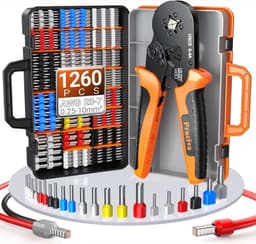
| Best value |  Preciva Preciva square ferrule kit CP621200 | 1,200 claimed | Not stated | 0.25–10 mm²; small sizes go first | 9.6 | about £22.99 | View offer |
| Alternative |  Preciva Preciva ferrule kit with 260 dual ferrules | 1,000 singles claimed | 260 duals claimed | 0.25–10 mm² | 9.6 | about £23.99 | View offer |


On this page
Match mm², not the plastic
DIN, French, and the sequence UK sellers call German
Twin ferrules
What the amazon kits actually put in the box
Common questions
Is a red collar always 1.5 mm²?
What is the difference between DIN, French, and German colours?
What ferrule goes on 1.5 mm² and 2.5 mm² flex?
When do I need a twin ferrule instead of two singles?
Will a tool marked 16 mm² crimp a 2 × 16 mm² twin?
Related pages
Sources
Public UK sources from the research digest, last checked on 19 October 2026. Shelf prices and star lines are the amazon.co.uk figures in the display file. The price bands are this set, not a market average.
- IET Wiring Matters: terminal blocks and regulation 526.9 (retrieved 19 October 2026)
- GOV.UK: building work, replacements and repairs (retrieved 19 October 2026)
- IET: Part P FAQ for England and Wales (retrieved 19 October 2026)
- Electricity at Work Regulations 1989 (retrieved 19 October 2026)
- Knipex 97 72 180 product page (retrieved 19 October 2026)
- Weicon 10100513 data sheet (retrieved 19 October 2026)
- RS Online: crimp tools guide (retrieved 19 October 2026)
- Termnex: bootlace ferrule colour codes (retrieved 19 October 2026)