Independent comparisons. We may earn from shop links. More info

How to use combination pliers

Updated: 21 October 2026

You have the pair in your hand and you need to know which part of the head does which job before the first squeeze. How to use combination pliers is a procedure, not a ranking. Check the jaws, grip with the right zone, cut at a right angle, and stop if the handle is only a comfort coat. This page does not pick a winner. The [combination pliers comparison](/hub/pliers/combination-pliers) holds the table. This was written from the saved amazon.co.uk set and UK safety notes, not from a lab.

You have the pair in your hand and you need to know which part of the head does which job before the first squeeze. How to use combination pliers is a procedure, not a ranking.

Our top picks

On this page

Three zones, one job each

A classic combination head has three zones. Flat serrated jaws hold a tab or a flattened cable end. The oval seat, the hollow behind the tip, grips a rod or a thick round conductor without chewing a flat into it. The cutter beside the pivot is the cut. Twist the flat jaws on a bolt and the serrations slip. Cut at the tip and you nick the gripping faces. The WORKPRO extractor shows the other limit: the cavity can stop a thin wire at the tip, and one review put the jaw opening at about 25 mm. A 5-in-1 still has the three classic zones. Extra holes are only as good as the sizes the listing printed.

Grip, then cut at a right angle

Grip first, then cut. Set the stock deep in the chosen zone. Cushion-grip advice echoed on UK pages is to pull rather than push if the tool might slip. Cut at a right angle. Rocking the cutter leaves a hinge of metal. Place the wire nearest the pivot, not at the tip. UK notes on the Milwaukee 7-in-1 mention a clean cut on 2.5 mm copper on an isolated circuit, and one pair snapped on earth-bonding cable. That is a reason to stop. Do not pull nails unless the pair was built for it. Sharp-tec claims a nail puller. A classic KNIPEX or Bosch head does not. Do not drag the cutter along a twin-and-earth sheath. The WORKPRO 5-in-1 prints no strip sizes.
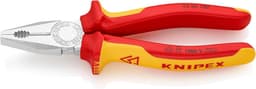
KNIPEX KNIPEX 03 06 180 insulated

Testsieger

KNIPEX KNIPEX 03 06 180 insulated
9.4/10about £25.50

A check before the first cut

Close the jaws on daylight before the first squeeze. They should meet. A 1 mm gap on the insulated KNIPEX, in one UK note, is a return. A joint that arrived stiff is an arrival fault. Plastic-coated red, green soft-grip, and TPR are not insulation. The WORKPRO extractor notes handles unsuitable for live wires. Milwaukee reviewers asked for VDE and got CE. If you cannot read a 1000 V mark, treat the pair as bare steel with a grip. HSE treats that visual check as normal before use: jaws, pivot, handle mark, rust under chrome. Oil a dry pivot lightly after a clean arrival. Do not soak the cutter, and do not tape a nicked coat. How you chose the pair sits on the combination pliers buying guide. Who should skip a row sits on the best combination pliers page.

What these pliers are not

They are not a hammer. Striking the head mushrooms the joint. They are not a spanner. The flat jaws will mark a hex and then slip. If the fastener is a nut on a pipe, water-pump pliers or a wrench are the next tool. They are not a live-work tool unless a safe method is already in place. A coloured handle is a comfort coat. Isolation first. This page will not teach live stripping. They are also not a dedicated side cutter. Combination cutters sit at the pivot and leave a pinch. If the title says lineman and combination together, confirm the head before you copy a US splicing step onto a UK drawer pair. That split is on the combination pliers vs linesman page. If the oval seat will not close, stop and pick a sliding-pivot tool.

Common questions

Which part of the head holds flat stock?
The flat, serrated jaws at the tip. Use them on a tab, a flattened cable end, or a small fastener you only need to hold. Do not use them as a spanner on a hex. If those faces rock or leave a gap, the jaws do not meet and the pair should go back.
What is the oval seat for?
The hollow behind the tip is for round stock: a rod, a pipe, or a thick round conductor. It spreads the bite so you do not flatten the work the way the serrated tip would. If the seat will not close on the diameter in front of you, you want a different family, not more force.
Where do I put the wire to cut it?
In the cutter beside the pivot, at a right angle to the strand. Do not cut at the tip, and do not rock the edge along the wire. Dull cutters need more force, which is how the handles twist out of your hand.
Can I use combination pliers as a wrench?
No. The serrations slip and the fastener rounds. A 5-in-1 listing may claim a wrench function. That is still a pliers jaw, not a hex. Use a spanner or water-pump pliers when the job is a nut.
Do I oil the pivot?
A light oil after a clean, dry arrival is enough if the joint feels dry. Do not oil a notchy pivot that arrived stiff, and do not soak the cutter. A stiff joint in the box is an arrival fault, not a maintenance task.
When should I stop and use another tool?
Stop when the oval seat will not close, when the cutter will not bite after a square cut, when you are tempted to hammer or to strip with the cutter, or when the handle is only a comfort coat and the conductor is not proven dead. That is another tool, or another person, not a harder squeeze.

Related pages

Sources

Public UK sources from the research digest, last checked on 19 October 2026. Shelf prices and star lines are the amazon.co.uk figures for these eleven listings.

  1. The Electricity at Work Regulations 1989, regulation 14 (retrieved 19 October 2026)
  2. HSE, INDG291 Providing and using work equipment safely (retrieved 19 October 2026)
  3. HSE, Inspection of work equipment (retrieved 19 October 2026)
  4. BSI Knowledge, BS EN IEC 60900:2018 (retrieved 19 October 2026)
  5. KNIPEX product sheet 03 06 180 (retrieved 19 October 2026)
  6. KNIPEX product sheet 03 02 180 (retrieved 19 October 2026)
  7. Screwfix, Pliers buying guide (retrieved 19 October 2026)
  8. Electricity North West, ES604 issue 3 (May 2022) (retrieved 19 October 2026)