Self-watering planter: what to check before you buy
You have a UK kitchen sill or a balcony that only gets water when you are home, and the pots on amazon.co.uk all claim to water themselves. A self-watering planter is a container with a reservoir and a route into the compost, usually a cotton or fabric wick, sometimes a liner and an indicator. A 12 cm six-pack and an 80 cm trough only look alike until you measure the sill and name the plant. The twelve prices are on the [self-watering planter comparison](/hub/plant-accessories/self-watering-planter). Products Compared did not run a laboratory test. A qualifying purchase can earn us a commission at no extra cost to you.
You have a UK kitchen sill or a balcony that only gets water when you are home, and the pots on amazon.co.uk all claim to water themselves.
You have a UK kitchen sill or a balcony that only gets water when you are home, and the pots on amazon.co.uk all claim to water themselves. A self-watering planter is a container with a reservoir and a route into the compost, usually a cotton or fabric wick, sometimes a liner and an indicator. A 12 cm six-pack and an 80 cm trough only look alike until you measure the sill and name the plant. The twelve prices are on the self-watering planter comparison. Products Compared did not run a laboratory test. A qualifying purchase can earn us a commission at no extra cost to you.
Our top picks
| Badge | Product | Form | Level check | Drainage | Note | Price | Offer |
|---|---|---|---|---|---|---|---|
| Best overall |  Lechuza Lechuza BALCONERA Color 80 | Balcony trough | Level indicator | Drain plug | 9.2 | about £45.87 | View offer |
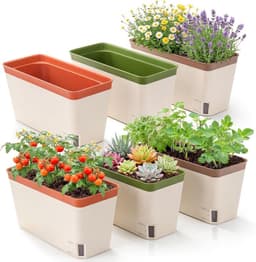
| Alternative |  Fayavoo Fayavoo herb boxes, set of 6 | Windowsill box | Window | Hole into the base | 9.2 | about £29.99 | View offer |
| Preis-Tipp |  yarlung yarlung 12.7 cm pots, set of 6 | Nested square pot | Float | No drainage hole | 8.6 | about £16.99 | View offer |


On this page
What a self-watering planter actually does
Five checks before you compare prices
What the prices in this set are telling you
When the fault is the pot
Common questions
Do I still have to water a self-watering planter?
Is a water window better than a float?
What size do I need for a sill versus a balcony?
Can any indoor-outdoor pot stay out in frost?
What if the pot arrives cracked or the rods do not fit?
Related pages
Sources
Public UK sources used for this comparison, plus the amazon.co.uk listing facts in the display file. Shelf prices and star lines are those UK figures, recorded for this page in October 2026. They are a snapshot, not a promise.
- RHS: holiday care for houseplants (retrieved 16 October 2026)
- RHS: watering hanging baskets trial (retrieved 16 October 2026)
- Garden Organic: make a self-watering container (retrieved 16 October 2026)
- Lechuza UK planters assortment catalogue (retrieved 16 October 2026)
- Lechuza balcony planter sheet (retrieved 16 October 2026)
- Homes & Gardens: what are self-watering planters (retrieved 16 October 2026)
- GrowTropicals: do self-watering pots work for houseplants (retrieved 16 October 2026)
- Consumer Rights Act 2015, section 22 (retrieved 16 October 2026)