Independent comparisons. We may earn from shop links. More info

How to use grow lights for houseplants

Updated: October 2026

You bought a lamp, or you are about to after reading our [plants lamp comparison](/hub/plant-accessories/plants-lamp), and the first week ends with pale new leaves or a stem that still leans toward the window. Hardware is only half the job. Photoperiod, distance and a seasonal change decide whether supplemental light helps. The Royal Horticultural Society treats artificial lighting as a backup when daylight is insufficient, and uses leaf colour as the feedback, not a seller PPFD chart on amazon.co.uk. This page is how you run the lamp. It is not a ranking.

You bought a lamp, or you are about to after reading our plants lamp comparison, and the first week ends with pale new leaves or a stem that still leans toward the window.

Our top picks

On this page

Start with the window

Use the free light before you turn a dimmer to full. Move the pot to the brightest spot you can live with, clean the glass, and see whether growth still stretches toward the pane. North-facing rooms lose hours in midwinter. A south bay may still suit a sansevieria and still fail a seedling tray. The lamp fills that gap. Watering and humidity stay separate jobs. If gaps between leaves remain, add hours or move the head closer, one change at a time. If tips bleach while the compost is moist, raise the fixture or lower the brightness. The RHS uses that leaf-colour loop.

Hours per day

In the dark months, houseplants commonly get roughly twelve to sixteen hours of combined daylight and lamp light, then a dark night. Sixteen hours appears in RHS examples for small grouped plants. Succulents often sit at the lower end. Seedlings and salad leaves often sit at the upper end while they are small. A repeated timer matters more than a perfect match to sunrise. A 6/12/16 h floor lamp, or a 4/8/12/18 h desk unit, can cover the hours you are at work. Twenty-four hours wastes power and stresses many plants. The timer still does not water the compost. Presets, and what they forget after a power cut, are in timers and dimming for grow lights.

Distance and dimming

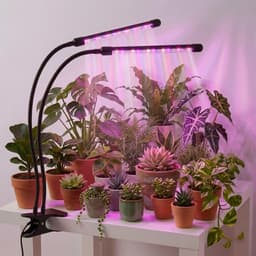
Start farther than the box photo, often 30–45 cm for a small head over seedlings, and more for mature foliage. Watch new growth for two weeks. A floor pole adds height. A head at the top of its range can still miss the canopy and light the floor behind the pot. If a gooseneck sags, distance shrinks overnight and leaves can scorch by morning. Re-seat the clip. Use a dim step where the listing has one: ten levels on the HNMA clip, five on the Sonamindary desk head. Full power on day one is how pothos tips bleach in January. An E27 bulb inherits the lamp you already own, so rotate a tray if the spread is uneven. A 48 W panel covers more shelf and needs the same distance check.

Watch the leaves

Leaf colour is the meter. Note the timer cycle, the approximate distance and a photo of new leaves for two weeks, so you can undo a change. UK heating dries the air. Crispy tips are sometimes dry air, and raising intensity at the same time adds stress. Bleached patches on new leaves, with moist compost, point to too much intensity or too little distance. Yellowing only on older base leaves is a weaker light clue, so check water first. Wide gaps between leaves mean the plant is searching, so add hours or move the head. A reddish tint that stays on new growth is a prompt to step brightness down.

A fortnight you can undo

Pick one timer cycle in the 12–16 hour band, start the head farther away than the box photo, and change only one thing at a time. If new leaves stay a normal colour, hold the setup. If they bleach, raise the lamp or drop a dim step. If stems still lean, add hours or move the pot closer to the window first. If you still need a mount and a wattage before you buy, use the plants lamp buying guide.

Common questions

How many hours for a pothos?
Try roughly twelve to fourteen supplemental hours in winter if the room is dim, with darkness overnight. Adjust using legginess and leaf colour rather than a fixed species chart. A plant that already sits in a bright bay may need fewer hours than one in a hallway. Do not run the lamp for the full twenty-four.
How close can an LED grow light be?
Start conservative and move closer week by week while new leaves look healthy. There is no single centimetre that fits twelve different heads. A small head over seedlings often starts around 30–45 cm. A brighter panel needs more room. If tips crisp while the compost is moist, move the head back.
Can I leave a grow light on for 24 hours?
No for most houseplants. They need a dark period, and you pay for power you are not using well. Heat can build on a cheap housing. Set a repeating timer and leave an overnight gap. A short auto-off of a few hours is a different feature from a daily 12-hour cycle.
What are the signs of too much light?
Bleached, crisp or washed-out new leaves, especially when soil moisture is normal. A reddish cast that stays on new growth under a strong LED mix is another prompt to drop a brightness step or raise the head. Older yellow leaves at the base are a weaker clue. Check water before you blame the lamp.
What are the signs of too little light?
Leggy stems, small new leaves, and a strong lean toward the window. Wide gaps between leaves mean the plant is searching. Add hours or move the head closer in one change, then wait. Extra feed does not replace photons the leaves are not receiving.
Do I only need a grow light in winter?
Many UK owners run lamps from October to March, then taper the hours in spring as daylight lengthens. A north room or a seedling tray can still need help outside those months. Shorten the supplemental window when the plant moves closer to a brighter pane, rather than leaving a winter cycle on into June.

Related pages

Sources

Public UK sources used for this comparison. Shelf prices, stars and review counts are the amazon.co.uk figures captured for these twelve listings. Last checked 19 October 2026.

  1. RHS artificial lighting for houseplants (retrieved 19 October 2026)
  2. RHS choosing houseplants (retrieved 19 October 2026)
  3. Which? grow lights for plants (retrieved 19 October 2026)
  4. GrowTropicals, cost of running grow lights in the UK (retrieved 19 October 2026)
  5. GOV.UK product safety report, YIKEDAN LED grow light (retrieved 19 October 2026)
  6. GOV.UK General Product Safety Regulations 2005 (retrieved 19 October 2026)
  7. The Standard, indoor plant grow lights (retrieved 19 October 2026)