Independent comparisons. We may earn from shop links. More info

How to use a grow light

Updated: October 2026

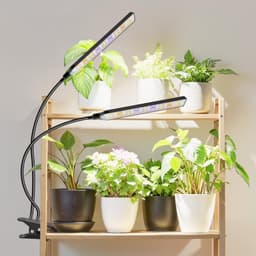
Learning how to use a grow light starts with a repeatable day and night, not leaving it on whenever you remember. Put the lamp above the foliage, use daylight where you have it, and set a timer period that matches the plant and the room. Our [plant lamps comparison](/hub/plant-accessories/plant-lamps) includes timers from 12 to 18 hours, but UK reviews show that some do not keep their cycle. The steps below help you set a sensible routine, adjust it from the plant's response and recognise when the equipment should be unplugged. A qualifying purchase can earn us a commission at no extra cost to you.

Learning how to use a grow light starts with a repeatable day and night, not leaving it on whenever you remember.

Our top picks

Aumtrly Aumtrly 2-head clip

Best overall

Aumtrly Aumtrly 2-head clip
9.4/10about £18.99
Ainiv Ainiv 48-LED stick

Best value

Ainiv Ainiv 48-LED stick
8.4/10about £8.99
On this page

Set hours and preserve a real night

Dobbies suggests roughly 8–10 hours of added light where there is already some sun, and up to about 16 hours in a dark position. The Royal Horticultural Society uses about 16 hours in a home example. A bright spring sill does not need the same supplement as early tomatoes in a dim room. Do not run the lamp for 24 hours. If you choose 16 hours on, the remaining eight hours are the dark period. Run the light during the day or early evening so spill is less disruptive in a bedroom. Change one variable at a time. Why a wattage title cannot set the schedule is in the grow light buying guide.

Use the timer step the lamp actually offers

Ainiv, Bamworld, SANSI, OHFAMO, Uocub, the dual-head Sonamindary and vsshe list a maximum of 12 hours. Aumtrly, Wolezek and Garpsen list 16 hours. The single-head Sonamindary and fayleer list 18 hours. If your schedule sits between the steps, use the nearest setting with daylight or a suitable external timer. A repeating timer normally counts from activation. SANSI says its timer needs resetting after a power cut. Several Uocub reviewers say the timer is unpredictable. One Aumtrly sometimes stays on, and a Bamworld missed a start. An external timer cannot repair a faulty driver. Stop if the lamp flickers, smells hot or behaves erratically. For early sowings, the seedling grow-light guide covers a 14–16 hour setup.
Aumtrly Aumtrly 2-head clip

Testsieger

Aumtrly Aumtrly 2-head clip
9.4/10about £18.99

Adjust distance from stretch, colour and heat

There is no single distance. The RHS puts T5 HO tubes about 60 cm over a small group, and that example does not apply to every USB clip. Use the product instructions, then watch the plant. If stems lean or new internodes lengthen, the light may be too weak, too far or on for too short a period. Bring an adjustable head closer in small stages, provided the leaves do not overheat. If leaves become pale, crisp or warm, increase the gap. UK reviews mention heat on Ainiv and SANSI, whose goosenecks can sag. A single stick that lights one cutting will not light a whole shelf. The mount decision is in the clip-on versus floor lamp guide.

Know when to unplug

Do not energise a product with a cracked casing, an exposed conductor, a broken pin or scorching. One Garpsen plug reportedly broke on first use, and one Wolezek arrived with a broken earth prong. Unplug the lamp if it trips a circuit, smells of burning, sparks, flickers when the cable moves, or becomes hot enough to damage what is around it. Do not open a mains adapter. None of these products should be treated as waterproof. Keep adapters away from wet compost and unplug before watering nearby. A bathroom or greenhouse needs equipment rated for that damp air.

Common questions

How long should a grow light stay on?
Use daylight first, then add enough lamp time for the plant and room. UK guidance ranges from roughly 8–10 hours where some sun already reaches the plant to about 16 hours in a dark setup or for seedlings. Preserve a daily dark period and adjust from the plant's response rather than running continuously.
Do plants need darkness?
Yes. Darkness forms part of normal plant cycles, and night length helps control flowering in some species. Do not leave a household grow light on around the clock. A regular timer period, such as 16 hours on and eight hours off, provides a clear night while keeping the routine consistent.
How far should the lamp be from the leaves?
Follow the instructions for that lamp, because output and optics vary. Do not apply the RHS 60 cm T5-tube example to every small LED clip. Start at the maker's distance, position the head above the foliage, then move it gradually if stems stretch or leaves show bleaching, drying or excess heat.
What if my timer will not run for 16 hours?
Use the longest appropriate built-in step alongside available daylight, or use a suitable external timer if the lamp safely restarts when power returns. Do not assume a 12-hour button can be programmed to 16. If the controller itself is erratic, an external timer is not a repair for an electrical fault.
Is a hot grow-light housing normal?
LED equipment can become warm, but excessive heat, smell, discolouration or a sagging head needs attention. Ainiv and SANSI UK reviews mention hot housings. Increase clearance, keep material away from the head and unplug the lamp if heat appears unsafe or is accompanied by flickering or damage.
Can I use a plant lamp in a bathroom?
Not unless the particular product is rated for that wet or damp location. Lamps in this comparison are either stated as not waterproof or lack a waterproof rating. Keep the light, controller, USB connection and mains adapter away from splashes, condensation and wet surfaces.

Related pages

Sources

Public UK sources used for hours, photoperiod, plugs, and lighting labels, plus the amazon.co.uk listing facts in this comparison. Shelf prices and star lines are those UK figures. No listing in the set prints a PPFD.

  1. RHS: Artificial lighting for houseplants (retrieved 16 October 2026)
  2. RHS: How plants sense the environment (retrieved 16 October 2026)
  3. RHS: How plants use light to grow (retrieved 16 October 2026)
  4. GOV.UK: Electrical Equipment (Safety) Regulations 2016 (retrieved 16 October 2026)
  5. legislation.gov.uk: Electrical Equipment (Safety) Regulations 2016, regulation 35 (retrieved 16 October 2026)
  6. GOV.UK OPSS: Fecida LED grow light UFO600, report 2305-0074 (retrieved 16 October 2026)
  7. legislation.gov.uk: Ecodesign for Energy-Related Products and Energy Information (Lighting Products) Regulations 2021 (retrieved 16 October 2026)
  8. Mike’s Garden: Which grow light to buy (retrieved 16 October 2026)