Independent comparisons. We may earn from shop links. More info

Herb spiral buying guide

Updated: October 2026

You have typed herb spiral into amazon.co.uk and found a masonry coil that could cover a patio table, steel rings about ninety centimetres across, a compact pyramid, and ordinary pots that never use the name. This herb spiral buying guide is for the moment before individual listings: which shape the dimension line actually describes. It stays on criteria and trade-offs. It does not crown a winner, teach a planting sequence, or size a balcony. The three steel listings we score are in the [herb spiral comparison](/hub/plant-accessories/herb-spiral).

You have typed herb spiral into amazon.co.uk and found a masonry coil that could cover a patio table, steel rings about ninety centimetres across, a compact pyramid, and ordinary pots that never use the name.

Our top picks

On this page

Four things called a herb spiral

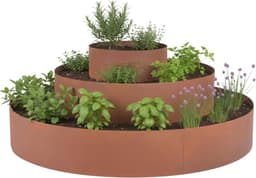
In UK gardening a herb spiral usually means a rising coil of stone, brick or timber about two metres across. British Beekeepers Association notes describe a spiral you walk around. That coil almost never arrives flat-packed. The second object is concentric steel rings: the ninety-centimetre Relaxdays set is ninety by ninety by twenty centimetres and slots together. Upper, middle and lower are names on that low shell. The third is the pyramid, about forty-three centimetres high on a sixty-one by forty-one centimetre base, described as pre-assembled. The fourth is ordinary pots. A ring does not replace the walk-around spiral. It can be enough for parsley and chives this weekend.

Footprint and stated height

The ninety-centimetre rings are ninety by ninety by twenty centimetres and about 4.4 kg empty. The larger set is one hundred and twenty by one hundred and twenty by twenty. The pyramid is about forty-three by sixty-one by forty-one centimetres and 6.17 kg. That third figure is packed height. Do not add ring walls into a tower. A bullet may say about twenty centimetres per ring while the table still says twenty overall. The 127.23 litre field matches one outer cylinder, not three deep pots. The 25.13 litre field on the larger listing does not match the same geometry, so do not order compost from it. Plantura still describes classic coils around three metres across. Compact may only mean smaller than that.

Drainage, grit and what is not in the box

The ring listings do not state drainage holes. The pyramid page, when checked, said there were none and that you should drill. RHS container guidance assumes holes and a peat-free mix with up to twenty-five per cent coarse grit. Soil, plants, grit and a liner are not in the box. Rosemary, in the RHS note, wants a pot at least thirty centimetres deep. A twenty-centimetre wall is shorter than that. Thyme, chives and parsley can still grow in a shallow, free-draining fill. Keep mint in its own pot. The rings slot together and the pyramid is described as pre-assembled, so the time you need is for filling, not for laying bricks.

Steel claim, review sample and the 30 cm line

A rust finish is not a thickness and not a corten grade. A 1.5 mm figure from a prima terra listing that does not deliver to Great Britain is not the spec of these rings. One review headed Germany describes sheet under 0.6 mm and wobble after assembly. That is one buyer’s account. A lower price is not a thick wall. Star lines of 4.5 from five and 5.0 from three, often with reviews headed Germany, are a sanity check, not proof a ring outlasts masonry. For houses in England, a platform no more than thirty centimetres high can be permitted development if Planning Portal rules on location and coverage are met. Flats, listed curtilage, and the other UK nations sit outside that page. Ask the council about a tall front-garden coil. This is not legal advice.

Which shape matches the job

If you want a dry crown you can walk around, these steel listings are the wrong object. If twenty centimetres of free-draining fill suits mixed culinary herbs, a ring can do that weekend job. If you need more stated height on a small rectangle, the pyramid is the only piece here above the ring line, and it is still not a two-metre coil. If rosemary needs a thirty-centimetre pot you can move, use ordinary pots.

Common questions

Is a herb spiral the same thing as a herb pyramid?
No. The pyramid is one pre-assembled unit about forty-three centimetres high. The rings are twenty centimetres on the specification line. Neither is a two-metre coil.
Why does one listing say 20 cm high and also height per ring?
The table height is the outer shell as measured for delivery. The bullet refers to each ring’s side wall, not a stack you should add. If you need more than twenty centimetres in total, you are outside what that listing describes.
How much compost do the rings actually hold?
The 127 litre field on the ninety-centimetre listing matches one cylinder twenty centimetres deep, not three pots. Ignore 25.13 litres on the larger page until it is corrected.
Do I need planning permission for a 20 cm kit?
A house in England may sit under the thirty-centimetre platform line with a twenty-centimetre kit. Flats, listed sites and the other UK nations do not follow that page. Check the council. This is not a permission answer.
What is missing from the box?
Soil, plants, grit, a liner and often any confirmed drainage. You supply peat-free compost, and you supply the means to make holes if the page tells you to drill.
When are ordinary pots the better buy?
When you need a defined depth for rosemary, easy winter moving, or a balcony load you can split across several lighter containers. Pots are less photogenic than a spiral title. They match the RHS container note more literally than a shallow ring.

Related pages

Sources

Public UK sources used for this comparison. Shelf prices, stars and review counts are the amazon.co.uk figures captured for these three listings on 20 October 2026.

  1. RHS: herbs in containers (retrieved 20 October 2026)
  2. RHS: grow your own rosemary (retrieved 20 October 2026)
  3. RHS: growing herbs (retrieved 20 October 2026)
  4. British Beekeepers Association: building a herb spiral (retrieved 20 October 2026)
  5. Garden Organic A37: making a herb spiral (retrieved 20 October 2026)
  6. Planning Portal: decking and raised platforms (retrieved 20 October 2026)
  7. Consumer Rights Act 2015, section 22 (retrieved 20 October 2026)
  8. amazon.co.uk listings for the three herb spirals (retrieved 20 October 2026)