Independent comparisons. We may earn from shop links. More info

LED vs HPS grow light UK

Updated: October 2026

You are in a UK spare room, and the listing calls a small LED a 600 W light. That line is the decision. An LED vs HPS grow light UK choice is the watts drawn, the heat left in the room, and whether you are lighting a shelf or a 120 cm canopy. The scored listings sit on our [grow shop comparison](/hub/plant-accessories/grow-shop). For most spare rooms, choose an LED sized by actual watts. Keep high-pressure sodium for a cold, extracted space where you want the heat. Prices are amazon.co.uk figures from 19 October 2026. This is not a lab test.

You are in a UK spare room, and the listing calls a small LED a 600 W light. That line is the decision.

Our top picks

On this page

Actual watts, not equivalent watts

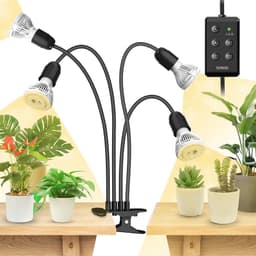
The figure that matters is power from the wall. A 600 W HPS is sold as that figure, and the ballast adds a little more. Many LED pages print a huge equivalent beside a small draw. Garden UK treats a 1000 W LED that draws 100 W as a warning. The SANSI clamp draws 40 W. Its 600 W equivalent, at 3,600 lumens, is an incandescent comparison, not a 600 W sodium lamp. The DragonLight draws 50 W at 230 V, so a 200 W HPS bullet is advertising. PPFD, in µmol/m²/s, is light on the canopy, not watts. A rule of thumb we did not measure puts herbs around 200–400 and fruiting tomatoes around 600–900. Neither listing maps that. A real 600 W HPS also puts far more heat in the room.

Heat and extraction in a UK room

HPS throws a large share of its energy as heat onto the leaves. Growsave and AHDB notes describe LEDs as cutting that radiant load. In a spare bedroom, a closed door, a tent and a 600 W lamp for 12 hours is a heater. In a cold garage the same heat can hold a canopy, if air leaves the tent instead of pooling under the roof. DiscountHydro’s 2026 example, about 27p per kWh, puts a 600 W HPS for 12 hours a day at about £710 a year, and a 480 W LED on the same hours at about £568. Your tariff and any extra fan will differ. GroWell’s notes, on commercial fixtures, add that HPS is usually cheaper to buy and LED cheaper to run.

What this comparison’s lights can and cannot do

Neither scored lamp will fruit 1.44 m². The SANSI is a 40 W clamp, 4.2 from 30 UK reviews, at 220 V AC, with a 4-, 8- or 12-hour timer you reset after a power cut. UK reviews say the heads get hot, so keep them about 10 cm off the leaves. The spec table does not confirm a UK plug. The DragonLight is 50 W at 230 V, with no timer listed, and reviewers call it quiet enough for cuttings. Hydro Bros start 120 × 120 cm at about 400–600 W of actual LED. A 50 W bar is not a 600 W HPS. The title claims about 2 × 2 ft and a 3-metre cable; one UK review says neither is true. This set has no HPS listing.

When HPS is still the rational buy

Choose LED for a spare room when you will match wall watts to the canopy and you would rather not heat the bedroom. A 40 W or 50 W LED still fails for fruiting plants. The fixture you want is in the hundreds of watts. Choose HPS when the space is cold, extraction is real, and you want leaf heat. A 600 W HPS pushes through a deeper canopy than a 50 W bar. A warm July garage removes the point. A tent is not a licence to grow cannabis. The SANSI and DragonLight drivers are inside the lamp. A sodium kit is bulb, ballast and usually a reflector. On 230 V both want a fused BS 1363 plug. If a plug or ballast runs hot, use an electrician.

Spare room or cold garage

If the room is a spare bedroom, buy an LED quoted in the watts it draws, in the hundreds for a 120 cm fruiting tent, and do not treat a 40 W or 50 W lamp as that fixture. If the space is a cold garage with real extraction and you want heat on the leaves, HPS can still be the rational buy. If the only lamps in front of you are the clamp and the bar in this set, use them for a shelf or for cuttings. This comparison does not include an HPS listing.

Common questions

LED or HPS for a UK spare room?
For most spare rooms, choose an LED sized by the watts it draws, not by an equivalent slogan. A 600 W HPS on a 12-hour day also heats a closed bedroom. Keep HPS for a cold, ventilated space where that leaf heat is useful. The 40 W and 50 W lamps here are not that fruiting light.
How much does a 600 W HPS cost to run?
As a rule of thumb, not your bill: at about 27p per kWh, DiscountHydro’s 2026 example puts a 600 W HPS, 12 hours a day, at about £710 a year, and a 480 W LED at about £568. Your tariff and any extra fan will move those figures.
Will a 50 W LED fruit tomatoes in a 120 cm tent?
No. The DragonLight CW2000 draws 50 W. Hydro Bros’ starting point for 120 × 120 cm is about 400–600 W of actual LED. The bar can cover seedlings. A 200 W HPS bullet does not close that gap, and we did not map PPFD.
Is HPS better in a cold garage?
It can be, if you want radiant heat on the leaves and you extract the air so a mild day does not cook the tent. HPS earns the buy only while that heat replaces a heater you would otherwise run. A warm July garage removes the point.
Are cheap Amazon grow lights electrically safe?
Some are not. The Office for Product Safety and Standards has rejected certain Amazon grow lights for earthing faults and missing fuses. That is not a verdict on the SANSI or the DragonLight, and a photo of a plug is not a certificate. On UK mains, look for a fused BS 1363 plug with sleeved pins on either family. Stop if the plug, the driver or the ballast runs hot.

Related pages

Sources

Public UK sources used for this comparison. Shelf prices, stars and review counts are the amazon.co.uk figures captured for these seven listings on 19 October 2026.

  1. RHS, How to sow seeds indoors (retrieved 19 October 2026)
  2. Misuse of Drugs Act 1971, section 6 (retrieved 19 October 2026)
  3. CPS, Drug offences (retrieved 19 October 2026)
  4. GOV.UK, Drugs penalties (retrieved 19 October 2026)
  5. Electrical Equipment (Safety) Regulations 2016 (retrieved 19 October 2026)
  6. OPSS, YIKEDAN LED grow light 2408-0204 (retrieved 19 October 2026)
  7. CANNA UK, PK 13/14 (retrieved 19 October 2026)
  8. One Stop Grow Shop, beginner tent setup 2026 (retrieved 19 October 2026)