Independent comparisons. We may earn from shop links. More info

How to catch and release a spider

Updated: 23 October 2026

A male house spider is on a hallway wall, and you have a tumbler and a card, or a new bristle grabber. How to catch and release a spider comes down to three details: seal the rim or bristles, check the handle stays shut when you relax, and walk to a dry shed rather than wet grass. The nine tools are in the [spider catcher comparison](/hub/pest-control/spider-catcher). This is the sequence, and the point where you call someone else.

A male house spider is on a hallway wall, and you have a tumbler and a card, or a new bristle grabber.

Our top picks

On this page

Cup and card, done once

A clear cup and a stiff card are the simplest way to move a spider if you will stand within arm's reach. Pest specialists quoted by Good Housekeeping UK recommend a clear plastic pint tumbler over a heavy glass: it weighs less, will not shatter on a skirting board, and lets you see every leg. Use a postcard or cereal-box panel wider than the rim. Wait until the spider is on a flat wall or floor. Place the cup so the rim lands outside the leg span. Pause for two seconds, then slide the card slowly underneath. Hold a finger on the card as you lift and turn the cup upright. Shoving the card too fast can pinch an Eratigena leg or leave a gap. You must stand within about 30 cm. Overhead, the guide to a spider catcher for ceilings uses the same seal from further back.

The tool, only after you know the trigger

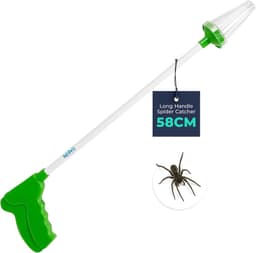
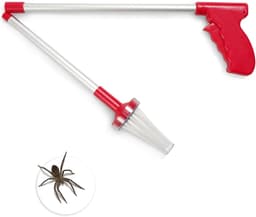
A handheld catcher puts a stated 66–83 cm of shaft between your hand and the spider, and only if you know how the head locks. Listings between £9.58 and £29.55 use three closing actions. The wrong guess drops the spider on the stairs. On the Niftii (about £10.99) you squeeze to open, press the head over the spider, and relax so the spring holds the head shut. On the red KEPLIN (about £10.17, 82.5 cm stated) UK reviews say the head sits open at rest and stays shut only while you keep squeezing. On the PEST GUARD (about £13.64, 81 cm, 440 g) or the telescopic Exsulity (about £29.55) you place the hood over the spider and close the hatch by hand. Exsulity reviewers say a hand or foot slide fails above waist height. Test the handle in an empty hallway first. If you treat a KEPLIN like a Niftii and relax at the back door, the bristles part. Keep the shaft level. Bristles suit larger spiders on flat walls. Tiny spiders can walk through. The mechanisms are in the spider catcher buying guide.
Niftii Niftii spider catcher

Testsieger

Niftii Niftii spider catcher
9.2/10about £10.99

Where it goes

The British Arachnological Society advises against an open lawn. House spiders belong in dry cover, not on cold wet grass. Walk to a shed, an unheated garage, a log pile, or the dry base of a hedge. Hold the head or cup near a surface and open the bristles, or lift the card slowly. Leaning out of an upstairs window is a poor shortcut, because wind can blow the spider back onto the sill. A bath spider did not climb the plughole. The Society says the U-bend blocks that route. The spider fell in from above and cannot grip smooth enamel. Drape a dry towel over the rim overnight, unless you need the shower now, when a plastic cup and card on the flat tub floor is faster.

The box, the bite, and when to stop

Open a new catcher on a table, not over your lap. The Niftii listing includes a plastic practice spider, and Vivo (about £9.58) reviews describe a fake spider tumbling out of the wrapping. Use it to practise the grip before the guide to the best spider catchers in the UK. UK spider bites are uncommon, the NHS and NHS 111 Wales say, though a noble false widow (Steatoda nobilis) bite can swell like a wasp sting. Wash with soap and water and use a cold cloth. Call NHS 111 if redness spreads, you feel dizzy or feverish, or the bite is near your mouth or eyes. Dial 999 for breathing trouble or a swollen face, tongue, or throat. Do not use a grabber on wasps in a wall or loft. GOV.UK and the British Pest Control Association say call the council, or a BPCA or National Pest Technicians Association technician.

Common questions

Should I use a glass or a clear plastic cup to catch a spider?
A clear plastic pint tumbler is safer and lighter than a drinking glass. UK pest specialists quoted by Good Housekeeping UK note that clear plastic lets you see every leg before you slide a stiff card underneath, while weighing less at arm's length and avoiding broken glass on hard floors.
Where should I release a house spider after catching it?
Release a house spider into a shed, garage, outbuilding, log pile, or the sheltered base of a hedge rather than an open lawn. The British Arachnological Society explains that house spiders are adapted to dry, sheltered places and struggle on cold, wet, or windy grass.
Did the spider in my bath come up through the plughole?
No. A bath spider did not climb up the plughole, because the water trap in the U-bend blocks the way. The British Arachnological Society explains that wandering spiders fall in from above and cannot grip smooth bath sides. A dry towel over the rim lets them climb out overnight.
How do I know which way the trigger works on a bristle spider catcher?
Test the handle in an empty room first, because amazon.co.uk models work in opposite ways. On a spring-closed catcher such as the Niftii (about £10.99), squeezing opens the bristles and releasing traps the spider. On a squeeze-to-hold tool such as the KEPLIN (about £10.17), relaxing your grip drops the spider.
When should I call NHS 111, 999, or a professional pest controller?
Call NHS 111 if a spider bite worsens, spreads, causes a fever, or sits near your eyes or mouth, and call 999 immediately for breathing trouble or swelling of the face, tongue, or throat. For wasps entering a wall cavity, or an infestation you cannot identify, GOV.UK advises calling your council or a BPCA or NPTA technician.

Related pages

Sources

Public UK sources used for this comparison. Shelf prices, stars and review counts are the amazon.co.uk figures captured for these nine listings. Last checked 22 October 2026.

  1. BAS, Spiders in the House (retrieved 22 October 2026)
  2. BAS house spider factsheet (retrieved 22 October 2026)
  3. Wildlife and Countryside Act 1981 Schedule 5 (retrieved 22 October 2026)
  4. Glue Traps (Offences) Act 2022 (retrieved 22 October 2026)
  5. GOV.UK pest control (retrieved 22 October 2026)
  6. NHS inform bites and stings (retrieved 22 October 2026)
  7. NHS insect bites and stings (retrieved 22 October 2026)
  8. Consumer Rights Act 2015 section 22 (retrieved 22 October 2026)