How to use silverfish spray without coating the wrong surface
You have a bottle, and the insect was on a skirting board, a pipe or the edge of a cupboard. How to use silverfish spray is mostly about where the liquid is allowed to stay, and how long you leave it there. Wiping the residue off in the morning undoes the treatment. This page is the sequence. It does not rank the bottles. The [silverfish spray comparison](/hub/pest-control/silverfish-spray) is the table, and the [buying guide](/hub/pest-control/silverfish-spray/sub/silverfish-spray-buying-guide) is the label check. Use biocides safely. Always read the label and product information before use. The label in your hand outranks any example below.
You have a bottle, and the insect was on a skirting board, a pipe or the edge of a cupboard. How to use silverfish spray is mostly about where the liquid is allowed to stay, and how long you leave it there.
You have a bottle, and the insect was on a skirting board, a pipe or the edge of a cupboard. How to use silverfish spray is mostly about where the liquid is allowed to stay, and how long you leave it there. Wiping the residue off in the morning undoes the treatment. This page is the sequence. It does not rank the bottles. The silverfish spray comparison is the table, and the buying guide is the label check. Use biocides safely. Always read the label and product information before use. The label in your hand outranks any example below.
Our top picks
| Badge | Product | Where the listing points | Dose or distance | Form | Note | Price | Offer |
|---|---|---|---|---|---|---|---|
| Best overall |  NOPE! NOPE! CP Silverfish Killer Spray, pack of 2 | Indoor and outdoor; not food surfaces | Sheet: 25–50 ml per m², this product only | Water-based spray | 8.4 | about £27.98 | View offer |
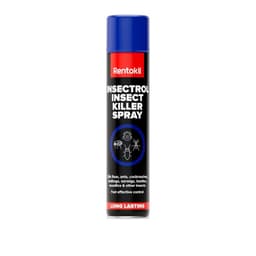
| Preis-Tipp |  Rentokil Rentokil Insectrol Insect Killer Spray 600 ml | Cracks, crevices and skirtings | Spray from 20–25 cm | Aerosol | 5.9 | about £10 | View offer |
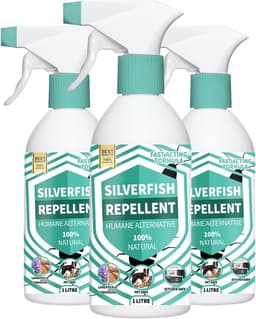
| Alternative |  UK GROW UK GROW silverfish repellent spray, 1 litre | Bath, kitchen, basement, closet | No ml per m²; reapply 2–3 weeks | Oil | 5.3 | about £18.99 | View offer |

On this page
Before you spray
Where a residual spray goes
After it is on
If your bottle has no dose
Common questions
Where do I actually spray?
Can I spray the worktop because that is where I saw one?
When can I vacuum?
Does the spray kill eggs?
How is an aerosol different from a water-based trigger spray?
What do I do about books and bedding?
When do I stop and call someone?
Related pages
Sources
Public sources from the research digest, checked on 16.10.2026. Shelf prices are the amazon.co.uk listings in this set.
- Exeter City Council — Silverfish (retrieved 16.10.2026)
- Middlesbrough Council — Silverfish (retrieved 16.10.2026)
- Lancaster City Council — Silverfish (PDF) (retrieved 16.10.2026)
- Gateshead Council — Silverfish (retrieved 16.10.2026)
- HSE — Biocide advertisement requirements (retrieved 16.10.2026)
- Regulation (EU) No 528/2012, Article 72 (retrieved 16.10.2026)
- BPCA PestWatch — Silverfish and grey silverfish (retrieved 16.10.2026)
- NOPE! CP sheet — HSE No. 10815 (retrieved 16.10.2026)