Independent comparisons. We may earn from shop links. More info

Solar vs battery mole repeller: choose for sun or shade

Updated: October 2026

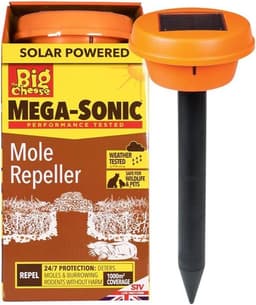
The solar vs battery mole repeller decision is about whether the stake can remain powered where you put it, not which power source has been shown to clear moles. On an open lawn, a solar panel avoids loose cells and running costs. Under trees, beside a wall or through a dull UK winter, replaceable batteries give you more control over the energy supply. The cleanest comparison in our [mole repeller range](/hub/pest-control/mole-repeller) is between Defenders STV757 solar at £11.79 and STV645 battery at £16.94, although their review pool is shared. Neither is an efficacy winner: the ASA has not accepted general performance claims for this device class.

The solar vs battery mole repeller decision is about whether the stake can remain powered where you put it, not which power source has been shown to clear moles.

Our top picks

Nitoer Nitoer S40L 4-pack

Best overall

Nitoer Nitoer S40L 4-pack
8.4/10about £19.90
Defenders Defenders STV645 battery

Alternative

Defenders Defenders STV645 battery
6.8/10about £16.94
Defenders Defenders STV757 solar

Alternative

Defenders Defenders STV757 solar
6.6/10about £11.79
On this page

Solar only works where the panel can charge

A solar stake needs enough daylight to replenish its cell. It may continue overnight, but a shaded, dirty or buried panel eventually leaves it quiet. Initial-charge instructions vary. Nitoer advises two days of sun before first use. NIUBDHQ claims about five hours of sun gives roughly 38 hours of running, BOJYS says four hours gives about four days, and PCXWTLN advertises up to 400 hours from a full charge. These figures were not produced by one comparative test, so they should not rank products. Solar is the straightforward choice for an exposed small lawn where the head stays above the soil. It is less convincing under dense foliage or in weak winter light. Keep the panel clean and do not bury it to make mowing easier. Our guide to using a mole repeller covers placement and signs that a unit has stopped.

The battery stake takes two D cells, not a cable

Defenders STV645 is the battery option in this set. It costs £16.94 and uses two 1.5 V D cells, which are not included. The listing describes a five-second vibration every 55 seconds, an IP44 claim and a visible cap. Replaceable cells make sense where sunlight is unreliable. Add two D cells to the purchase price and check them rather than treating an anecdotal runtime as a specification. Remove leaking cells immediately. STV757 is the solar sibling at £11.79, with a built-in rechargeable 1.5 V pack and an IP44 claim. Retailer pages disagree over a 30- or 50-second pulse and coverage from 30 to 1,000 square metres. Choose STV757 where the panel can charge and STV645 where shade would undermine solar.
Nitoer Nitoer S40L 4-pack

Testsieger

Nitoer Nitoer S40L 4-pack
8.4/10about £19.90

Solar multi-packs bring quantity and catalogue conflicts

PCXWTLN costs £14.99 for a four-pack title and has a 3.7-star line from 84 reviews. It is the best-value choice in the set, but reviews report dead units and an internal cell that could not be replaced. There is no numbered IP code. Nitoer S40L at £19.90 is our top pick from the listing evidence. Its bullets describe solar charging and two days in the sun before first use, yet the power-source attribute says ac_dc. The title and pieces field say four while the unit count says one. Verify the offer instead of choosing the most favourable field. NAKAICUN, NIUBDHQ and BOJYS conflict on pack or range. NIKAND’s £39.95 and £33.96 packs both sit at 3.3 stars, and one power field is empty. Use our mole repeller buying guide before ordering.

Same stars, no efficacy winner

The two Defenders products both display 3.0 from 697 and repeat the same review texts. Some comments concern solar failure, while others mention D batteries. This is one shared variation pool, so do not add the counts. Read comments for an identifiable power source and model. The practical question is which energy source you can support on that spot. The ASA says efficacy claims need suitable substantiation, and the RHS says an electronic buzz may only move a mole to another part of the garden. Larger cells or extra stakes do not, by themselves, show a stronger effect.

Common questions

Does a solar mole stake need direct sun?
It needs enough light at the panel to recharge its internal cell. A product may run overnight or through a dull period using stored energy, but persistent shade eventually reduces operation. Keep the panel above ground, clean and positioned according to the named manual.
What batteries does Defenders STV645 use?
The STV645 listing specifies two 1.5 V D batteries. They are not included, so add their price when comparing the £16.94 stake with solar products. Check the cells and contacts periodically, and stop using the unit if a battery leaks.
Is STV757 the solar version of the same idea?
Yes. STV757 is the solar model in the Defenders pair and describes a rechargeable 1.5 V pack. STV645 is powered by two replaceable D cells. They share a review pool, so the identical 3.0-from-697 line cannot distinguish their reliability.
Can a solar spike really work in poor light?
It may continue operating from stored charge, but poor light supplies less energy than a good charging position. Treat retailer wording as a claim, not a guarantee for a shaded winter garden. If the panel cannot recharge, the stake eventually goes quiet.
What if the bullets say solar but the attribute says ac_dc?
Treat the listing as unresolved and ask the seller to confirm the power source and box contents. Nitoer has this exact conflict. Do not infer that a cable is included, and do not ignore the attribute simply because the solar description is more prominent.
Does battery power repel moles better than solar power?
There is no evidence here that it does. Batteries can keep a stake powered where sunlight is unreliable, while solar avoids replacement cells in an exposed position. That is a power-supply difference, not proof of a stronger biological effect.

Related pages

Sources

Public UK sources and the amazon.co.uk listings recorded for this comparison, mapped on 17 October 2026. Prices are those recorded shelf prices, not a live re-check.

  1. RHS, Moles in Your Garden
  2. Mammal Society, Mole
  3. RSPCA, Living with moles (2022)
  4. GOV.UK, foxes, moles and mink (England)
  5. BPCA spring-trapping code
  6. ASA, Pest repellents
  7. IEC IP ratings
  8. amazon.co.uk listing B0H8R4PGC6