Independent comparisons. We may earn from shop links. More info

Fly swatter kitchen hygiene

Updated: 23 October 2026

A fly has landed on the chopping board while the kettle boils, and the paddle is in the drawer. Fly swatter kitchen hygiene is the part that matters after you decide to hit it: what the insect has already walked through, what the smear leaves on the worktop, and why a café cannot treat that drawer as its pest control. This page stays with the kitchen. The full set of listings is the [fly swatter comparison](/hub/pest-control/fly-swatter). No lab test. A qualifying purchase can earn us a commission at no extra cost to you.

A fly has landed on the chopping board while the kettle boils, and the paddle is in the drawer.

Our top picks

On this page

Why flies in the kitchen matter

Houseflies are about 7–8 mm. The British Pest Control Association describes them feeding on whatever is sweet, rotting, or left out, and carrying bacteria on their bodies and in their gut onto the next surface. You may press that material into the board you were about to use for bread. Bromley Council's leaflet for food businesses says flies contaminate food and surfaces, and a fly in the food is physical contamination as well as a bacteria problem. A swatter does not disinfect the flight path. If the fly landed on a plate, wash the plate. If it is on bare laminate or a cool hob, you can strike and then clean. If it is circling, wait, or open a screened door.

Home kitchen routine

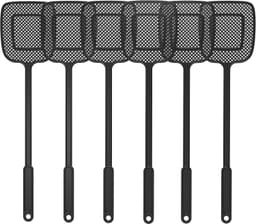
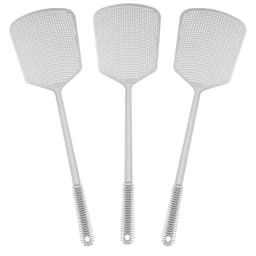
Cover food first. Bins get a lid that actually shuts. A fly screen on the kitchen window is the control BPCA puts ahead of remedies, because it stops the next fly without a smear. Hang one paddle in the kitchen, clean, and off the worktop, so you are not walking a dirty lounge paddle onto the board. This set includes a hanging loop on the MR.SIGA six-pack and a hanging hole on the IME three-pack. A loop inside a cupboard door is far enough from the food and close enough to grab. Rinse a plastic head and let it drip on the hook. Wipe a leather head and keep the wooden handle out of the bowl. If the fly landed in a pan of food, bin that food. The swing itself is on how to use a fly swatter.

Food businesses and the law

A takeaway, a café, or a home kitchen that sells food is not a household with one fly and a paddle. Retained Regulation (EC) No 852/2004, Annex II, Chapter IX, requires food businesses to have adequate procedures to control pests. The Food Standards Agency points caterers at the Safer food, better business pest pages: checks, signs of insects, and food that must be thrown away if it is contaminated. A swatter in the drawer is not that procedure. Domestic kitchens are not inspected like a café. Bacteria on a fly's feet are still a reason to wash the board. If the plan is that you have a swatter, rewrite the plan. The paddle can sit on a hook for one insect on a tiled wall, after the screens, the lids, and the contract are in place. It cannot be the plan.

When to stop swatting and call for help

Stop swatting as the plan when you can see maggots, when flies are constant, or when the source is waste you cannot seal. BPCA's order is find the breeding site, deny it, and only then worry about the adults. In a food business, persistent flies are a reason to call a pest contractor and record what they found. Call for help when a wasp nest is in a wall, a roof, or a soffit. Bullets on these swatters name wasps. A nest is not a bullet. Cluster flies in a loft you cannot proof are the same boundary. A single wasp on the kitchen window is still a household swat if you clean up afterwards.

Common questions

Is it safe to swat flies near open food?
It is a poor moment to swat. The fly may already have contaminated the food, and the hit can push debris into it. Cover or move the food, or bin it if the fly has been in it. Strike only on a clear surface, then wash that surface. A paddle is not a way to make an exposed dish safe.
What should I clean after a fly lands on the worktop?
The landing spot and anywhere the swatter smeared, with hot soapy water and your usual kitchen cleaner, then dry it. Wash your hands. Rinse a plastic paddle or wipe a leather one. If the fly was in food, throw that food away.
Do I need fly screens as well as a swatter?
If flies are a pattern, yes. BPCA treats screens, lids, and covered food as the controls, and a swatter as something that only deals with an adult you can see. A screen on the kitchen window stops the next one. The paddle still has a job for the fly that is already inside.
Can a takeaway use a fly swatter instead of a pest contract?
No. Food businesses need adequate pest procedures under retained Regulation (EC) No 852/2004. Safer food, better business expects checks and action when insects show up. A swatter does not exclude flies, does not treat a breeding site in the waste, and is not a record an inspector can read as your method.
Why do flies keep coming back after I swat them?
Because you are removing adults and leaving the source. In warm weather a housefly generation can finish in about a week, and the eggs are in waste, not on the window. Shut the bin and take sticky recycling out. More swings do not empty a caddy.
When must I call a pest professional?
When maggots are present, when flies stay constant after the bins and screens are sorted, when a food business needs a proper pest procedure, or when a wasp nest or cluster flies are in a space you cannot proof. One fly on the glass is not that call.

Related pages

Sources

Public UK sources used for this comparison. Shelf prices, stars and review counts are the amazon.co.uk figures captured for these eight listings on 20 October 2026. Two saved listings have no star line.

  1. BPCA house flies (retrieved 20 October 2026)
  2. BPCA flies (retrieved 20 October 2026)
  3. BPCA lesser housefly (retrieved 20 October 2026)
  4. FSA, setting up food premises (retrieved 20 October 2026)
  5. FSA Safer food, better business pest control (retrieved 20 October 2026)
  6. Regulation (EC) No 852/2004 Annex II Chapter IX (retrieved 20 October 2026)
  7. Bromley Council, flies in a food business (retrieved 20 October 2026)