Independent comparisons. We may earn from shop links. More info

How to use a fly swatter

Updated: 23 October 2026

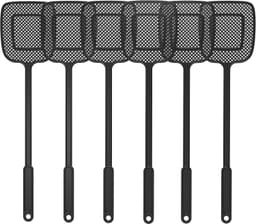
The fly is on the tile above the sink, you swing from the doorway, and it is gone before the paddle arrives. That miss is the usual one in a UK kitchen, and it is mostly timing rather than the brand printed on the handle. This is how to use a fly swatter so the face meets the surface, and so you do not wipe the result into the butter. The paddles themselves, fixed, telescopic, or leather, are compared on the [fly swatter](/hub/pest-control/fly-swatter) page. No lab test. A qualifying purchase can earn us a commission at no extra cost to you.

The fly is on the tile above the sink, you swing from the doorway, and it is gone before the paddle arrives.

Our top picks

On this page

Before you swing

Wait until the fly lands. A swatter is for an insect you can see on a surface, not for fencing with one circling the light. Clear the mug and the knife so the follow-through hits tile, glass, or a bare worktop. If the fly is on the food, move the food. Smashing it into a sandwich is contamination, not a successful swat. If the same flies are back after lunch every day, look at the bin, the recycling, and the open window. The British Pest Control Association treats covered food, lids, and screens as the controls that interrupt a fly problem. In warm weather a housefly generation can finish in about a week, and the paddle does not reach eggs in the bin.

Approach and aim

Move in until you are close, then strike once. A fast walk from across the room is what the fly sees in time. The Naked Scientists note that a very slow approach can muddy a fly's motion vision and is awkward to do well, so do not start the fast part until the paddle is near. The Independent's RES summary says get close, then hit hard and fast, aimed a little ahead of the insect. On a wall, aim slightly above the fly with the flat of the head square to the glass. On a worktop, come down so the head lands flush. Do not sweep sideways across crumbs. Holes only help if the head stays flat. Press curled leather flat before you count it as ready. If a telescopic head will not sit square, stop using that one.

The strike and common misses

The strike is one movement, close in, with the face parallel to the surface. Follow through far enough to pin the fly, then lift the head. A wild overhead smash into a cupboard door is how cheap telescopic joints come apart. Listings here quote about 26 cm closed and about 73 cm open. That length is for a high pane in a controlled line, not a golf swing at a ceiling rose. A single wasp on a window is the same mechanical problem as a fly. A nest in a soffit or a loft is not a swatter job. The paddle is for the insect on the glass in front of you.

After the hit

Look at the surface before you cook again. A crushed fly leaves a mark, and the British Pest Control Association notes that houseflies carry bacteria from what they have walked on. Wipe the spot with hot soapy water, then the kitchen cleaner you already use, and wash your hands. Rinse a plastic head and let it dry. Wipe a leather paddle. Do not soak a wooden handle and hang it wet. Hang the swatter where the next fly will be. The MR.SIGA listing states a hanging loop, and the IME handle has a hole, for a hook by the patio door or inside a cupboard, away from open food. A telescopic pack with no loop can live closed, at about 26 cm, in a drawer if the head is clean. Do not leave a dirty paddle across the chopping board. Worktop cleaning, and the line between a home and a food business, is on fly swatter kitchen hygiene.

Common questions

Should I swing fast from far away or move slowly first?
Move in without a big fast motion, then one hard strike when the head is close. A charge from across the kitchen is what the fly sees in time to leave. The Independent's RES summary is close, then fast, aimed a little ahead of the fly.
Why do holes in the paddle matter?
They let air through so you are not shoving a pressure wave in front of a solid face. Barnard's point, reported by BBC Magazine, is that flies detect that wave and take off. A newspaper is worse for this than a holed swatter. Holes do not help if the head is bent, stiff in the wrong way, or so small that you miss the insect beside the face.
Where should I aim when the fly is on a wall?
Aim a little ahead of its body, often slightly above it on a vertical surface, with the flat of the head square to the wall. Hit once. On a worktop, come down onto the fly rather than across it.
How do I clean the swatter and the worktop?
Wipe the worktop with hot soapy water and your normal kitchen cleaner before you prepare food there, and wash your hands. Rinse a plastic head and dry it. Wipe leather and keep the wooden handle dry.
Is a glass better than a swatter?
For one fly on a bare wall, a tumbler and a card let you put it outside without a smear. Use that when the fly is on paint and you have a free hand. Use the swatter when there are several flies, or when the insect is on glass you can strike cleanly and then wash. Neither tool fixes an open bin.
Can I swat flies on the ceiling with a telescopic handle?
You can try if the handle reaches. The listings here talk about roughly 26 cm closed and 73 cm open. Extend only as far as you need, and keep the head flat. If you cannot see the head land square, wait until the fly is lower.

Related pages

Sources

Public UK sources used for this comparison. Shelf prices, stars and review counts are the amazon.co.uk figures captured for these eight listings on 20 October 2026. Two saved listings have no star line.

  1. BPCA house flies (retrieved 20 October 2026)
  2. BPCA flies (retrieved 20 October 2026)
  3. BPCA lesser housefly (retrieved 20 October 2026)
  4. FSA, setting up food premises (retrieved 20 October 2026)
  5. FSA Safer food, better business pest control (retrieved 20 October 2026)
  6. Regulation (EC) No 852/2004 Annex II Chapter IX (retrieved 20 October 2026)
  7. Bromley Council, flies in a food business (retrieved 20 October 2026)