Independent comparisons. We may earn from shop links. More info

Wood stain for doors and windows

Updated: October 2026

A front door and its frame may look like a modest staining job, but they need a coating made for smooth exterior joinery rather than an interior dye, rough-fence treatment or decking oil. The right wood stain for doors and windows forms a weather-resistant film, names the end use and supplies a complete preparation and coat schedule. In our [wood stain comparison](/hub/paints-and-varnishes/wood-stain), Ronseal 10 Year and Rustins Quick Dry Outdoor are the two rows that clearly belong in this use case. The choice between them is mainly project size, documented system and how much listing uncertainty you will accept.

A front door and its frame may look like a modest staining job, but they need a coating made for smooth exterior joinery rather than an interior dye, rough-fence treatment or decking oil.

Our top picks

On this page

Doors and windows are not fences or decks

BS EN 927-1 classifies exterior wood-coating end uses. Windows, doors, shutters and garden furniture are relatively stable items, while overlapping fences and similar rough construction are non-stable. A door coating must remain coherent on smooth planed timber, detailed edges and joints. Fence stains are designed for a different surface and maintenance pattern. Rustins specifically directs timber decking to its decking oil rather than Quick Dry Outdoor Woodstain. Interior dye is also the wrong category. Colron’s maker says the dye is not for outside. If the shared names are still confusing, use the wood stain buying guide before choosing a shade.

Ronseal 2.5 litres or Rustins 250 ml

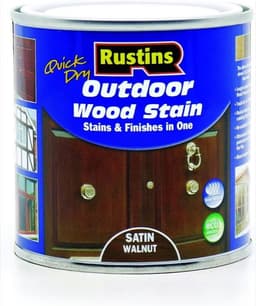
Ronseal 10 Year dark oak is the large-project option. The amazon listing gives a 2.5-litre fill, satin finish, £35.64 shelf price and one-coat coverage of 18 m² per litre. Ronseal’s technical information names doors, windows and garden furniture on smooth planed timber, and a three-coat build. The marketplace composition fields conflict: paint type says oil, while materials list oil, solvent and water, whereas Ronseal’s relevant product information describes a water-based system. Use the current tin and technical sheet, not that mixed field. Rustins Quick Dry Outdoor satin walnut is the compact alternative at £7.88 for 250 ml. Its maker names exterior joinery, doors, windows, conservatories and garden furniture. Repeated complaints mention open or dented tins and a walnut shade that did not match expectations. For count-based and unit-price picks across the whole set, see our best wood stain comparison.

Calculate for all coats, not one

Coverage is normally stated per coat. Ronseal’s 18 m²-per-litre figure describes how far the liquid may spread once, not how much finished three-coat joinery one litre produces. As a rough planning calculation, three equal coats reduce that figure to about 6 m² per litre before waste. Rustins states roughly 12–15 m² per litre per coat. A 250 ml tin consequently covers about 3–4 m² for one coat, or around 1–1.25 m² for three equal coats before waste. Do not use the advertised rainproof time as the recoat interval. Ronseal may be rainproof in one hour but still requires all required coats; Rustins is touch-dry in about 30 minutes and recoatable after roughly four hours. Our guide to how to apply wood stain covers preparation and cleanup.

When stain is the wrong trade

An exterior decorative coating cannot restore rotten timber. If the wood crumbles, a joint has opened or a window no longer closes correctly, ask a joiner to assess repair or replacement before coating. Stain is not automatically a preservative either. If a listed building, conservation area, lease or tenancy specifies the colour or finish, obtain the necessary consent before stripping the existing coating. Access can be the deciding issue on upper-storey windows. A stable ground-level door is a manageable DIY project; leaning from a window or balancing on an unsuitable ladder is not.

Common questions

Can I use Ronseal or Rustins on a front door?
Both relevant product systems name exterior doors or joinery, so they are plausible choices for sound, smooth timber. Confirm the current colour, preparation, compatibility and coat instructions before buying. Ronseal’s 2.5-litre tin suits a larger programme, while Rustins’ 250 ml tin is more realistic for a small area or repair.
Do I need a primer?
Follow the selected system rather than adding a generic primer. Ronseal lists no basecoat or primer for its stated system, but bare wood must still receive the required preparation and coats. Damaged timber or a need for preservative treatment is a separate issue and may require a compatible specified product before decorative finishing.
How many coats does bare joinery need?
Ronseal and Rustins specify three coats for the relevant bare exterior systems. One-coat coverage is a measurement, not a complete application schedule. Apply each coat at the stated spread and interval, including any sanding step, because film build is part of weather protection and appearance.
Will 250 ml cover a door?
Possibly only a small, simple door face, and not necessarily the complete three-coat job. At 12–15 m² per litre per coat, 250 ml represents roughly 3–4 m² for one coat or about 1–1.25 m² across three equal coats before waste. Measure panels, edges and frame before relying on it.
Can I use the same tin on decking?
Do not use these joinery stains on decking unless the current manufacturer instructions explicitly allow it. Rustins directs decking users to Quick Dry Decking Oil, and other exterior woodstains may also exclude horizontal walked-on surfaces. Choose a dedicated decking product for abrasion, standing water and maintenance appropriate to boards.
Is garden furniture in the same class as windows?
BS EN 927-1 gives garden furniture among stable end-use examples, and both manufacturers name it. That does not make every piece identical to a window: horizontal surfaces, joints and contact with soil or standing water can increase exposure. Follow the product’s exact furniture guidance and maintain the coating when it begins to weather.
What should I do if the wood is rotten?
Stop before staining. A coating can colour the surface but cannot restore lost strength or repair failed joints. Remove the source of moisture and ask a competent joiner or timber specialist to assess whether the section can be repaired. Apply preservative or finish only after the substrate is sound and compatible.

Related pages

Sources

Public UK sources used for the VOC limits, end-use classes and maker figures on this page. Prices, stars and review counts are from the amazon.co.uk listings on 16 October 2026.

  1. SI 2012/1715 — VOC in paints and varnishes (retrieved 16 October 2026)
  2. Ronseal — 10 Year Woodstain (retrieved 16 October 2026)
  3. Ronseal — 10 Year Woodstain technical data sheet (retrieved 16 October 2026)
  4. Rustins — Quick Dry Outdoor Wood Stains PDS (retrieved 16 October 2026)
  5. Colron — wood dye FAQ (retrieved 16 October 2026)
  6. Colron — Refined Wood Dye product data sheet (retrieved 16 October 2026)
  7. BS EN 927-1:2013 — exterior wood coating classification (retrieved 16 October 2026)
  8. British Coatings Federation — VOCs (retrieved 16 October 2026)