Independent comparisons. We may earn from shop links. More info

How to varnish an acrylic painting without clouding it

Updated: October 2026

You have finished an acrylic painting, the surface feels dry, and one last coat seems like the easy part. Yet learning how to varnish an acrylic painting means separating several drying clocks before you open the bottle. The safest sequence is to let the paint dry for the period appropriate to its thickness, follow the varnish maker’s instructions, apply thin coats with the work flat, and resist brushing back into a film that has started to set. Our [synthetic varnish comparison](/hub/paints-and-varnishes/synthetic-varnish) covers the bottles sold on amazon.co.uk; this guide explains the application decisions that can prevent stickiness, clouding and lifted colour.

You have finished an acrylic painting, the surface feels dry, and one last coat seems like the easy part. Yet learning how to varnish an acrylic painting means separating several drying clocks before you open the bottle.

Our top picks

Liquitex Liquitex Professional satin

Best overall

Liquitex Liquitex Professional satin
9.0/10about £14.93
EIGTWEN EIGTWEN gloss and matte

Alternative

EIGTWEN EIGTWEN gloss and matte
7.8/10about £14.36
On this page

Three clocks, and which bottle they belong to

There is no universal waiting time for every acrylic painting and every varnish. Winsor & Newton UK advises at least 24 hours for thin acrylic paint but up to a week for impasto. Liquitex UK says to allow up to two weeks before varnishing acrylics. The Liquitex satin amazon.co.uk listing adds another source of confusion: its product information gives four hours and a 24-hour cure, whereas the Liquitex UK varnishing guidance says up to two weeks before varnish and at least 24 hours between coats. Treat the four-hour figure as listing information, not as permission to varnish a newly finished painting. Other bottles have their own clocks. EIGTWEN’s 200 ml and 100 ml instructions mention about three hours, while an EIGTWEN pair listing says 24 hours; Nicpro specifies one to two hours between coats, followed by 24 hours flat. Those intervals belong to those products and must not be transferred to Liquitex. If you have not chosen a bottle, compare the stated waits on the best synthetic varnish page before buying.

Apply thin coats while the painting lies flat

Set the fully dry painting flat on a clean, level surface in a room with good light and as little dust as practical. Use a clean, soft varnishing brush suited to the size of the work, load it without flooding it, and move steadily from one edge to the other. Do not return to a patch that has begun to tack. Liquitex advises limiting satin or matte varnish to one or two coats because accumulated matting agent can cloud the film. The acrylic-painting guide explains the separate choice between gloss, satin and matte.

Sticky, cloudy, peeled or lifted: when to stop

A wet film may look milky before it clears, so its appearance during application is not automatically a failure. Leave the coat alone for its stated drying period. Stickiness commonly points to a coat that is too thick, repeated brushing, an unsuitable surface or conditions that have slowed drying. Reviews in this comparison mention tacky Nicpro and an EIGTWEN 100 ml film likened to mayonnaise. Do not try to hide tackiness beneath another wet coat. Lifted paint is more serious. Once colour has moved, further wet work can enlarge the damage.

Water, oil paint and spray are not shortcuts

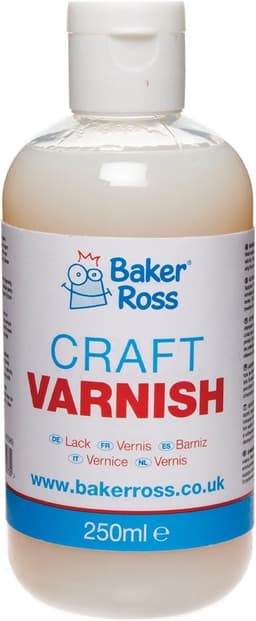
Do not thin Liquitex varnish with water when the maker explicitly says not to do so. The same principle applies to Baker Ross or any other bottle: a water-based product is not necessarily a product intended to be diluted. If the label gives no thinning ratio, do not invent one. Nor does a listing bullet that names “oils” make an acrylic-varnish timetable suitable for oil paint. Liquitex advises waiting six to twelve months before varnishing an oil painting, far longer than the acrylic waits above. These comparison bottles are primarily brush-applied unless their own instructions say otherwise. The UK Health and Safety Executive advises ventilation for paint work and notes that spraying is the activity more likely to require respiratory protection. Do not convert a brush varnish into a spray.

Common questions

How long should acrylic paint dry before varnishing?
Use the paint and varnish makers’ instructions, allowing extra time for thick texture. Winsor & Newton UK gives at least 24 hours for thin acrylic and up to a week for impasto; Liquitex UK says up to two weeks. A surface that feels dry is not proof that a thick layer has dried throughout.
Why does the Liquitex listing say four hours?
Four hours appears in the amazon.co.uk listing information for Liquitex satin, alongside a 24-hour cure. Liquitex UK’s own varnishing guidance instead says to wait up to two weeks after painting and at least 24 hours between varnish coats. Keep the retailer figure attributed to the listing and follow the current maker instructions for your product.
How many coats of varnish should go on a canvas?
The answer depends on the formula and sheen. Liquitex high gloss allows up to three thin coats, at least 24 hours apart, while satin or matte should generally be limited to one or two coats to reduce clouding. Nicpro’s two or three coats and shorter interval apply only to Nicpro, not to every bottle.
Why is my acrylic varnish sticky or cloudy?
A heavy coat, re-brushing as the film sets, cool or humid conditions, or an incompatible surface can delay curing or leave an uneven film. Give it the full labelled cure time and do not add another coat while it remains tacky. Persistent clouding or stickiness needs product-specific advice from the manufacturer.
Can I thin acrylic varnish with water?
Only if the instructions for that exact varnish explicitly provide a method and ratio. Liquitex UK says not to thin its varnish with water. “Water-based” describes the product system; it does not mean that extra water is harmless. Unauthorised dilution can alter levelling, clarity and film formation.
What should I do if the paint has already lifted?
Stop brushing and let the area stabilise without adding water, cleaner or more varnish. Keep any loose fragment and photograph the damage so a conservator can see its original position. For valuable or sentimental work, professional conservation advice is safer than trying to press the colour back into a wet coating.

Related pages

Sources

Public UK sources for the VOC and brushing points on this page. Prices, stars and review counts are from the amazon.co.uk listings extracted on 15 October 2026. Scores use those listings and the review text available on 16 October 2026.

  1. SI 2012/1715 — VOC in paints and varnishes (retrieved 16 October 2026)
  2. SI 2012/1715 — Schedule 1, categories (retrieved 16 October 2026)
  3. SI 2012/1715 — Schedule 2, VOC limits (retrieved 16 October 2026)
  4. British Coatings Federation — solvent-based paint (retrieved 16 October 2026)
  5. HSE — paint FAQ (retrieved 16 October 2026)
  6. Liquitex UK — varnishing acrylics (retrieved 16 October 2026)
  7. Liquitex — Professional satin varnish (retrieved 16 October 2026)
  8. amazon.co.uk listings, extracts 15 October 2026 (retrieved 15 October 2026)