Paint over water stains on a ceiling
The brown ring came back a fortnight after you painted the ceiling, usually in the same place the leak left it. Paint over water stains on a ceiling only after that leak is finished and the board is hard and dry. Emulsion on its own will often lift the mark again. A stain-blocking coat, taken to opacity, then a finish over the whole plane, is the sequence UK decorating guides describe. This page maps that sequence onto the tins in this set that owners actually used on water marks. Nicotine and knots belong elsewhere. The full table is the [stain block primer comparison](/hub/paints-and-varnishes/stain-block-primer). The Products Compared editorial team used amazon.co.uk reviews and UK leak guidance on 16 October 2026. No laboratory test was run. A qualifying purchase can earn a commission.
The brown ring came back a fortnight after you painted the ceiling, usually in the same place the leak left it. Paint over water stains on a ceiling only after that leak is finished and the board is hard and dry.
The brown ring came back a fortnight after you painted the ceiling, usually in the same place the leak left it. Paint over water stains on a ceiling only after that leak is finished and the board is hard and dry. Emulsion on its own will often lift the mark again. A stain-blocking coat, taken to opacity, then a finish over the whole plane, is the sequence UK decorating guides describe. This page maps that sequence onto the tins in this set that owners actually used on water marks. Nicotine and knots belong elsewhere. The full table is the stain block primer comparison. The Products Compared editorial team used amazon.co.uk reviews and UK leak guidance on 16 October 2026. No laboratory test was run. A qualifying purchase can earn a commission.
Our top picks
| Badge | Product | Stain focus | Coverage | Base | Note | Price | Offer |
|---|---|---|---|---|---|---|---|
| Best overall |  Zinsser Zinsser Cover Stain 1 litre | Water stains, knots, and exterior wood in UK reviews and the title | 9.8 m² per litre | Oil | 9.4 | about £17.48 | View offer |
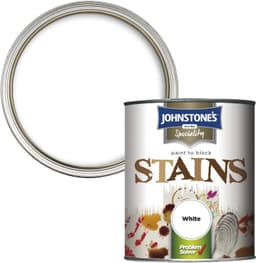
| Alternative |  Johnstone's Johnstone's Stain Block 750 ml | Ceiling water stains and some knots in UK reviews | 8 m² per tin | Water-based on the paint-type line; oil and solvent also listed | 8.6 | about £15.32 | View offer |
| Best value |  Bartoline Bartoline Stain Blocker Spray | Mould stains, grease, water, rust, smoke, and pen marks in the bullets | – | – | 8.0 | about £6.74 | View offer |


On this page
Is the leak finished?
Why emulsion brings the mark back
What this set’s owners used
What not to expect from damp seal or a spray
Common questions
Why did emulsion let the brown ring back?
How do I tell a dead stain from a live leak?
Can I spot-paint the ring only?
Which tin did UK reviewers use on water marks?
Will Polar damp seal replace a plumber?
Is the spray enough for a ceiling tide mark?
Related pages
Sources
Public UK sources for the primer rules, ventilation and manufacturer figures on this page. Prices, stars and review counts are the amazon.co.uk listing lines in this batch.
- SI 2012/1715 — VOC in paints and varnishes (retrieved 17 October 2026)
- HSE INDG273 — Solvents and ventilation (retrieved 17 October 2026)
- Zinsser UK — B-I-N (retrieved 17 October 2026)
- Zinsser UK — Cover Stain (retrieved 17 October 2026)
- Zinsser UK — Water-stained surfaces (retrieved 17 October 2026)
- Checkatrade — Water leaking from a ceiling (retrieved 17 October 2026)
- Johnstone’s 750 ml retailer notes (retrieved 17 October 2026)
- B&Q — Bartoline stain blocker spray directions (retrieved 17 October 2026)