Independent comparisons. We may earn from shop links. More info

Powder filler vs ready mixed

Updated: October 2026

You are choosing powder filler vs ready mixed, and the convenient pack is not always the cheaper one once it is open. Paste can go back under the lid. Powder starts setting as soon as you add water. Use ready mixed for a few shallow marks you will not get back to, and use powder only if you will mix a small batch for a deeper patch. This page is that contrast, not a five-way ranking. Prices and stars for the whole shelf are on the [indoor plaster comparison](/hub/paints-and-varnishes/plaster-indoor). Listings were read on 21 October 2026. We did not lab-test hardness or shrinkage. A qualifying purchase can earn a commission at no extra cost to you.

You are choosing powder filler vs ready mixed, and the convenient pack is not always the cheaper one once it is open. Paste can go back under the lid. Powder starts setting as soon as you add water.

Our top picks

On this page

What changes after you open the pack

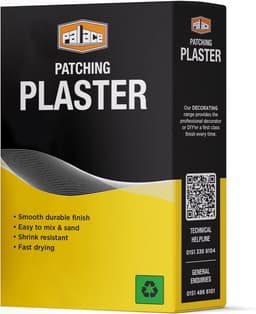
A ready-mixed tub is already a paste. The rest can sit if the lid seals. Palace fine surface filler is 600 g at £1.25, in layers of no more than 3 mm. SikaWall is the other paste, 600 g at £4.49. A leaked lid, or a tub that arrived open, turns tomorrow's convenience into a brick. Powder changes once you add water. Palace interior patching plaster is £2.49 for a 1.5 kg title, about £1.66 per listed kilogram, against about £2.08 for the fine paste and about £7.48 for SikaWall. The mix is written 1:2.5, and the bullets do not say which figure is water. The dry bag keeps. The wet mix does not.

Shallow marks

Nail holes, a chip in the skim, and a still hairline sit inside a fine paste. Feather it and put the lid on. UK reviews report a hard sand, a grey shade, a short date, and shrinkage. Believe a shrinkage review on this tub. Skip powder for three nail holes. You will mix more than you place. Toupret's comparison of its own range, not these ASINs, uses the same split. DIY Guides UK's few millimetres line is their rule of thumb. Do not replace Palace's 3 mm cap with it. Missing skim is no longer this case.

A deeper patch

A palm-sized loss of skim, or a ceiling hole after a small light fitting, is where powder earns the lower price per kilogram. Reviewers use Palace patching plaster on those patches. The listing prints no single-coat depth and does not call the powder non-toxic. If the mix stiffens, bin it. Do not add water to a setting mix. SikaWall is the no-mix alternative inside 9 mm deep and 25 mm wide. The sheet says low movement, a hard dry, and about an hour between layers, with no rebuild past 9 mm in one pass. Some reviews report sagging and a strong smell when wet. It is not waterproof. A whole wall is the buying guide.

Sanding, storage and which to buy

Powder reviews include a set that defeats sandpaper. Both pastes draw the same complaint. Powder loses its shape in the pot. Paste loses it on the wall. If you will not come back for an hour, a feathered paste layer is safer than a bowl of gypsum. Dry powder waits in a closed bag. Paste waits only if the lid was on. Buy the fine filler inside the 3 mm line if you want the tub tomorrow. Buy the powder if you need more and will mix a small batch. Buy SikaWall only up to 9 mm by 25 mm. Soudal is sold by the millilitre. Stars sit on the best patching plaster page.

Common questions

Which should I buy for nail holes?
The ready-mixed fine filler, in layers of no more than 3 mm. Palace fine surface filler is £1.25, with 4.6 from 2,247 reviews. You will not get a powder batch onto three nail holes before it starts to go off. Keep the powder for a patch worth mixing, and check the lid.
Which should I buy for a patch of missing skim?
Palace patching plaster, if you will mix a small batch and the plaster around the patch is dry. At £2.49 for a 1.5 kg title it is about £1.66 per listed kilogram. If you will not mix, and the hole is within 9 mm by 25 mm, SikaWall is the paste at £4.49. A whole wall is a merchant bag, not this box.
Can I keep leftover powder?
Keep it only while it is dry and the bag is sealed. The wet mix is the part that sets. Do not add water to revive a stiff mix. Next time mix less than a mug for one patch, and leave the rest of the bag dry.
Will the paste stay soft in the tub?
Only if the lid seals. Ready mixed does not start a chemical set by adding water, so a well-closed tub should stay usable. Once the paste has skinned or dried in the pot, it will not become filler again. A hard cure on the wall is a separate complaint from a ruined tub.
Which sands more easily?
Neither form wins that claim in this set. Shape the fill while it is soft, and sand only after it is dry. A mask is not a substitute for sanding less. Sika's sheet says that filler dries hard, and powder reviews include grit.
Is powder always stronger?
No. Strength here is not a lab number, and the listings do not publish one. A deeper patch can suit powder because you can build more material, not because every powder fill is stronger than every paste. Sika's sheet limits that paste to low movement. A joint that is still moving needs caulk or tape, not a stronger tub.
What did Palace buyers say about the hour on the packet?
Several UK reviews say the mix was unusable after about 5 to 10 minutes, not the hour they had expected. Palace's shop page says the product sets within 2 hours. Read 2 hours as a set time and the reviews as the working time. Do not plan a whole room around one mix.
When is neither right?
Neither is right on a damp wall, on hollow plaster that drums across a wide area, on a sagging ceiling, or when you are trying to skim a room from a 1.5 kg box. A moving crack is also the wrong job for a rigid filler.

Related pages

Sources

Public sources from the research digest, last checked on 22 October 2026. Shelf prices and star lines are the amazon.co.uk figures stored on 21 October 2026. The price band is this set, not a market average. No listing was lab-tested.

  1. BS EN 13279-1:2008, NBS (retrieved 21 October 2026)
  2. HSE: sanding plasterboard joints (retrieved 21 October 2026)
  3. HSE CIS36: construction dust (retrieved 21 October 2026)
  4. British Gypsum White Book, finishes (retrieved 21 October 2026)
  5. Palace Chemicals, patching plaster (retrieved 21 October 2026)
  6. Polycell: fill holes and cracks in walls (retrieved 21 October 2026)
  7. SikaWall all purpose ready mixed filler data sheet (retrieved 21 October 2026)
  8. Wickes: Thistle Multi Finish 25 kg (retrieved 21 October 2026)