Independent comparisons. We may earn from shop links. More info

Best filler for plaster walls

Updated: October 2026

You are looking at a mark on an indoor wall, and the shelf uses three words that all sound like plaster. A fine filler, a box of patching plaster, and a bag of finish plaster are different purchases. A shallow nick on dry, sound plaster is a tub. A palm-sized loss of skim is closer to a powder you mix in a small batch. A whole wall, or a ceiling that drums when you tap it, is not a tub. This page sorts the type. It does not crown a brand. The five amazon.co.uk listings sit on the [indoor plaster comparison](/hub/paints-and-varnishes/plaster-indoor). Those listings were checked on 21 October 2026. We did not lab-test adhesion or shrinkage. A qualifying purchase can earn a commission at no extra cost to you.

You are looking at a mark on an indoor wall, and the shelf uses three words that all sound like plaster. A fine filler, a box of patching plaster, and a bag of finish plaster are different purchases.

Our top picks

On this page

What you are actually repairing

Name the damage before you name the product. A nail hole, a screw hole, or a chip in the skim is a surface job when the plaster around it is dry and still stuck. Press it. If it feels solid, a fine surface filler is the type those packs describe. A patch is larger: a fist-sized piece of skim gone, or the hole left when a ceiling light came down, with the background still attached at the edges. A crack is a line, not a hole. A hairline that has not moved can take a fine filler. A line that came back, or a straight joint in plasterboard, belongs on the hairline cracks guide. A picture hook in a bedroom shows the split. If the hole is about the width of a pencil and the wall rings solid, buy a fine filler. If a piece the size of your palm has fallen and the edge is firm, you are nearer patching plaster. If the plaster moves, stop.

Depth on the label

The millimetre on the label is the seller's limit, not a measurement we made. Palace fine surface filler keeps deeper repairs to layers of no more than 3 mm. SikaWall's bullets allow up to 9 mm deep and 25 mm wide. The Polyfilla kit allows holes up to 10 mm. Polycell's own how-to, a separate page from that kit's bullets, says to build in layers once a hole is deeper than 10 mm. You cannot borrow the 9 mm line to justify a thick plug of the 3 mm filler. A rawlplug hole is already past 3 mm, so the fine filler only works there in layers, or you change type.

Powder and a room skim

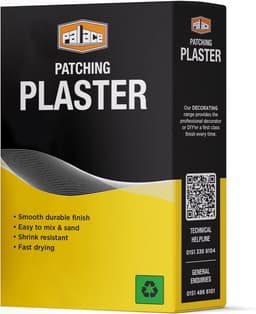
Powder is another form, not a stronger paste. Palace interior patching plaster is a 1.5 kg gypsum powder for interior walls and ceilings. The bullets say mix with water, written as 1:2.5, and they do not print a single-coat depth. UK reviews often say a batch was unusable after about 5 to 10 minutes. Palace's shop page says the powder sets within 2 hours, which is a set claim, not an hour of soft mix in the bucket. The powder or ready-mixed page works through that choice. A room skim is a third product. Wickes lists British Gypsum Thistle Multi Finish at £11.25 for 25 kg, about 10 m² at 2 mm, and cites EN 13279-1 type B1/20/2. That £11.25 is a merchant price. Do not average it with the £1.25 to £2.49 amazon.co.uk prices at the cheap end of this set. BS EN 13279-1, as indexed by NBS, covers bagged gypsum finish plaster. It does not turn an acrylic tub into finish plaster.

When a tub is the wrong product

Damp is the stop no depth line fixes. A brown tide under a window, or a ceiling stain that grew after rain, means water is still moving. British Gypsum's White Book says not to skim a damp wall. None of these listings is a damp-proofing product. Interior and exterior is a usage line, not a waterproof rating. SikaWall is listed for both, and the water-resistance field says not water resistant. Outdoor repairs on that listing are told to be sealed with an oil-based paint. Hollow plaster is the second stop. A dull drum over a wide area means the skim has left the background, and a tub will not glue it back. A hard acrylic plug in soft lime often cracks at the edge. The White Book uses 2°C as the floor for backgrounds on British Gypsum finishes. The Health and Safety Executive's page on sanding taped plasterboard joints puts on-tool extraction ahead of a mask for gypsum dust. If the wall is damp, hollow, or a whole room, leave the tub.

Common questions

Is a fine filler enough for a deep hole?
Not in one pass, once the hole is deeper than the layer the pack allows. Palace fine surface filler caps each layer at 3 mm. A wall-plug hole is already past that, so you build thin layers and wait, or you change product. SikaWall's listing allows 9 mm deep and 25 mm wide. The Polyfilla kit allows holes up to 10 mm. A single thick plug past the printed line is how fills sink at the rim.
When is patching plaster the right bag?
It fits a small interior loss of skim, on a dry wall or ceiling that is still attached, when you will mix only what you can place before the batch goes off. In this set that is the 1.5 kg Palace powder at £2.49. UK reviews often report about 5 to 10 minutes of working time. Palace's shop page says it sets within 2 hours. Those are different clocks.
Can I skim a room with a 1.5 kg box?
A 1.5 kg box is a patch, not a room. People skim with a merchant bag such as Thistle Multi Finish, which Wickes lists at £11.25 for 25 kg, about 10 m² at 2 mm, under EN 13279-1. That price is not an amazon.co.uk price. One review of the Palace powder says it is not a finish plaster. Keep the small box for one short mix.
What if the wall is damp?
Do not fill it and paint over the stain. Find the water first. A filler labelled interior and exterior will not stop moisture. SikaWall's field says not water resistant, and the White Book says not to skim a damp wall. Dry the structure, then repair the plaster.
Do I need a plasterer for hollow plaster?
You do, once the hollow area is wider than a local patch you can cut back to a firm edge. Drumming across a ceiling, sagging, or plaster that moves when you press it is beyond a tub. A plasterer cuts out to sound material. Filling the loose skin usually cracks again.
Does interior and exterior mean waterproof?
No. SikaWall is listed for interior and exterior, and the water-resistance field says not water resistant. Outdoor use on that page is tied to an oil-based paint seal. The Polyfilla kit is listed indoors and outdoors and has no water-resistance field. Read the water line, not the room line in the title.

Related pages

Sources

Public sources from the research digest, last checked on 22 October 2026. Shelf prices and star lines are the amazon.co.uk figures stored on 21 October 2026. The price band is this set, not a market average. No listing was lab-tested.

  1. BS EN 13279-1:2008, NBS (retrieved 21 October 2026)
  2. HSE: sanding plasterboard joints (retrieved 21 October 2026)
  3. HSE CIS36: construction dust (retrieved 21 October 2026)
  4. British Gypsum White Book, finishes (retrieved 21 October 2026)
  5. Palace Chemicals, patching plaster (retrieved 21 October 2026)
  6. Polycell: fill holes and cracks in walls (retrieved 21 October 2026)
  7. SikaWall all purpose ready mixed filler data sheet (retrieved 21 October 2026)
  8. Wickes: Thistle Multi Finish 25 kg (retrieved 21 October 2026)