Independent comparisons. We may earn from shop links. More info

Hard wax oil buying guide for UK projects

Updated: October 2026

Choosing a finish for a pine floor, oak table or wooden worktop is not simply a matter of buying the tin with the highest star rating. This hard wax oil buying guide shows you how to compare the job, sheen, base and usable coverage before price. Our [hard wax oil comparison](/hub/paints-and-varnishes/hard-wax-oil) holds the current amazon.co.uk listings and prices; this page explains the trade-offs behind them. Start with the appearance and area you need to cover, then check whether the maker's instructions suit your room and timetable. That order prevents a cheap tester tin, an unsuitable tint or an attractive one-coat coverage figure from becoming an expensive mistake.

Choosing a finish for a pine floor, oak table or wooden worktop is not simply a matter of buying the tin with the highest star rating.

Our top picks

On this page

What you are choosing

Hard wax oil combines oils with waxes to finish interior timber. It is not the same as paste wax, which is normally applied as a thin surface dressing, and it is not a lacquer that builds a continuous film over the wood. An oil-wax surface still needs care and periodic refreshing; it is not a fit-and-forget coating. Define the job before comparing brands. A 250 ml tin can suit a table, whereas a floor points towards 750 ml or one litre. Existing varnish or paint normally has to come off rather than being hidden under oil. If you are still choosing systems, read hard wax oil versus varnish.

Choose sheen and colour together

Matt, dead matt, soft satin and satin describe reflected light, but the names are not calibrated across brands. A sample on the actual wood is more useful than comparing labels alone. Clear does not necessarily mean that pale wood will retain its unfinished colour. Clear oil commonly deepens the grain and gives pine or oak a warmer, slightly wet-looking tone. Osmo Polyx-Oil Raw 3044 is the listing in this set aimed at keeping light timber paler; its maker states about 30 m² per litre for one coat, but reviews also warn that an over-thick application can dry whitish. That makes a thin test coat particularly important. Honey and Terra are deliberate colour choices, not clear alternatives. Approve a dried sample on the actual wood before buying for a connected area.

Solvent-borne or water-based

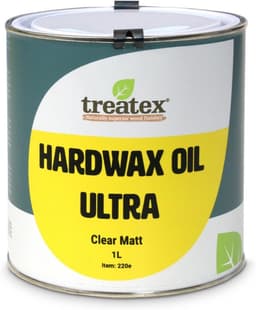
Osmo, Fiddes and Treatex products in this set are the conventional oil-and-wax choices, while Libéron offers a water-based one-litre satin. Water-based does not mean the same product without the smell. It changes clean-up, application instructions and the way the wet coating looks. Libéron says its cloudy liquid dries clear and asks for sanding with 240 grit between coats; Osmo and Treatex instructions do not impose that same between-coat rule for the products covered here. Solvent-borne oils need good ventilation and careful rag handling. Osmo 3032 states an 8–10 hour dry, while the coloured and Raw versions state around 24 hours. Treatex gives 3–6 hours for its matt litre. The exact tin's instructions outrank a generic internet timetable. See how to apply hard wax oil for the sequence.

Work out how much tin you need

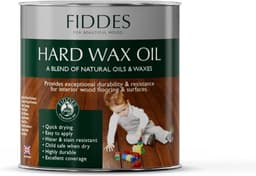
Coverage is a maker's estimate for prepared wood, not a promise for every floor. Osmo states about 24 m² per litre for one coat of clear Polyx-Oil, and Fiddes gives 20–24 m² per litre. Bare, porous boards, end grain and rough sanding can consume more. Pack price can mislead. At the 15 October 2026 capture, Fiddes 250 ml cost £14.72, about £59 per litre, while Treatex matt one litre was £38.39. Fiddes has the lowest shelf price, but repeated small tins reverse that advantage. The Fiddes title says 250 ml while one volume cell says one litre.

Match the listing to the job

For a low-sheen table or worktop trial, the Fiddes 250 ml dead matt tin keeps the initial spend down. Its maker names worktops and says the cured finish is food safe, but pack size still limits it as a floor buy. The kitchen worktop guide separates those claims from product-specific food-contact testing. Osmo 3032 in 750 ml suits a clear satin floor, while Raw is the pale-timber option. The right tin covers the prepared area, produces an approved sample and can cure in your room.

Common questions

How many litres do I need for one room?
Multiply the floor area by the number of coats, then divide by the maker's stated one-coat coverage. Alternatively, use a published two-coat figure where available. Add a modest allowance for absorbent boards and application waste, and buy whole pack sizes. A 20 m² floor commonly points beyond one litre when two coats are required.
Does clear hard wax oil change pine?
Usually, yes. Clear oil tends to deepen the grain and warm pale pine, even though it contains no deliberate tint. A Raw product is designed to limit that wet look, but can appear whitish if applied too heavily. Test both approaches on the same sanded timber and judge them only after drying.
Is water-based hard wax oil the same as Osmo Polyx-Oil?
No. Libéron's water-based product and Osmo Polyx-Oil have different formulations, clean-up and coat instructions. Libéron calls for 240-grit sanding between coats, while Osmo's clear Polyx system gives its own sanding and drying guidance. Follow the label for the exact product rather than combining directions from different brands.
Does 4.8 stars from 19 reviews beat 4.7 from 1,673?
Not by itself. A tiny difference in average rating is less persuasive when one product has only 19 reviews and the other has 1,673. Check whether the reviews describe your intended job, then weigh pack size, instructions and recurring faults. Stars are supporting evidence, not a substitute for product fit.
Can one brand's matt match another brand's matt?
You should not assume so. Brand terminology, timber colour, sanding and coat thickness all affect the result. Even two “clear matt” products can differ in warmth and reflected light. Make adjacent samples if you need to continue an existing floor or joinery finish.

Related pages

Sources

Public UK sources used for the VOC, food-contact and sanding-dust points on this page. Prices, stars and review counts are from the amazon.co.uk listings in the mid-October 2026 extracts.

  1. SI 2012/1715 — VOC in paints, varnishes and vehicle refinishing products (retrieved 16 October 2026)
  2. Osmo UK — Polyx-Oil Original product information (retrieved 16 October 2026)
  3. Osmo UK — Polyx-Oil Effect Raw product information (retrieved 16 October 2026)
  4. Fiddes — Hard wax oil (retrieved 16 October 2026)
  5. Treatex — Hardwax Oil Ultra (retrieved 16 October 2026)
  6. Libéron — Hard wax oil (retrieved 16 October 2026)
  7. HSE — Cutting and sanding wood (retrieved 16 October 2026)
  8. Osmo UK — TopOil (retrieved 16 October 2026)