Independent comparisons. We may earn from shop links. More info

How to paint a wall black

Updated: 22 October 2026

The first coat has dried in patches, the white is still grinning through, and the roller is almost dry because you were trying to make one tin reach. How to paint a wall black, on a sound interior wall, is two full coats of emulsion and a roller that is actually loaded. Which tin to buy stays on the [black wall paint comparison](/hub/paints-and-varnishes/black-wall-paint). This page assumes the wall is already painted, basically sound, and indoors. Peter F., editor for DIY & tools, did not run a lab test. A qualifying purchase can earn a commission at no extra cost to you.

The first coat has dried in patches, the white is still grinning through, and the roller is almost dry because you were trying to make one tin reach.

Our top picks

On this page

Two coats over white, unless the tin says otherwise

Ordinary interior emulsion wants two coats, and black over white is a strong contrast, so plan for the extra coat Johnstone's mentions rather than hoping the first pass will settle. Johnstone's application notes say two coats, a further coat where the contrast is strong, and do not overspread. Surrey decorators describe two coats as the normal film and a third when the change is severe or the wall is patched. COAT Paints says two coats for durability and allows that a drastic change can still ghost. A wall of 3.0 m by 2.4 m is 7.2 m². At about 12 m² per litre that is 0.6 L a coat, so two coats are about 1.2 L before waste, and a third coat takes you toward 1.8 L. A 2.5 L tin covers that one wall. It does not cover four walls of a small room twice. Crown's Grey Black bullets say two coats on most previously painted surfaces. If the tin is Dulux Simply Refresh, use the black feature wall page instead of thinning it. The finish choice is on the matt versus soft sheen page.

Prepare a sound, dry wall

Clean the wall and let it dry. Fill cracks and let the filler cure before you paint, because a sheen will show a hollow that a matt might hide, and either way a soft filler drags under the roller. If the existing paint is sound and glossy, Johnstone's says wet-key it so the emulsion has something to hold. That is a damp abrasive, not a dry sanding block. Ventilate the room while you work and while the film dries. If the house was built before the 1980s and the old paint is sound, HSE says wet-key and overcoat. Do not dry-sand it and do not burn it off. Keep children and pregnant women away if you have any reason to think the coating contains lead, and stop if the paint is flaking and has to come off. BS 6150 is the painting code for ordinary buildings. It does not cover listed buildings or fire coatings.
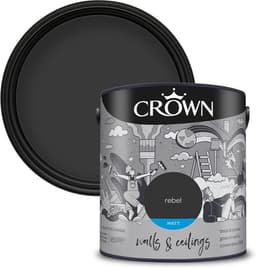
Crown Crown Grey Black matt 2.5 L

Testsieger

Crown Crown Grey Black matt 2.5 L
8.8/10about £22.20

Cut in, then load the roller

Cut in the edges with a brush, then roll while that edge is still wet, or you will see a frame of brush marks in a raking light. Johnstone's specifies a medium-pile roller for this matt. Load it. A starved roller is how black looks grey in bands. Work a wet edge across the wall so you are not rolling into a skin that has already set. Do not overspread. The maker's warning is the opposite of the instinct to stretch a £17 tin across a whole room. If the tray is empty halfway down a wall of about 7.2 m², you are overspreading, not being careful. The Johnstone's matt listing prints 32 m² for the 2.5 L tin, about 12.8 m² per litre, which is the same order of magnitude and not a reason to squeeze a third room out of the tin.

Recoat only when the tin says

Touch dry is not recoat, and it is not a cue to wipe a patchy bit with a damp cloth. The Johnstone's matt listing says touch dry in 1–2 hours, and the full-cure field says 2 hours. The soft sheen says 1–2 hours, with a field at 1.5 hours, and a full-cure field that reads as 30 days. Crown says touch dry in 2 hours and recoat in 4 hours. Dulux Simply Refresh says touch dry in 4 hours. A patchy first coat means the film is thin or the contrast is strong. The repair is another full coat after the recoat time, not a rub. On the Johnstone's matt, reviewers say wiping a mark makes it worse, so a damp cloth on a fresh black wall is how you polish a pale streak into the film. If white still ghosts after two coats, lay the further coat Johnstone's allows for a strong contrast.

Stop and call someone

Call a decorator when the substrate is flaking and the old paint may contain lead, when you would otherwise have to strip it, or when the building is listed. BS 6150 does not hand you a DIY method for listed buildings or for a lining that is part of a fire strategy. Call someone when damp or mould keeps returning after you have dealt with a leak. An anti-mould coating in this set does not repair rising damp, and painting over active mould only hides it until the next cold week. A sound modern emulsion in one bedroom is the job these steps are for. A whole house of failing plaster, a ceiling that is still wet, or paint that powders when you touch it is not. If you are unsure whether the coating is lead, do not dry-sand a test patch to find out.

Common questions

How many coats of black paint over a white wall?
Two full coats of ordinary emulsion, and a third if white still ghosts. Johnstone's says two coats plus a further coat over a strong contrast, and white to black is that contrast. Crown states two coats on most previously painted surfaces. A one-coat claim belongs to Dulux Simply Refresh, not to the 2.5 L tins. Do not count a starved first pass as one of the two.
Do I need a primer?
On a sound, already-painted wall, Johnstone's does not start with a separate primer. It starts with a clean, dry surface and a wet key if the old paint is glossy. Bare new plaster is the case where a mist coat is common practice, and this page will not invent a water percentage the tin does not print.
What roller should I use?
A medium-pile roller, which is what Johnstone's specifies for the matt, loaded so the film is not starved. Cut in with a brush and keep a wet edge. A short-pile roller on textured plaster leaves black in the peaks and grey in the hollows. A foam roller can show lines in a sheen.
Can I thin black emulsion with water?
Not to make a tin go further. Johnstone's says do not overspread, and a one-coat feature-wall paint loses its claim if you water it. A mist coat on new plaster is a separate, maker-specific step, and the percentage some decorators use is their note, not a figure printed for these tins. If the paint feels heavy, lay it at the stated coverage and accept a second coat.
When should a decorator take over?
When the paint must be stripped, when you suspect lead and the film is unsound, when damp or mould returns after the leak is supposed to be fixed, or when the building is listed. A single sound bedroom over modern emulsion is a two-coat job you can do with a loaded roller.

Related pages

Sources

Public UK sources used for this comparison. Shelf prices, stars and review counts are the amazon.co.uk figures read on 19 October 2026. The Dulux tin was checked again on 20 October 2026. Last checked 20 October 2026.

  1. SI 2012/1715 Schedule 2, VOC caps and labelling (retrieved 20 October 2026)
  2. BS EN 13300:2022 preview, wet-scrub classification (retrieved 20 October 2026)
  3. BS 6150:2019, painting of buildings code of practice (retrieved 20 October 2026)
  4. HSE: lead in paint, wet key, no dry sanding or burning (retrieved 20 October 2026)
  5. Dulux Simply Refresh feature wall, one coat and roller load (retrieved 20 October 2026)
  6. Johnstone's matt wall and ceiling paint, coverage and two coats (retrieved 20 October 2026)
  7. Sandtex 10 Year exterior multi-surface satin (retrieved 20 October 2026)
  8. amazon.co.uk listings for the six ASINs (retrieved 19 October 2026)