Independent comparisons. We may earn from shop links. More info

Anti mould paint vs additive

Updated: 22 October 2026

You want the walls a colour other than white, or you have seen a 100 ml bottle that says it will turn ordinary emulsion into anti-mould paint. Anti mould paint vs additive is that choice: a ready-mixed white tin, or a measured dose of concentrate stirred into a paint you already like. It is not a contest between the five amazon.co.uk tins. Every kept listing in the [anti-mould paint comparison](/hub/paints-and-varnishes/anti-mould-paint) is matt white, captured on 19 October 2026. Peter F. compared those listings and the public UK pages named below. We did not run a lab test, and we did not crown one ASIN. A purchase through the comparison can earn us a commission at no extra cost to you.

You want the walls a colour other than white, or you have seen a 100 ml bottle that says it will turn ordinary emulsion into anti-mould paint.

Our top picks

On this page

Two different products

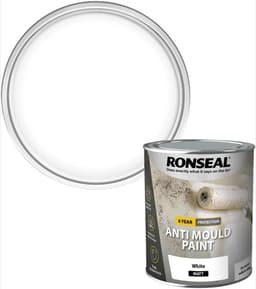
A ready-mixed anti-mould paint is a white matt emulsion with the mould-resisting treatment already in the tin. You stir it and you put it on the wall. In this comparison that means Zinsser Perma-White, two sizes of Ronseal, Polar and Mould Solve. An additive is a concentrate you stir into someone else's paint. Dryzone's technical sheet, sold through trade merchants, is the clearest public dose: 100 ml treats 5 litres of emulsion, which is 20 ml per litre, blended for at least one minute. The active ingredient named there is IPBC, and the sheet carries HSE number 10634. You keep the colour and the brand of the emulsion. You take on the mixing. Wickes' advice page describes the same split: biocidal paint, often white, against an additive used when colour matters. Neither route is just bathroom emulsion. A bathroom emulsion with a marketing line about steam is a third product. It is not one of these five tins and not the same as a measured biocide dose.

Why colour pushes you off these five tins

All five finishes are matt white. Mould Solve's colour code is RAL 9016, a white, not a tint base. Zinsser does sell tint bases. The ASIN in this comparison, B079DD65SS, is the white 2.5 litre tin, not that base. Do not assume the top pick can be coloured at a desk because another Zinsser product can. Ronseal closes the obvious workaround. Its FAQ says you should not paint ordinary emulsion over the anti-mould film. Covering the white with a coloured coat a month later hides the surface the treatment is sold to leave exposed. One reviewer of the 750 ml tin did paint their original colour over it after three coats. For a colour other than white, Ronseal points to an anti-mould clear coat applied over the coloured paint. That clear coat is not in our five ASINs. An additive avoids that deadlock because the colour is in the emulsion you dose. You are not painting white and then hiding it. You are making the coloured coat the treated coat. The limit moves to the dose. Too little concentrate, or a stir that does not last the minute the sheet asks for, is how a coloured tin fails while looking exactly like the emulsion you wanted. Measure 20 ml per litre, or 100 ml into 5 litres, rather than a splash in the tin. How that top-coat rule works on the day is on how to apply anti-mould paint.

Dose, and the years on the label

Dryzone's sheet claims up to 5 years when you use that 100 ml per 5 litres and you do not overcoat or wallpaper the finished coat. Wickes' own product tile for the additive also says at least 5 years. Wickes' advice page, on the same subject, says additives last around 3 years and depend on the mix. Ronseal's ready-mixed paint claims up to six years if you follow the instructions, including leaving the film as the top coat. Polar's Amazon features say 5 year protection, while a bullet says up to 10 years. A six-year tin and a five-year additive are not comparable results. They are brand conditions on different systems. Reviews of the ready-mixed tins include mould back in about eight weeks on a wet wall and a ceiling that lasted about 1.5 years, alongside much longer reports. An additive will not beat a wet wall by having a longer line on the label. Price is a weak way to choose, because the baskets differ. On 19 October 2026 the best value ready-mixed tin was Ronseal's 2.5 litres at about £13.68 per litre, while both 500 ml tins were about £31.98 per litre. An additive still needs the emulsion you stir it into. Tin sizes for the ready-mixed route are on the anti-mould paint buying guide. If you only need white, the ready-mixed tin is the simpler sum. If you need colour, the mixing step is the cost of keeping it.

What neither product does

Neither a white tin nor a dosed emulsion stops a leak, rising damp, or a failed gutter. Both are films for a surface you have already dried. GOV.UK's damp and mould guidance says that wiping mould off, without fixing the cause, does not stop it returning. A concentrate stirred into a favourite colour fails on a wet wall for the same reason a dedicated tin fails there. Both finished films are sold on the same idea: the treatment has to stay at the surface. Dryzone says do not overcoat or wallpaper the anti-mould coat. Ronseal says do not paint over its anti-mould paint. A later decorative coat can cancel the point of either system. Plan the final colour first. If you might wallpaper the wall next year, say so before you dose 5 litres or open a white tin you are not allowed to cover. A mould claim can make the product biocidal, so do not dress either route up as safe for the household. Dryzone's sheet carries an HSE number, and Zinsser UK describes dried Perma-White as a treated article that does not stop food-borne or disease-causing bacteria. If the colour matters and you will measure 100 ml into 5 litres, the additive is the system that keeps that colour, with the year on the bottle read as a claim beside Wickes' three-year line, not as a test result.

Common questions

Should I buy a tin or mix an additive?
Buy a ready-mixed tin when the room can be white and you want a film that is already mixed. Mix an additive when the colour matters and you will measure the dose, 100 ml per 5 litres on the Dryzone sheet. The five tins in the comparison do not include a concentrate, so this page does not name a winning ASIN.
Can I keep my existing colour?
Yes, with an additive in that emulsion, or with a tint base that is not the white Zinsser ASIN in this set. You cannot keep the colour by painting a white anti-mould tin and then covering it with your old emulsion. Ronseal forbids that overcoat. The coloured coat has to be the treated coat.
How much additive goes into 5 litres?
Dryzone's sheet says 100 ml for 5 litres of emulsion, 20 ml per litre, blended for at least one minute. A shorter stir or a guessed splash is the failure Wickes warns about when it talks about mix ratio. Follow the bottle you bought if the figures differ, and do not scale about half a cap from memory.
Does the mix last as long as Ronseal's six-year claim?
They are different claims. Ronseal says up to six years if you follow the instructions. Dryzone says up to 5 years at the stated dose. Wickes' advice page says around 3 years for additives. None of those lines is a result from this comparison. A wet wall can bring mould back in weeks under either system.
Can I paint over the finished coat later?
Ronseal says no for its anti-mould paint. Dryzone says do not overcoat or wallpaper the finished anti-mould coat. The treatment is meant to stay at the surface. If you expect to change the colour or hang paper, decide that before you paint, not after the film has cured.
What if I only need white?
Use the ready-mixed tins. The comparison has the prices: about £13.68 per litre for Ronseal 2.5 litres up to about £31.98 per litre for the 500 ml tins, on 19 October 2026. An additive is an extra step you do not need if white is acceptable.

Related pages

Sources

Public sources from the research digest, last checked on 19 October 2026. Shelf prices and star lines are the amazon.co.uk figures in the display file. Scores are a reading of those listings, not a laboratory test.

  1. GOV.UK: damp and mould health risks (retrieved 19 October 2026)
  2. GOV.UK: Awaab's Law for social-housing tenants (retrieved 19 October 2026)
  3. SI 2025/1042 (retrieved 19 October 2026)
  4. VOC Regulations 2012, Schedule 2 (retrieved 19 October 2026)
  5. HSE: biocides and COPR (retrieved 19 October 2026)
  6. Ronseal: 6 Year Anti Mould Paint (retrieved 19 October 2026)
  7. Zinsser UK: Perma-White (retrieved 19 October 2026)
  8. Healthier Together (NHS): damp and mould (retrieved 19 October 2026)