How to use modelling paste
The tub is open and the knife is in your hand. The usual failure is a thick single coat, or paint laid over a skin while the core is still wet. That coat cracks, or it stays soft. This is how to use modelling paste: stir if it has settled, lay a layer you can dry through, wait, then paint. Which tub to buy is on our [Structural paste](/hub/painting-supplies/structural-paste) comparison. If the doubt is the stretched canvas, use the [modelling paste on canvas](/hub/painting-supplies/structural-paste/sub/structural-paste-on-canvas) page. Peter F. used the amazon.co.uk extracts on 16 October 2026 and did not time a drying test. A qualifying purchase can earn a commission at no extra cost to you.
The tub is open and the knife is in your hand. The usual failure is a thick single coat, or paint laid over a skin while the core is still wet. That coat cracks, or it stays soft.
The tub is open and the knife is in your hand. The usual failure is a thick single coat, or paint laid over a skin while the core is still wet. That coat cracks, or it stays soft. This is how to use modelling paste: stir if it has settled, lay a layer you can dry through, wait, then paint. Which tub to buy is on our Structural paste comparison. If the doubt is the stretched canvas, use the modelling paste on canvas page. Peter F. used the amazon.co.uk extracts on 16 October 2026 and did not time a drying test. A qualifying purchase can earn a commission at no extra cost to you.
Our top picks
| Badge | Product | Body | Layer note | Dry-time field | Note | Price | Offer |
|---|---|---|---|---|---|---|---|
| Best overall |  Liquitex Liquitex Flexible Modeling Paste 473 ml | Flexible white | About 6 mm, dried slowly | 24 hours | 8.5 | about £21.20 | View offer |
| Alternative |  Kreul Kreul Solo Goya coarse sand 250 ml | Coarse sand | Not the 6 mm Liquitex rule | 6 hours | 7.3 | about £16.86 | View offer |
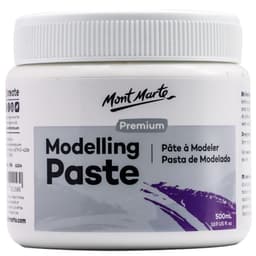
| Preis-Tipp |  Mont Marte Mont Marte Modelling Paste 500 ml | Smooth white | No layer cap printed | No field | 8.2 | about £13.05 | View offer |


On this page
Knife, support, and a stir if the tub has settled
How thick a layer, and why one coat fails
Drying without sealing the core
Paint, tint, cracks, and cleanup
Common questions
Do I use a brush or a knife?
How thick can one layer be?
Can I force it dry with a hair dryer?
When can I paint over it?
What if it cracks?
Which dry-time on the tub should I trust?
Related pages
Sources
Public UK sources on CLP labelling, VOC scope for building coatings, satisfactory quality, and workplace COSHH. Shelf prices, stars, and review counts are the amazon.co.uk lines in the nine listings dated 16 October 2026. Prices move.
- Liquitex UK, professional flexible modelling paste (retrieved 16 October 2026)
- Liquitex UK, Basics modeling paste (retrieved 16 October 2026)
- Winsor & Newton UK, professional acrylic modelling paste (retrieved 16 October 2026)
- Daler-Rowney, System 3 texture paste (retrieved 16 October 2026)
- The Volatile Organic Compounds in Paints, Varnishes and Vehicle Refinishing Products Regulations 2012 (retrieved 16 October 2026)
- GB CLP, assimilated Regulation (EC) No 1272/2008 (retrieved 16 October 2026)
- Consumer Rights Act 2015, section 9 (retrieved 16 October 2026)
- HSE, COSHH (retrieved 16 October 2026)