Independent comparisons. We may earn from shop links. More info

How to use a ring roller

Updated: 21 October 2026

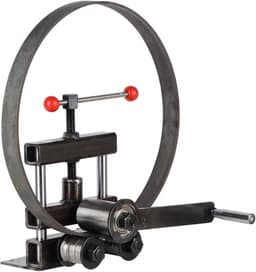
You are at a bench with mild steel and a hand-crank ring roller. How to use a ring roller means several light passes, extra length for the ends that stay straighter, and fingers kept out of the nip. One hard turn on a tight setting twists the bar or throws it into a corkscrew. If the bar is heavier than a published mild-steel table, use the [ring roller buying guide](/hub/painting-supplies/ring-roller/sub/ring-roller-buying-guide) instead of forcing the handle. Peter F. drew on a school workshop note, a US machinists’ forum, and HSE guidance on 20 October 2026. A qualifying purchase can earn us a commission at no extra cost to you. The pocket machines are on the [ring roller comparison](/hub/painting-supplies/ring-roller).

You are at a bench with mild steel and a hand-crank ring roller. How to use a ring roller means several light passes, extra length for the ends that stay straighter, and fingers kept out of the nip.

Our top picks

KAKA INDUSTRIAL KAKA Industrial PR-3

Best overall

KAKA INDUSTRIAL KAKA Industrial PR-3
7.3/10about £185.63
Enborpe Enborpe KF-2437

Best value

Enborpe Enborpe KF-2437
0.0/10about £139.99
GYKOZY GYKOZY ring roller

Alternative

GYKOZY GYKOZY ring roller
0.0/10about £197.91
On this page

Set the machine before you set the radius

Bolt the body down before you set a radius. The PR-3 listing gives 6.21 kg, and that handle can shift an unfixed frame. A Sheffield-area owner bolted a Cyclops roller down so the crank could turn freely. That is experience, not a British Standard. US and Canadian notes say the two-piece handle unscrews, and a vice can block the swing. Treat those notes as overseas comments. Start with a gentle bow on an offcut. If that scrap corkscrews, the first gap was already too small.

Several passes, not one

These sources publish no pass count you can copy onto your bar. A school maker hub says to start at the largest radius and tighten a little each pass, or the bar corkscrews. A US forum thread about an 8 in ring, about 200 mm across, describes many passes and a flat spot at each end. Run a pair through the same setting before you tighten. Leave extra length, because a blank cut to the finished circumference comes out with two flats. Springback has no percentage here for mild steel on a small crank. Mark the adjuster and compare the bar with a circle on ply or card.

Hands and gloves

The hazard is the in-running nip. HSE leaflet EIS7 says fingertip gloves should not be used on the feed, because the tips get pulled in. If you need protection, the leaflet allows the palm only. A hand crank has no motor stop, and the nip is still there. Keep one hand on the crank and the other on the tail, well back from the rolls. At work, PUWER 1998 sits with the employer. A listing that mentions children does not make the crank a toy. If an offcut twists, read flat bar or round bar before you pull harder.

When the ring is done, and when it is not

Trim when the curve sits on your template and the straighter ends are still spare. This page does not describe how to join them. The Stakesys STA143 can have its top mechanism removed so a closed ring can come off. Do not assume the pocket listings open the same way, and do not use that step on the PR-3. Stop above the published mild-steel table, on unknown alloy, or on box, channel, angle, or structural work. A pocket crank suits about 6–8 mm mild rod. The PR-3 listing states 6.5 mm round and 25 × 4 mm flat, with rings from about 75 mm, as a description rather than a test we repeated.

Common questions

How many passes does a ring take?
A ring takes several light passes. These sources give no standard number. Start at the largest radius and tighten a little each time, or the bar corkscrews. A US forum described that build-up on an 8 in ring. Roll both pieces of a pair before you move the adjuster.
Why do the ends stay straight?
The ends stay straight because the lead and the tail have no bar beyond the pinch, so they curve less than the middle. Leave the blank longer than the finished ring and trim the flats once the arc matches your template. Overlap is the school-page name for that spare length.
How do I allow for springback?
Allow for springback with a template, not a percentage. The bar opens a little off the rolls, and these notes give no figure for mild steel on a small crank. Mark the adjuster, compare the piece with a circle on ply or card, and tighten one small step if it is still too open. A plate-roll chart belongs to the wrong machine.
Where do my hands go?
One hand stays on the crank. The other holds the tail well back from the rolls so you can resist the feed. Keep both hands out of the triangle between the three rolls, and do not pinch the leading tip as it enters. EIS7 says to hold the work back on a manually loaded three-roll bender. A bench crank has the same nip and no motor stop.
Can I wear gloves?
Do not wear fingertip gloves while you feed the bar. EIS7 warns that the tips can be drawn into the nip. If you genuinely need protection, limit it to the palm and keep loose cuffs clear of the rolls. Bare hands you can pull away are safer than a coated fingertip. A hand crank has the same nip.
How do I mount it so the crank clears?
Bolt the roller down and leave a full circle for the handle, because a vice often puts the jaws in that circle. US or Canadian notes on the PR-3, not a British test, mention a two-piece handle that unscrews and a vice that blocks the swing. Turn the empty crank once and move the fixing if the handle clips the bench or the wall.
When do I stop and call a fabricator?
Stop when the section exceeds the published mild-steel capacity, when the alloy is unknown, or when the ring is structural, box, channel, or angle. Also stop if a light pass corkscrews the bar or the blank is too short to trim. A pocket crank suits light rod and narrow flat. Heavier work belongs with a fabricator.

Related pages

Sources

Public UK sources used for this comparison. Listing prices, stars and review counts are the amazon.co.uk figures saved for this set on 20 October 2026. Trade prices below are not amazon.co.uk prices.

  1. HSE EIS7, Safe use of 3-roll bending machines (retrieved 20 October 2026)
  2. HSE, PUWER overview (retrieved 20 October 2026)
  3. GOV.UK, Product safety advice for businesses (retrieved 20 October 2026)
  4. GOV.UK, Supply of Machinery (Safety) Regulations 2008 (retrieved 20 October 2026)
  5. GOV.UK, UKCA and CE marking by sector (retrieved 20 October 2026)
  6. W. Neal Services, WNS heavy duty manual ring roller (retrieved 20 October 2026)
  7. DIMAKIN, Ring roller RM-602 (retrieved 20 October 2026)
  8. Consumer Rights Act 2015 (retrieved 20 October 2026)