How to use a paint scraper on ordinary modern paint
You are standing at a panel door with a blade in one hand and a heat gun in the other. Cold gloss will not lift if you lean on the edge, and the wood takes the gouge instead. How to use a paint scraper starts with a small softened patch, a flat blade, and a rest for the gun that will not melt. This page is the method for ordinary modern paint. Peter F. checked Screwfix, Homebuilding, DIY Doctor and BuildWiz on 20 October 2026. A qualifying purchase can earn a commission at no extra cost to you. Which blade you bought sits in the [paint scraper comparison](/hub/painting-supplies/paint-scraper).
You are standing at a panel door with a blade in one hand and a heat gun in the other. Cold gloss will not lift if you lean on the edge, and the wood takes the gouge instead.
You are standing at a panel door with a blade in one hand and a heat gun in the other. Cold gloss will not lift if you lean on the edge, and the wood takes the gouge instead. How to use a paint scraper starts with a small softened patch, a flat blade, and a rest for the gun that will not melt. This page is the method for ordinary modern paint. Peter F. checked Screwfix, Homebuilding, DIY Doctor and BuildWiz on 20 October 2026. A qualifying purchase can earn a commission at no extra cost to you. Which blade you bought sits in the paint scraper comparison.
Our top picks
| Badge | Product | Type | Blade | Handle | Note | Price | Offer |
|---|---|---|---|---|---|---|---|
| Best overall |  Harris Harris 3 inch stripping knife | Stripping knife | 3 inch steel | Plastic | 9.1 | about £5.88 | View offer |
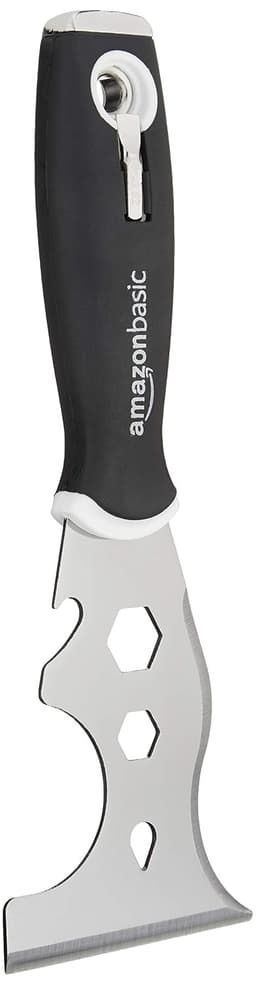
 Amazon Basics Amazon Basics 14-in-1 | Multi-tool | 76.2 mm carbon steel | Soft grip | 8.0 | about £8.35 | View offer | |
 ALLWAY Contour scraper set | Contour set | Six stainless profiles | Soft grip, file in the handle | 7.1 | about £17.99 | View offer |


On this page
Soften before you load the blade
How the blade should meet the wood
The heat gun when it is not in your hand
When this method is the wrong method
Common questions
Do I heat the paint or just push harder?
How big a patch should I heat?
Do I scrape with or across the grain?
Do I pull or push a shave hook?
Where do I put the heat gun while I scrape?
How do I stop the blade cutting me between passes?
Related pages
Sources
Public UK sources used for this comparison. Listing prices, stars and review counts are the amazon.co.uk figures saved for this set, not a live re-check on 20 October 2026.
- HSE, Lead in construction (retrieved 20 October 2026)
- HSE, CIS79 Old lead paint (retrieved 20 October 2026)
- GOV.UK, Lead information for the public (retrieved 20 October 2026)
- British Coatings Federation, PaintSafe (retrieved 20 October 2026)
- Painting and Decorating Association, HS-034 Lead in painted surfaces (retrieved 20 October 2026)
- Homebuilding, Tools to remove paint from woodwork (retrieved 20 October 2026)
- Screwfix, Remove paint from wood (retrieved 20 October 2026)
- Cleaning Guides, Paint on glass (retrieved 20 October 2026)