Independent comparisons. We may earn from shop links. More info

Lime mortar pointing gun: old walls and listed brick

Updated: October 2026

You have watched a video of a wet cement mix sliding out of a pointing gun, and the wall in front of you is soft red brick, stone, or a house built before 1919. The mix that suits the plunger can be too strong, too waterproof, or simply the wrong machine for the lime your wall needs. This page stays on that problem. It does not rank the six amazon.co.uk guns, and it does not repeat a modern patio recipe. Those sit on the [mortar syringe comparison](/hub/painting-supplies/mortar-syringe) and on [how to use a mortar gun](/hub/painting-supplies/mortar-syringe/sub/mortar-syringe-how-to-use). The mortar for your elevation still has to be specified by someone who has seen it.

You have watched a video of a wet cement mix sliding out of a pointing gun, and the wall in front of you is soft red brick, stone, or a house built before 1919.

Our top picks

On this page

Why the cement gun mix is the wrong default

Traditional walls were built with lime mortar that is softer and more permeable than the brick or stone. The joint is meant to weather first. A cement-rich mix can trap water, crack, and pull the face off soft brick. The Brick Development Association notes that M12, M6 and M4 mortars are not generally suitable for old masonry built in lime, and points to BS 8221. Faithfull’s sheet, right for a modern gun on a modern joint, gives 5 sand to 1 cement with an optional half part of hydrated lime. Copying that onto a Victorian terrace is how hard grey joints appear on soft brick. That hydrated lime sits inside a cement mix. SPAB’s test is simpler: soft mortar, by itself, is a reason to leave sound joints alone.

Which gun a lime supplier will accept

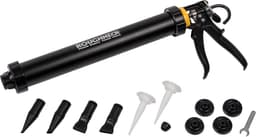
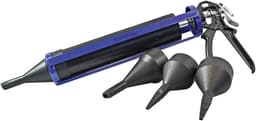
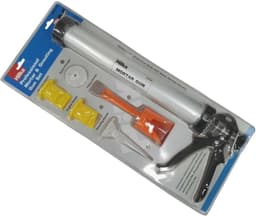
Ty Mawr’s note of 8 April 2024 says its lime mortars are usually applied with an auger or a forced-action machine. A conventional plunger gun is the tool that note sets aside. If your supplier is Ty Mawr, ask about the machine before you expect their mortar to pass an amazon.co.uk ratchet. Conserv sells Gunlime as a hydraulic lime made to flow through a gun, from £17.95 plus VAT for the mortar. Conserv’s other limes are a different product. Nothing on that page approves the Roughneck, the Faithfull or the Hilka. One HISUEKIG review mentions lime around a stone window, on a file of four. That becomes your specification only when your supplier agrees. Until then, a hawk and iron are what most lime literature assumes. Ordinary cement work is on mortar gun or pointing trowel.

Raking, dust and when to stop

SPAB’s rule of thumb for depth is about twice the joint width, and only where the mortar has failed. Sound soft joints stay. A grinder is the wrong default on a listed wall: the arris of an old brick is easily lost to a disc. The dust is still silica when the joint is old cement. HSE says uncontrolled raking can peak around 5 mg/m³, against 0.1 mg/m³ for respirable crystalline silica over eight hours. Stop for a bricklayer or a conservator when you cannot tell lime from cement, when the wall bulges, or when the job is at height. If you later buy a tool through the main comparison, a qualifying purchase can earn us a commission at no extra cost to you.

Common questions

Can I put lime mortar through a normal pointing gun?
Only if the supplier of that lime says this gun will take it. Ty Mawr, on 8 April 2024, usually specifies an auger or a forced-action machine, with aggregate often 3 mm down, and warns that a wetter-than-hand mix shrinks more. A plunger gun from a general amazon.co.uk listing is built around cement and grout that move when they are soft. Ask before you mix a tub you cannot return.
Is Gunlime the same as any lime?
Gunlime is Conserv’s hydraulic lime made to flow through a gun, listed from £17.95 plus VAT for the mortar. Conserv’s other limes are sold as unsuitable for that use, including on their note beside a 540 mm pointing gun. A bag marked lime, or the optional hydrated lime in a cement gun sheet, is a different material. Match the product name your supplier wrote down.
Will a stronger cement mix be safer on an old wall?
A stronger mix is often the more damaging one. Cement-rich joints can hold water against soft brick and stone and can break the face. The Brick Development Association says M12, M6 and M4 are not generally the repair for old lime masonry, and it points to BS 8221. Safer here means a match for the wall, agreed in writing, and sound joints left alone.
Do I need listed building consent to repoint?
Sometimes. Historic England says careful hand removal of failed pointing, without damaging the masonry, does not generally need listed building consent. Carmarthenshire treats large areas as consent work and localised like-for-like as outside it. Ashford includes a change of mix or profile, and a whole elevation. There is no single national yes or no. Ask your conservation officer, and offer a sample panel.
How deep should I rake?
SPAB’s rule of thumb is about twice the width of the joint, and only where the mortar has failed. Sound historic pointing stays, even when it is softer than a modern cement joint. On a listed building, Ashford’s note prefers cement that is causing harm and will come away by hand. A disc that clips the arrises is damage, and depth beyond failed mortar is how that damage starts.
Can I grind out cement pointing on a listed building?
Grinding is the method most likely to damage arrises and to need consent once the area grows. Ashford’s note allows removal of cement pointing that is causing harm when it comes away by hand. Historic England’s narrow case is hand tools and undamaged masonry. HSE still treats the dust as respirable crystalline silica. If the cement will not release, stop and ask the conservation officer before a disc goes near the wall.

Related pages

Sources

Public UK sources on silica, cement, maker instructions and listed-building consent. Shelf prices, stars and review counts are the amazon.co.uk lines in the six listings dated 15 October 2026. Prices move.

  1. HSE, Chasing concrete and raking mortar (retrieved 16 October 2026)
  2. HSE, Cement (retrieved 16 October 2026)
  3. Faithfull, FAIPOINTING instructions (retrieved 16 October 2026)
  4. Faithfull, Pointing gun kit (retrieved 16 October 2026)
  5. Roughneck, Ultimate mortar gun (retrieved 16 October 2026)
  6. Refina, Mortar pointing mixes (retrieved 16 October 2026)
  7. Ty Mawr Lime, Can I use a mortar gun? (retrieved 16 October 2026)
  8. Historic England, Listed building consent, HEAG304 (retrieved 16 October 2026)